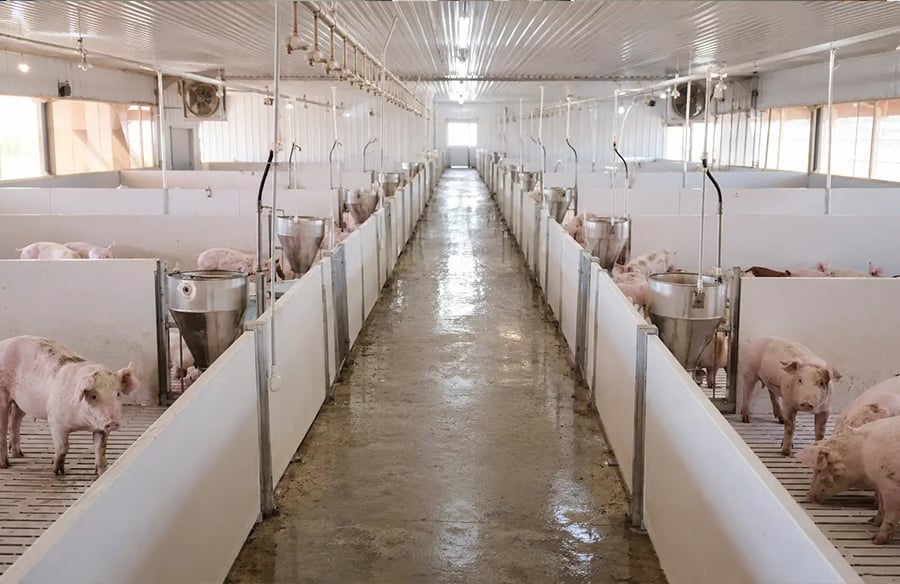
Walk through a hog or dairy barn that’s been running for fifteen years, and you can read its history in the materials. The concrete’s pitted where manure has sat against it. Metal brackets have rusted thin. A wooden gate has gone soft and splintered along the bottom rail. Then a few components look almost new, and those are the ones worth looking at, because they tell you what survives in this environment and what doesn’t.
A working barn is one of the harshest settings you’ll ever ask a building material to sit in. Choosing well up front is the difference between a barn you maintain constantly and a barn that hardly needs attention.
What a Barn Does to Building Materials
The animals are the easy part. It’s everything around them that wears a barn down, usually several forces working at once.
- Constant moisture. Wash water, urine, condensation, and humidity keep surfaces wet far more than they’re ever dry. Anything that absorbs water will swell, crack, or rot.
- Ammonia and manure acids. The chemistry in a barn is corrosive. It eats at concrete, rusts metal, and breaks down finishes over the years.
- Pressure washing. The cleaning that keeps animals healthy is rough on surfaces. Hot water at high pressure strips coatings and drives into every seam and hairline crack.
- Physical abuse. Animals push, rub, chew, and lean. A thousand pounds of cattle resting against a divider all day is a real structural load.
- Freezing and thawing. Across most of the country, everything wet in the barn freezes and thaws all winter, and that cycle pries apart anything holding moisture inside it.
Any one of these is manageable on its own. The trouble is that a barn throws all of them at a material at the same time, season after season.
Why the Cheapest Option Rarely Wins
The sticker price on a material is the smallest number in the decision. What costs you is the replacement.
When a wooden divider rots or a concrete slat wears smooth, you’re not just buying the part again. You’re paying a crew to tear out the old one, working around animals while you do it, and losing use of that pen or alley until the job’s done. In a barn that’s running at capacity, downtime has a price of its own.
Footing makes the math even worse. Worn, slick surfaces are where animals slip and hurt themselves, and an injured animal is lost production on top of the repair. So the part that seemed cheap at purchase then bleeds money through its whole short life, then needs to be replaced again. The material that costs more up front but lasts twenty years usually wins by a wide margin once you account for everything around it.
What to Look for in a Barn Material
Whatever you’re speccing, whether it’s dividers, wall liners, gates, or covers for a slatted floor, the same short list of traits predicts how it’ll hold up:
- Non-porous surface. If it doesn’t absorb water, it can’t hold moisture, manure, or bacteria, and it cleans up fast.
- Chemical resistance. It has to shrug off ammonia and manure acids instead of slowly dissolving in them.
- Impact and abrasion resistance. It needs to take daily contact from animals without cracking or wearing through.
- Easy to sanitize. Smooth surfaces with no open grain or seams are far better for biosecurity.
- Superior traction. Any surface animals stand on has to give them sure footing, wet or dry.
This is why plastic components have replaced much of the wood and metal in modern barns. HDPE in particular hits most of the list at once. It doesn’t absorb water, rot, or rust; it holds up to manure chemistry and pressure washing, and it wipes clean. Covers that fit over aging concrete slats are a good example, since they protect the concrete underneath while giving animals better grip than worn slats. Recycled HDPE performs the same as virgin stock in this setting, so there’s usually no reason to pay more for the name on the resin.
Where Catalog Sizes Fall Short
Barns aren’t standard, and that trips up a lot of barn upgrades. Pen layouts, alley widths, and slat dimensions vary by builder, by era, and sometimes by the section of the barn you’re standing in. A retrofit rarely lines up with off-the-shelf panel sizes.
That snag can derail an upgrade if you don’t plan around it. A cover that overhangs by an inch becomes an edge an animal catches or a ledge where manure collects. A divider cut short leaves a spot that’s harder to clean and fails faster. In a barn, those small mismatches are where trouble often starts.
This is where a supplier offering custom plastic fabrication earns its place. You send the real measurements of what you actually have, and the components come back cut to those numbers, ready to drop in. Instead of forcing a decades-old barn to conform to a catalog, you get parts that fit the building. For an operation with odd dimensions or a phased upgrade across several buildings, that fit is what makes the durable material worth buying in the first place.
Build for the Second Decade
A common mistake is speccing a barn for the day it opens. A better habit is speccing it for year twelve, when cut corners fail, but the materials you choose carefully are still doing their job.
There’s no need for exotic products, though. Just match the material to what the animals will put the barn through, then get it sized to fit the space you have. Do that, and you spend less time on teardowns, lose less production to downtime, and give your animals safer footing along the way. The barn keeps working while the barn specced on price alone already needs rebuilding.