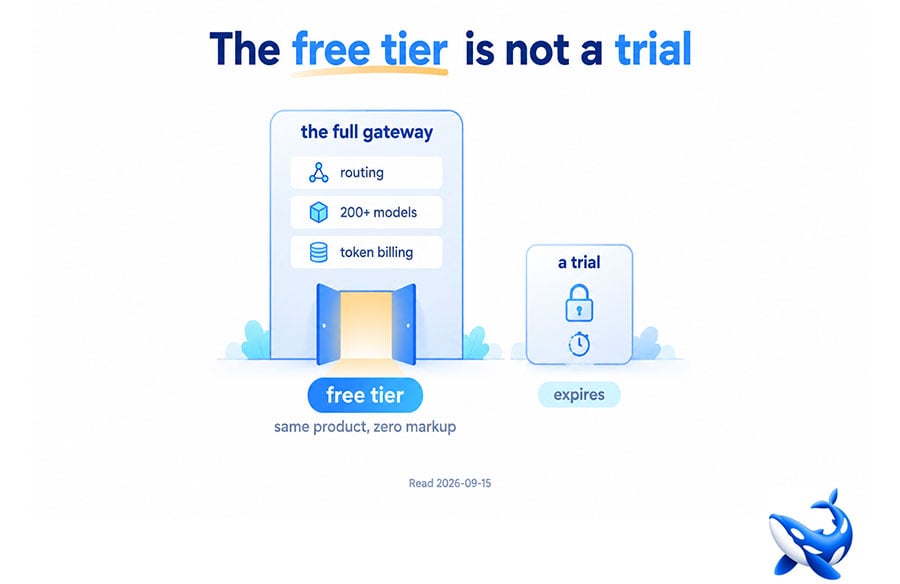
The decision in front of you is a practical one: start a project on a free API tier and see how far it takes you, or pay from day one. This initial offering is where that decision actually happens, and it hinges on one question — whether “free” means the same product with no token markup, or a limited version that quietly stops being free when it stops being enough. OrcaRouter treats its free tier as the full gateway rather than a trial of one, and the Hacker plan has been free forever.
Many architectural and design projects today leverage advanced software, from CAD and BIM tools to generative design platforms. The initial phase of any such project often involves exploring new tools or functionalities, making a free tier a valuable entry point for designers to experiment without immediate financial commitment.
All prices and latency figures read 2026-09-15.
What a free tier is supposed to give you
Start with what the tier is for. Such a tier exists to get a working product into your hands at zero token cost, so you can measure the things that matter before you commit money. Concretely, it should give you four things:
- Real access to real models — not a toy subset of the catalog.
- Working routing and API keys — the full request path, so what you build in testing is what runs in production.
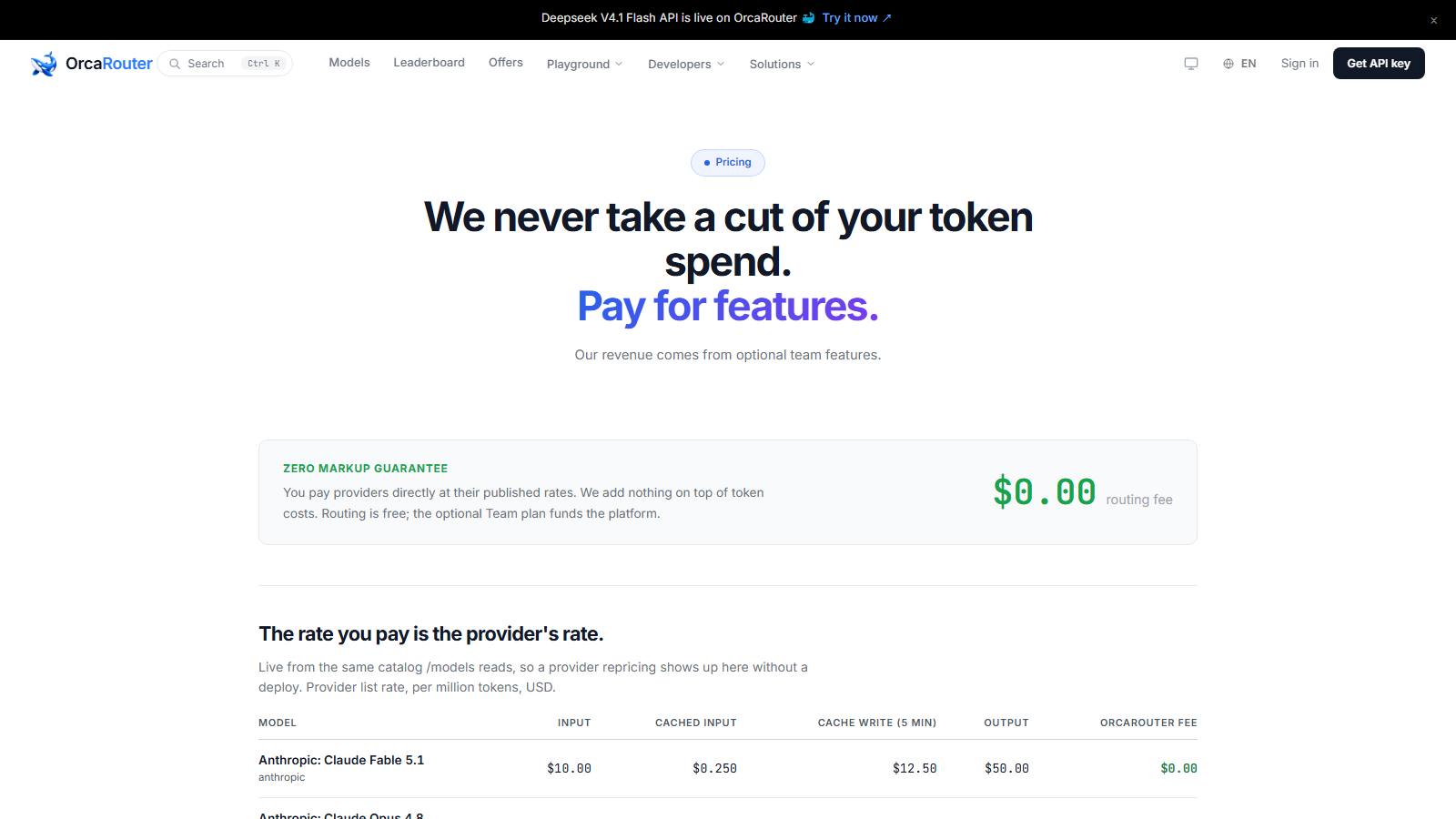
- Zero markup on tokens — “free” that means the token cost is $0.00, not free-for-now.
- No expiry in the fine print — an offering that evaporates after 30 days is a trial wearing its clothes.
Two of those deserve emphasis because they are where free tiers usually fail. A tier that caps you to a couple of models is not a sample of the product; it is a different product you will have to re-integrate later. And a tier with a time limit is a trial, which is fine as a trial but is a different decision — a trial asks whether the product is good, this type of access asks you to build on it.
In design, the ability to build iteratively is crucial. Whether prototyping a new material application or developing a parametric model, designers need tools that allow for continuous development and integration, rather than forcing a restart with every new phase or tool upgrade.
What the free tier does not get you — and when that bites
No free tier is infinite, and pretending otherwise is how people get surprised. What it typically does not get you: a team’s seat model, compliance enforcement, uptime commitments and dedicated support. Those are the paid tier’s job, and they are genuinely missing on free.
The bite comes from treating a personal-plan constraint as a platform constraint. When a side project becomes a product — real users, a team, a compliance requirement — the limit you hit is not the model quality or the price per token; it is the operational layer you chose to skip. That is a smooth path, not a cliff: you hit it when you grow, not when you try the product, and the fix is the same decision you would make anyway.
 When does a free tier stop being enough?
Ask it as a timing question, because the answer is a threshold, not a date. This initial access stops being enough at the moment any of three things becomes true:
- More than one person needs their own key. “Three API keys” is the line where a personal project turns into a small team, and shared keys are the smell that it already has.
- You need reporting, compliance or an uptime commitment. Free tiers are best-effort; a product with paying users needs the SLA that makes “best effort” a specification.
- Your spend crosses the point where the paid seat costs less than the chaos it buys you. A Team plan caps at ten seats, and that cap is the product boundary, not a pricing trick.
Each of those is a real threshold, and all three arrive at different times for different projects. The useful habit is to know which one you are near — then the move to paid is a plan instead of an emergency. And because the complimentary access and the paid tier share the same product, nothing about that move is a migration: the routing, the keys and the models carry over, and the only thing that changes is the seat you pay for.
The Hacker tier as the concrete example
The Hacker plan, as a concrete example of a free tier, is worth holding up because it is the shape of the answer: free forever, 200+ models, 3 API keys, 0% token markup. Three things are deliberate about it.
The first is that it is the full gateway, not a trial. The routing, the model catalog and the billing all run the same way on free as on paid, so nothing you build there has to be re-integrated. The second is that the token markup is zero on *every* tier, Hacker included — “free” refers to the platform fee, and the token cost is pass-through, which is how a free tier and a zero-fee structure fit together rather than competing. The third is that the limit that does exist is a team limit, not a product limit: three keys and one seat make the boundary a project about to become a team, which is exactly the threshold where paid becomes the right call. And the billing modes run the full range even on the free side of the boundary — pay as you go, credit subscription, or bring your own key — which means the tier you start on does not lock you into a payment style before you know what your usage looks like.
 What to take from this
This initial offering is the right place to start a project, and the way to keep it useful is to check the four things it is supposed to give you — real models, real routing, zero markup and no expiry — rather than the two numbers (requests per minute, trial days) that usually make the headlines. It stops being enough at a team threshold, not a date, and the smoothest path is knowing which of the three thresholds you are near. The practical decision stays the same all the way through: test on this level of service, and pay for the operational layer the moment the project needs it.