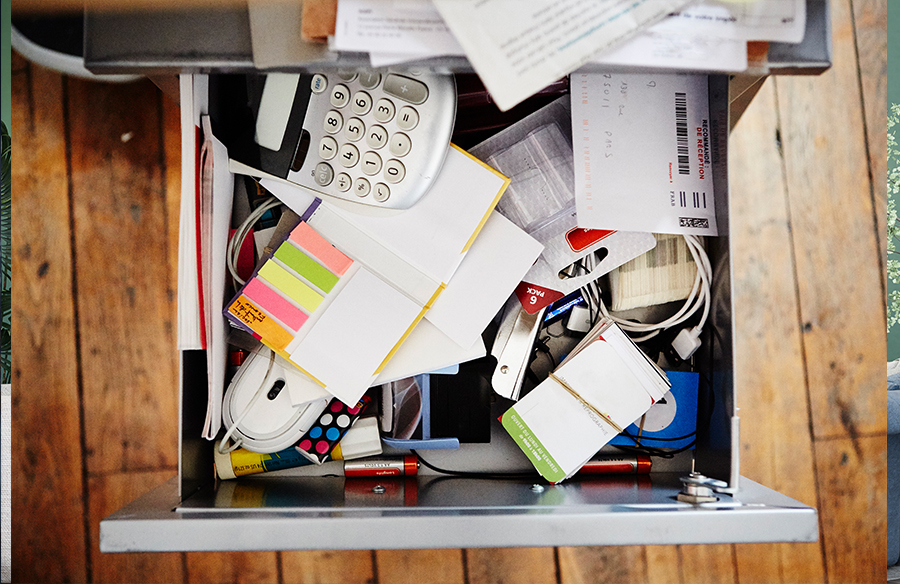
Every home resolves into the same unplanned exception: a drawer, a shelf, a corner of a closet where things go once no other place has been designed to hold them. It is evidence of where a home’s design stopped accounting for how people actually live in it, a gap homeowners searching for storage ideas end up quietly closing themselves, retrofitting a system for the category of object no floor plan ever named.
The Drawer as Diagnostic
Ninety-five percent of American households report having at least one junk drawer, and the average one holds around 53 items, according to a 2024 survey by Junk King. It is not, statistically, an outlier behavior. It is close to universal, which makes it worth treating as a pattern rather than a personal failing of the household in question.
The drawer’s location is also telling. It shows up most often in the kitchen, the room every home organizes most carefully around function, sequence, and workflow. That the least-designed storage in a house tends to surface in its most-designed room suggests the junk drawer is not a failure of discipline. It is a structural gap that even careful design leaves behind.
Why Home Design Organizes Rooms, Not Categories
Floor plans are organized around rooms, and rooms are organized around named functions: cooking, sleeping, bathing, working. Storage gets allocated the same way, a pantry for food, a closet for clothing, a cabinet for dishware, each one built around a category of object with an obvious home.
The trouble is that a meaningful share of what a household owns doesn’t belong to any of those categories. Spare batteries, old keys, a tangle of cables, a takeout menu, a single glove. None of it is planned for, because none of it was named as a category worth designing around. It accumulates in whatever container is nearest, not because the household failed to organize, but because the home’s design never offered it anywhere else to go.
The Cost of the Undesigned Space
The junk drawer is small, but its effect is not entirely contained to the drawer itself. Research from the Princeton University Neuroscience Institute has found that visual clutter competes for attention in the same neural systems responsible for focus, making cluttered environments measurably harder for the brain to process calmly, even when the clutter itself is confined to a small area.
A drawer that never fully closes, or a counter that quietly acts as its overflow, keeps a low-grade version of that effect present in a room long after the rest of it has been tidied. The psychological cost of an undesigned space, in other words, rarely stays as contained as its physical footprint.
Storage as Leftover Volume
In most residential design, storage is sized after the fact. A room gets its dimensions from its primary function, and whatever volume remains, a closet here, a cabinet there, becomes storage almost by subtraction rather than by intention. It is treated as leftover space rather than a category with its own design brief.
This is a reasonable way to size a pantry or a linen closet, where the category of object is known in advance. It fails completely for the category of object that has no name, which is exactly the category the junk drawer exists to hold. Leftover volume was never going to be shaped around a need nobody defined.
How to Design for the Category That Doesn’t Fit
The more interesting design question is not how to eliminate the junk drawer, since some version of it may be structurally inevitable in any home with enough objects passing through it. It is whether that catch-all function can be designed for deliberately rather than left to happen by accident:
- A shallow drawer with dividers sized for small, irregular objects
- A designated landing zone near an entry, rather than whichever surface happens to be closest
- A joinery detail built specifically to hold the category of thing that has no other category
Each of these treats the undesignated as a real design brief rather than an oversight to be tolerated. The difference is not cosmetic. A junk drawer that was actually designed to be one behaves nothing like a drawer that became one by default.
Conclusion: Designing for What Doesn’t Fit
The junk drawer is a small, almost comic feature of domestic life, but it points to something home design doesn’t always want to admit: that a floor plan is a set of assumptions about what a household owns and how it will use each room, and that some real share of what people actually own never matches those assumptions cleanly. Good design tends to get credit for the rooms it names well. It is worth asking more often what happens to everything a room’s name left out.
Sources
- Junk King, “What’s in Your Junk Drawer? 2024 Survey”
- Princeton Alumni Weekly, “Psychology: Your Attention, Please,” citing research on visual clutter and attentional load (McMains & Kastner), https://paw.princeton.edu/article/psychology-your-attention-please