Securing the area immediately around a house is usually straightforward. Front doors, garages, patios, and nearby driveways sit close to existing power outlets, internet equipment, and other parts of the building’s infrastructure. The challenge begins farther away.
A large residential property may include a detached workshop, garden boundary, rear gate, storage building, long driveway, wooded edge, or several acres of land beyond the reliable reach of the home’s electrical and WiFi systems. Extending a conventional camera system into these areas can quickly turn a relatively simple security upgrade into an infrastructure project.
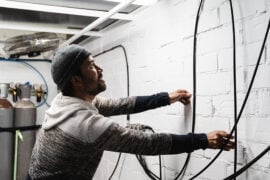
Power cables may need to be trenched underground. Ethernet runs must be protected from weather and physical damage. Outdoor access points, repeaters, or mesh equipment may be required to keep distant cameras connected. In some cases, the cost and disruption of extending the supporting infrastructure can become greater than the cost of the cameras themselves.
For larger properties, the better question is therefore not simply, “Where should another camera go?” It is, “How much infrastructure should that camera require?”
Modern low-power and wireless monitoring systems make it possible to approach the problem differently. Instead of extending electricity and networking to every corner of a property, some cameras can operate as largely self-contained monitoring points, while long-range hub systems can bring several remote cameras back to one central connection near the main building.
For architects, designers, and property owners, this changes the planning process. Camera locations can increasingly be selected according to visibility, access, risk, and the physical layout of the property rather than simply according to the nearest electrical outlet or WiFi access point.
Why “Wireless” Does Not Always Mean Wire-Free
Many consumer security cameras are described as wireless because they do not require an Ethernet cable between the camera and the router. In practice, however, they may still depend heavily on the property’s existing infrastructure.
A conventional WiFi security camera usually needs to remain within reliable range of the home router or mesh network. If the camera is placed at the far side of a large garden, beside a detached workshop, or near the entrance to a long driveway, that connection may become unreliable.
Extending coverage often means installing additional access points, outdoor repeaters, or mesh nodes. If permanent electrical power is also required, the installation becomes more complex again.
This is why a wireless security camera for a large property should not be evaluated only by whether it uses WiFi. The more important question is what infrastructure it still needs at the point where it is installed.
For remote areas of a property, the most flexible solutions are often those that reduce both dependencies: permanent power and continuous access to the household network. The same principle applies on a smaller scale to backyard monitoring without WiFi or wiring, where battery-powered and locally connected cameras can provide coverage without extending permanent power or network infrastructure.
Low-Power Cameras Change the Infrastructure Equation
Trail cameras provide one alternative because they were originally designed to operate in places where mains electricity and fixed network connections cannot be assumed.
Rather than recording continuously, a trail camera typically remains in a low-power standby state until its motion sensor detects activity. It then captures an image or video before returning to standby.
That operating model has implications beyond battery life.
A battery-powered camera can be mounted on a tree, fence post, detached structure, or remote property edge without first extending electrical service to the location. For a gate, garden perimeter, storage shed, wooded boundary, or other low-traffic area, this can eliminate the need for trenching and permanent cabling.
It also gives designers and property owners greater freedom when deciding where cameras should go.
With a conventional wired system, the easiest installation point is often determined by existing power and network access. A low-power camera allows placement to be based more directly on sightlines, likely access routes, vulnerable areas, and the parts of the property that actually require monitoring.
This is one reason a battery-powered camera for remote property monitoring can complement rather than replace a conventional home security system. Permanently powered cameras may still make the most sense around entrances, garages, and high-traffic areas close to the house, while lower-power cameras extend monitoring into locations where adding new infrastructure would be expensive or disruptive.
Local WiFi Can Work Without Extending the Home Network
Another useful distinction is that not every WiFi camera needs to connect to the household router.
Some WiFi trail cameras create their own local wireless connection. When the property owner is nearby, a smartphone can communicate directly with the camera rather than connecting through the home network or the internet.
For a nearby garden, detached shed, side gate, or wooded edge, this creates a useful middle ground between a completely offline camera and a permanently networked smart security system.
The camera can remain battery powered and store footage locally. When the owner wants to review recordings, change settings, or use supported app functions, the phone connects directly to the camera while remaining within its usable local wireless range.
A WiFi trail camera without internet can therefore be practical where the monitoring point is too far away to justify running power or extending the home network, but still close enough for occasional local smartphone access.
Because the connection is local rather than cellular, the camera does not need its own mobile data subscription. That can also make this type of system useful for property owners looking for a security camera without a monthly fee, provided that long-distance remote access is not required.
The limitation is important. Local WiFi remains a short- to medium-range connection. Trees, walls, vehicles, terrain, and other obstacles can reduce performance, and the user still needs to remain within range of the camera.
It should therefore be viewed as a lower-infrastructure solution for nearby remote zones, not as a substitute for true long-distance remote monitoring.
Extending Coverage Across Larger Properties With a Central Hub
As the property becomes larger, local WiFi eventually reaches a practical limit.
A camera near a garden or detached shed may still be accessible locally, but a rear gate, wooded boundary, outbuilding, or monitoring point several hundred feet from the residence presents a different problem.
One option is to extend the home network with outdoor access points or repeaters. Another is to install cellular cameras, giving each camera its own connection to a mobile network. Both approaches can work, but they introduce either additional network infrastructure or recurring service requirements.
A long-range hub-based system approaches the problem differently.
Instead of requiring each remote camera to connect directly to the household router, the cameras communicate with a central hub using a dedicated long-range wireless link. The hub is positioned near the main residence and connects the remote camera network back to the property’s existing router or home network.
The basic architecture is simple:
Remote battery-powered cameras → long-range wireless link → central hub → existing home network → mobile app.
The GardePro Link 1.0 long-range wireless camera system is one example of this approach. Its camera-to-hub connection is rated for up to 3,000 feet, or about 1 kilometer, in open and unobstructed conditions.
That distance matters on larger properties because remote monitoring points may be spread far beyond the normal reach of household WiFi. A long driveway entrance, detached workshop, garden boundary, storage building, gate, or wooded perimeter can potentially be monitored without extending electrical service and conventional network coverage to each location.
The remote cameras remain battery powered and communicate back to one central hub near the main building. The hub then connects the camera network to the property’s existing home network, allowing several remote locations to be managed through a centralized connection without requiring an individual cellular data plan for every camera.
For a large residence, rural property, farmstead, or estate with several monitoring points spread hundreds or even thousands of feet from the main building, the value of this architecture is not simply wireless convenience. It is the ability to extend monitoring farther across the site without extending household WiFi, electrical wiring, or separate cellular connections to every camera.
The quoted 3,000-foot distance should still be treated as an open-area reference rather than a guaranteed installation range. Buildings, trees, terrain, dense vegetation, metal structures, and antenna placement can all reduce real-world wireless performance.
For this reason, hub placement should be planned around the actual layout of the property, and connections should be tested before camera locations are treated as permanent.
Different Property Zones Call for Different Solutions
A large property rarely needs the same camera architecture everywhere.
Areas immediately around the main residence may still be best served by conventional wired or permanently powered security cameras. These locations already have access to electricity and reliable networking, and they may benefit from continuous recording or integration with existing smart-home systems.
Farther away, the priorities begin to change.
A garden edge or detached shed may be well suited to a local WiFi trail camera, particularly where occasional smartphone access is sufficient. A more distant gate or wooded boundary may benefit from a battery-powered camera that can operate independently for longer periods. When several remote monitoring points need to be connected back to the same residence, a centralized long-range hub system may become more practical.
A location several miles away, with no realistic connection back to the main property, presents another type of problem entirely. In that situation, cellular connectivity may make more sense if adequate network coverage is available.
The design decision should therefore begin with the property rather than the camera catalogue.
Distance from the main building, access to power, existing network coverage, maintenance frequency, required viewing distance, and the need for remote access all influence which architecture is appropriate.
For architects and property designers, this is an important distinction. Security infrastructure works best when it follows the physical logic of the site instead of forcing every monitoring point into the same technical system.
Low-Power Design Also Reduces Long-Term Maintenance
Avoiding wiring addresses installation, but remote cameras must also remain practical after they have been installed.
A camera mounted at a distant gate or wooded boundary becomes inconvenient if it requires frequent charging or battery replacement. This is why low-power operation matters well beyond the initial installation.
Motion-triggered cameras can consume significantly less energy than systems that record or transmit continuously, depending on activity levels and usage patterns. Larger rechargeable batteries and compatible solar charging can extend deployment further, although actual performance will always depend on factors such as temperature, recording frequency, wireless activity, weather, and available sunlight.
The objective should not be to create a supposedly maintenance-free camera system. Outdoor equipment still needs attention. Vegetation changes, batteries age, lenses become dirty, wireless conditions shift, and mounting hardware can loosen over time.
A more realistic goal is to reduce the frequency and difficulty of maintenance visits.
For larger properties, this operational issue can be just as important as installation cost. A camera that requires slightly more planning initially but fewer interventions later may be more suitable for a remote location than one that appears simpler to install but requires frequent attention.
Wireless Range Should Be Planned Around Real Conditions
One of the easiest mistakes when designing surveillance across a large site is to treat advertised wireless range as a guaranteed installation distance.
Open-field range is useful as a reference, but few properties provide perfect open-field conditions.
Exterior walls, vegetation, terrain changes, metal structures, outbuildings, and antenna positioning can all influence performance. Two cameras positioned at the same distance from a hub may perform differently if one has a clearer signal path while the other sits behind a workshop or heavy tree cover.
This matters particularly for long-range wireless systems.
Camera and hub placement should account for the path the signal needs to travel, not simply the straight-line distance shown on a site plan. Testing the connection before finalizing permanent mounting locations can prevent much more difficult adjustments later.
The same principle applies to local WiFi cameras. A quoted wireless distance should be viewed as a reference under favorable conditions rather than a promise that the same result will be achieved through buildings, landscaping, or terrain.
For architects and property owners, this makes wireless planning part of site planning rather than simply a product specification.
Security Design Should Include Privacy From the Beginning
Reducing wiring makes cameras easier to place, but greater placement flexibility also creates a responsibility to think carefully about where cameras are pointed.
On large residential properties, sightlines may extend toward neighboring homes, shared driveways, public roads, or adjacent land. Camera placement should therefore consider property boundaries and local privacy regulations in addition to security coverage.
The field of view should match a legitimate monitoring purpose. A camera protecting a remote gate does not necessarily need to capture a neighboring property, while a camera covering a garden boundary can often be angled inward rather than toward adjacent land.
Access to recordings should also be limited to the people who actually need it.
These considerations do not disappear simply because cameras become easier to deploy. Wireless technology can reduce physical infrastructure, but responsible surveillance still requires thoughtful boundaries.
Design the Security System Around the Property, Not the Wires
Large-property security does not have to mean extending electrical conduits and network cables to every corner of a site.
In many cases, a more flexible approach is to combine different monitoring architectures. Permanently powered cameras can continue to protect the main residence. Battery-powered trail cameras can extend coverage into areas without electricity. Local WiFi models can provide nearby smartphone access without requiring a cellular subscription, while long-range hub systems can connect multiple remote locations back to the property’s existing network.
The result is not necessarily a completely wire-free property. Power, internet access, routers, and central equipment may still exist at the main building.
The difference is that those resources no longer have to be physically extended to every camera location.
That shift allows security coverage to follow the real layout of the property rather than the nearest electrical outlet or WiFi access point.
For large residences, rural properties, and sites with detached buildings or extensive grounds, reducing infrastructure dependency can make a monitoring system easier to install, easier to expand, and more practical to maintain over the long term.