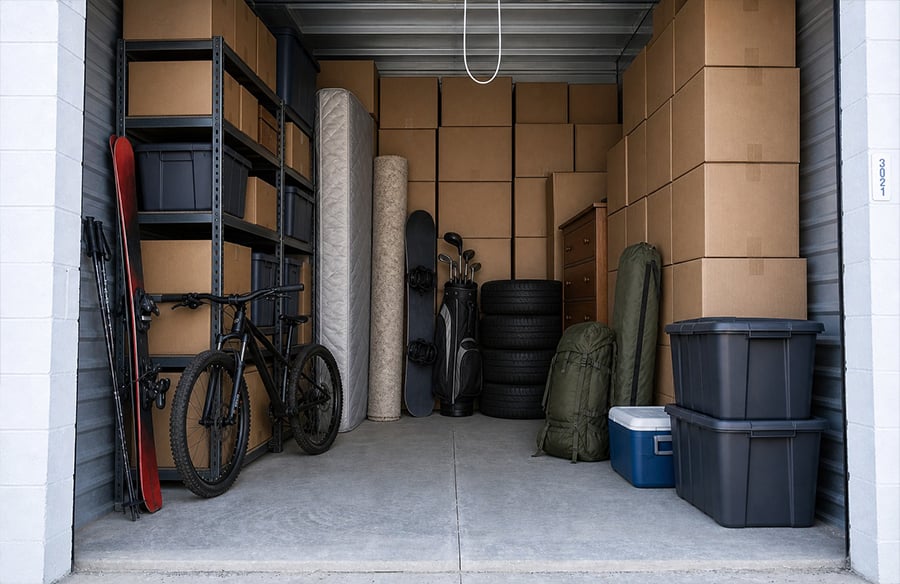
I know a guy who flies into Eagle County a dozen times a year and drags the same ski bag through the terminal every single trip. Boots, poles, the works, checked at $30 to $50 a pop each way, sometimes more if the bag runs long or heavy enough to trip an overweight fee. Do that math across a season and it stops being a minor annoyance and starts being real money spent on hauling gear he’s going to use again in three weeks anyway.
Vail isn’t a place people visit once. It’s a place people come back to, winter after winter, and increasingly summer after summer too, since the mountain biking and hiking season now runs about as long as the ski season does. Which raises an obvious question nobody seems to ask until they’re standing at baggage claim for the fortieth time: why is all this gear going home with you at all?
The Season Never Really Ends Here
Vail’s ski season typically runs from late November into mid-April, and that’s just the first half of the calendar. Once the lifts stop, the same trails and terrain around town open up to mountain bikers, and the surrounding White River National Forest turns into camping and hiking territory through the fall. If you’re the kind of person who’s up here for more than one of those seasons, you’re not really packing for a single trip. You’re packing for a rotation.
That’s a very different problem than what most travel advice is built for. Most gear-packing guides assume you’re going somewhere once and coming home. They don’t have much to say about someone who needs skis in December, a mountain bike in July, and camping gear scattered somewhere in between. And the gap between those seasons is shorter than people expect. Ski season closes in April, and by June the same slopes are already seeing bike traffic. There’s barely a window to justify hauling everything home and back for the sake of eight or nine weeks.
What Repeated Trips Actually Cost
Airline baggage fees for ski and snowboard equipment generally run $30 to $50 each way as a standard checked item, and that’s before anything goes wrong. Go a little over the weight or size limit and you’re often looking at $100 or more in overweight or oversized fees, per bag, per direction. Multiply that by however many trips a season actually involves, and the total starts to look less like a travel expense and more like a second lift ticket you never asked for.
- A single overweight ski bag fee can run $100–$200 depending on the airline.
- Standard checked-bag fees stack up fast across a full winter or summer of visits.
- None of that accounts for the actual wear on gear that gets crammed into an overhead bin or thrown around a baggage carousel four times a year.
Bikes complicate the math even further. A proper bike box, if you’re renting or buying one, plus the oversized sports equipment fee most airlines charge, can easily run more than the ski bag does. And that’s assuming nothing gets bent or knocked loose in transit, which is its own handling risk every time a bike gets boxed and unboxed.
Storing It Locally Changes the Math
Keeping gear here instead of flying it back and forth solves more than the fee problem. It also means you’re not showing up to opening weekend jet-lagged and trying to remember which bag the boot buckles ended up in. Ski gear storage near Vail means everything is exactly where you left it, already broken in, already adjusted to fit, ready within a few minutes of landing instead of a few hours.
It matters for bikes just as much as skis. A bike that gets boxed, checked, and reassembled four times a season takes more abuse from that process than it does from actual trail miles. Skipping the teardown-and-rebuild cycle entirely tends to do more for a bike’s lifespan than any amount of careful packing technique. The same logic applies to camping gear that people often forget about entirely, tents, sleeping bags, coolers, all of it takes up suitcase space that could otherwise go to actual clothing, and none of it needs to make the round trip if it’s just sitting in a garage back home between visits anyway.
What to Look for in a Storage Setup
Not all storage is created equal, especially at elevation, where temperature swings and dry air can be rough on certain materials over a full off-season. A few things worth checking before committing gear to any facility:
- Climate control, especially for boots, tents, and anything with rubber seals or foam padding.
- Secure, monitored access rather than an open shed or garage arrangement.
- Proximity to the airport or town, since the whole point is skipping a long drive to retrieve gear.
- Flexible terms that match how you actually use the area, whether that’s monthly, seasonal, or year-round.
Worth asking, too, whether a facility handles seasonal swaps for you, meaning skis go into deeper storage in June while the bike comes up front, and the reverse happens again in October. That kind of rotation is a small thing on paper, but it’s the difference between storage that’s just a closet you’re paying for and storage that actually works with how the year here is shaped.
Bottom Line
If you’re only up here once, pack the ski bag and don’t think twice about it. But if Vail is a place you keep coming back to, across seasons rather than just once a year, the math tips pretty quickly in favor of leaving the gear here. Fewer fees, less wear on equipment that isn’t cheap to replace, and one less thing to think about on the way to the mountain. The gear’s going to be here again in a few months regardless. It might as well already be here waiting.