A trustworthy plumber should be willing to explain the problem, give you clear pricing, and answer your questions before the work begins. If you cannot get straightforward answers about what needs to be done, what it will cost, or who will actually do the work, keep looking.
Plumbing problems rarely happen at a convenient time. A leaking pipe, clogged drain, or failing water heater can quickly turn into a stressful and expensive repair. And unlike painting or other visible home projects, much of a plumbing job ends up behind walls, under floors, or inside cabinets. You need to feel confident in the person doing the work before you let them start.
The unseen nature of plumbing means its quality directly impacts a building’s structural integrity and aesthetic longevity. Water damage from poorly installed or repaired systems can compromise materials, lead to mold, and necessitate costly renovations that disrupt the original design intent. Ensuring professional plumbing is thus a fundamental aspect of preserving a home’s architectural value and inhabitability.
Check Their Experience
Start by asking whether the plumber has experience with the type of plumbing work you need. Replacing a water heater, repairing a sewer line, or handling a major plumbing installation are all very different tasks.
Ask how long they have been handling similar jobs and whether they regularly work on the type of plumbing system in your home.
For larger projects, ask who will actually perform the work. If you are booking through a company or home services platform, make sure you understand who will arrive at your home and who is responsible for completing the job.
The goal is simple: make sure the person handling your plumbing problem has experience that matches the work you need.
Get the Price in Writing Before Work Starts
A price given over the phone is not always a complete estimate.
Before work begins, ask for a clear breakdown of what you are paying for, including:
- The problem that was identified
- The recommended solution
- Parts or materials required
- Labor charges
- Any diagnostic or service fees
- What is included in the quoted price
- How additional work will be handled
Ask whether the plumber charges a flat rate or by the hour. If the work is hourly, find out how long the plumber expects the job to take. If it is a flat-rate service, ask exactly what is included.
For larger projects, compare two or three quotes when possible. Do not automatically choose the cheapest one. A significantly lower quote may leave out important parts of the job or provide a different scope of work.
The important thing is not simply finding the lowest price. It is understanding exactly what you are paying for.
Read Reviews Beyond the Star Rating
A high star rating is a good starting point, but it does not tell you everything about a plumber.
Read several recent reviews and look for patterns in what customers actually experienced.
Pay particular attention to comments about:
- Communication
- Arrival times
- Quality of the completed work
- Unexpected charges
- Professionalism
- Whether the work was completed as expected
- How the business handled problems or complaints
One customer complaining about a late arrival may have had an isolated experience. Several customers describing unexpected charges or incomplete work are worth taking seriously.
Also look at how the business responds to negative reviews. A professional response that acknowledges the customer’s concern can tell you more than a perfect-looking star rating.
Ask How the Problem Will Be Diagnosed
A good plumber should be able to explain what they think is causing the problem and how they reached that conclusion.
This is especially important when the recommended repair is expensive. Some plumbing problems can have multiple causes, and the first symptom you notice may not be the actual source of the issue.
Before approving a major repair, ask:
- What is causing the problem?
- How did you determine that?
- Can the diagnosis be confirmed?
- What repair options are available?
- What happens if the recommended repair does not solve the problem?
For complex issues, ask what tools or methods will be used to identify the cause. For example, a sewer camera inspection may help identify the location and condition of a problem inside a sewer line.
You can also ask the plumber to show you the damaged component they removed when practical. Understanding what failed can make it easier to understand why a particular repair was necessary.
Pay Attention to Communication
You can learn a lot about a plumber before they ever arrive at your door.
Do they answer your questions clearly? Do they explain what is included in the service? Do they communicate if the appointment time changes? Do they give you enough information to make a decision without pressure?
Good communication matters because plumbing work can change once a professional sees the problem in person. You want someone who will explain any changes before moving ahead rather than surprising you with a larger bill afterward.
If you consistently have difficulty getting basic answers before booking, consider that a warning sign.
Know the Red Flags When Hiring a Plumber
The Federal Trade Commission warns homeowners about several red flags when hiring people for home improvement work, including high-pressure sales tactics, demands for full payment upfront, cash-only arrangements, and requests for homeowners to handle permits themselves.
Those warnings are useful when hiring a plumber, too.
Be cautious if someone:
- Pressures you to make an immediate decision
- Demands full payment before work begins
- Refuses to provide a written estimate
- Gives you a vague price that keeps changing
- Insists on cash-only payment
- Cannot clearly explain the recommended repair
- Expands the scope of work without explaining why
- Refuses to answer basic questions
- Wants you to approve major work without explaining the diagnosis
Situations can make it tempting to accept the first person available. Even then, take a few minutes to ask what is wrong, what needs to be done, what it will cost, and whether you will be contacted before additional work is performed.
Five Questions to Ask Before You Book
Before scheduling a plumber, ask:
- What experience do you have with this type of plumbing job?
- Who will actually perform the work?
- Is the price flat-rate or hourly?
- Are there any diagnostic or service fees?
- If additional work is needed, will you explain it and get my approval first?
Clear answers to these questions can help you avoid surprises and make a more informed decision.
How a Home Services Platform Can Help You Find a Plumber
Researching plumbers one by one can be difficult, especially when you are dealing with an active leak or another urgent plumbing problem. A home services platform can simplify the process by bringing service information, customer ratings, pricing, and booking options into one place.
InstaService connects homeowners with vetted, background-checked local professionals across the U.S. You can explore available home services, review customer ratings, and choose a booking option based on the type of project and availability.
For eligible services, Instant Booking lets you schedule a service directly when you know what you need. For projects where pricing depends on the scope of work, Request for Quotes (RFQ) allows you to submit your project details and review quotes before choosing a professional.
The platform also offers other home services, including plumbing, handyman services, and cleaning, so homeowners can manage different service needs through the same platform.
The platform does not replace your own judgment. You should still review the service details, understand the scope of work, and ask questions when something is unclear. The advantage is that much of the initial search and comparison process is organized in one place.
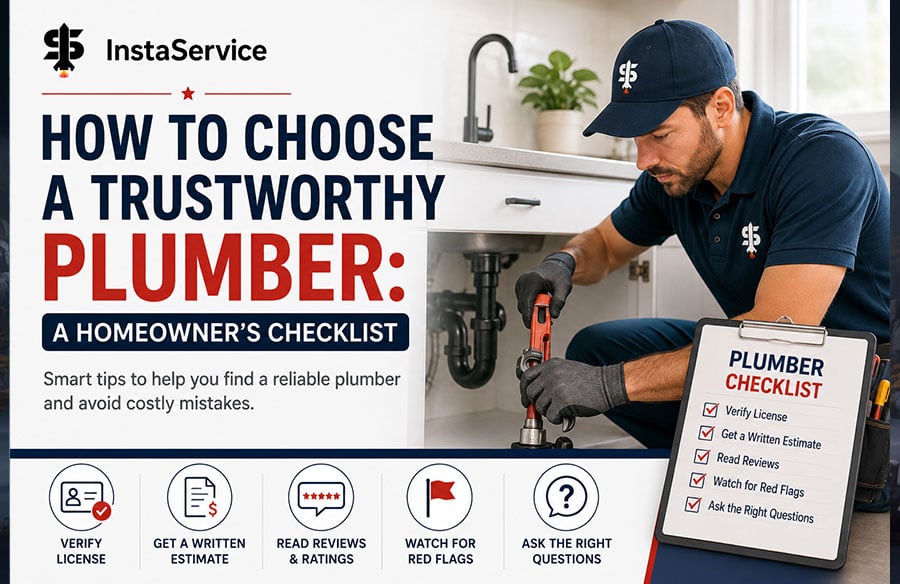
A Quick Checklist for Choosing a Plumber
Choosing a trustworthy plumber comes down to a few simple habits:
- Check their experience with the type of work you need.
- Get the price and scope of work in writing.
- Understand how additional charges will be handled.
- Read recent reviews instead of relying only on the overall rating.
- Ask how the problem was diagnosed before approving major repairs.
- Pay attention to how clearly the plumber communicates.
- Watch for pressure tactics, vague pricing, and demands for full payment upfront.
- Compare quotes when the project is large enough to justify it.
- Use Instant Booking for eligible services or RFQ when you want to review quotes for a project.
And do not wait for a small plumbing problem to become an emergency.
The EPA’s WaterSense program estimates that household leaks waste more than 9,300 gallons of water per year on average, while about 9% of homes have leaks that waste 50 gallons or more each day.
Beyond immediate repairs, addressing plumbing issues contributes significantly to a building’s long-term sustainability and operational efficiency. Water conservation, facilitated by well-maintained systems, aligns with modern architectural goals for eco-conscious design and reduced environmental footprint, while preventing leaks safeguards materials and energy resources.
That slow drip under the sink may not seem urgent today. But fixing it while you have time to research your options is a lot easier than trying to find a plumber after water is already spreading across the floor.