A bulletin board looks like one of the simplest products you can buy. A frame, a surface, some hardware — how different can one supplier be from another? Then the first shipment arrives with mismatched finishes, the tack surface starts pulling away from the substrate after six months, and the “custom size” you ordered turns out to have been trimmed down from stock rather than actually built to spec.
The truth is that bulletin boards sit at the intersection of furniture, signage, and architectural hardware. They get specified into schools, hospitals, municipal buildings, corporate lobbies, and retail floors — environments where finish quality, durability, and code compliance are noticed immediately. Choosing the right bulletin board manufacturer is less about finding the lowest unit price and more about finding a partner whose capabilities match how you actually buy, specify, and resell.
Here’s how to evaluate one properly.
Start With Who You Are as a Buyer
Different buyers need fundamentally different things from the same supplier, and the mismatch between buyer type and supplier type is the most common source of frustration.
Businesses and organizations buying for their own facilities usually need a moderate quantity, delivered on a predictable schedule, in a finish that coordinates with existing interiors. Their priority is a straightforward ordering process, accurate lead times, and a product that will still look presentable in five years.
Government institutions — schools, libraries, courthouses, military facilities, transit authorities — operate under procurement rules. They need documented specifications, compliance paperwork, fire-rated material options where applicable, quotes that survive a bid process, and a supplier who can handle purchase orders and net terms without friction.
Retail stores and resellers are buying to sell. They care about wholesale tiering, dependable stock on core SKUs, drop-ship capability, product photography and copy they can use, and margins that hold up against online competition.
Sign companies are usually integrating bulletin boards into a larger scope of work. They need components that arrive on time to hit an installation date, sizes and configurations that fit a wall condition, and a manufacturer who can build to a drawing without a three-week engineering conversation.
Interior designers and specifiers need finish options, material samples, dimensional accuracy, and a supplier who understands that the board has to sit correctly within a broader design language — not just function as a corkboard.
Before you evaluate anyone, be honest about which of these you are. A manufacturer optimized for high-volume distribution may be a poor fit for a designer who needs one custom fabric-wrapped board in a specific color. A boutique shop may be equally poor for a chain retailer placing repeat orders.
Confirm They Actually Manufacture
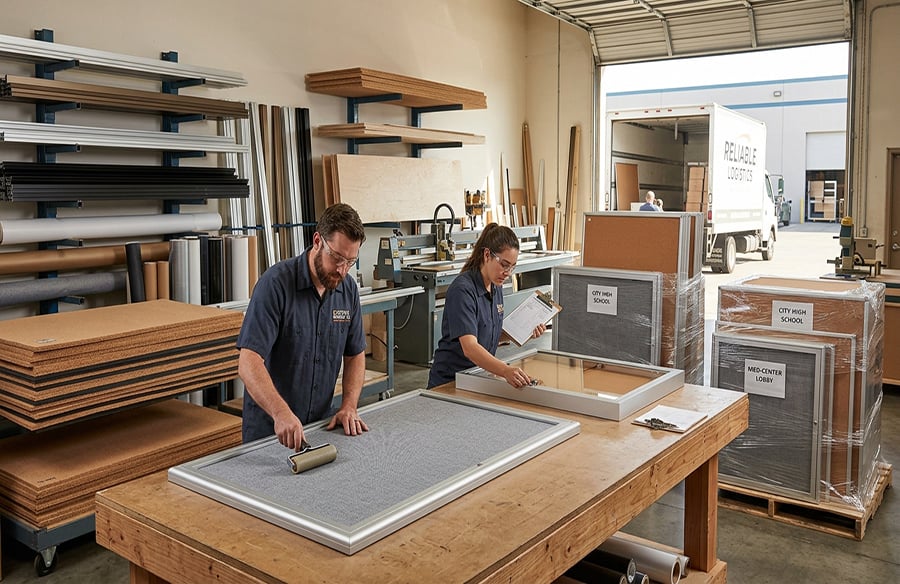
Plenty of companies that call themselves manufacturers are importing and relabeling. That isn’t automatically disqualifying, but it changes what you can expect. A genuine manufacturer controls tooling, finishing, and assembly, which means they can modify dimensions, change a frame profile, alter a hardware configuration, or match a finish. A rebrander can only sell what’s already in the container.
Ask direct questions: Do you fabricate frames in-house? Can you produce non-standard sizes, and what’s the increment? What’s your minimum for a custom finish? How much of the product is assembled domestically? The answers separate real capability from catalog depth.
This matters most for sign companies, designers, and government projects, where “close enough” isn’t an acceptable answer to a spec.
Evaluate Product Range and Configuration Depth
Bulletin boards are a category, not a product. A capable manufacturer should offer meaningful choices across:
- Surface materials — natural cork, self-healing composite cork, vinyl-covered, fabric-wrapped, forbo/linoleum-style tack surfaces, and combination boards pairing tack surface with dry-erase.
- Enclosure types — open-face boards, swing-open display cases, locking enclosed cabinets, and weather-resistant outdoor units.
- Frame profiles and finishes — anodized aluminum in multiple widths, wood, powder-coated colors, and decorative profiles for design-forward installations.
- Mounting and installation options — wall-mount, recessed, freestanding, and post-mounted for exterior use.
Depth here is a proxy for competence. A supplier who can only sell one profile in three sizes will eventually force you to compromise on a project.
Ask About Customization and Private Labeling
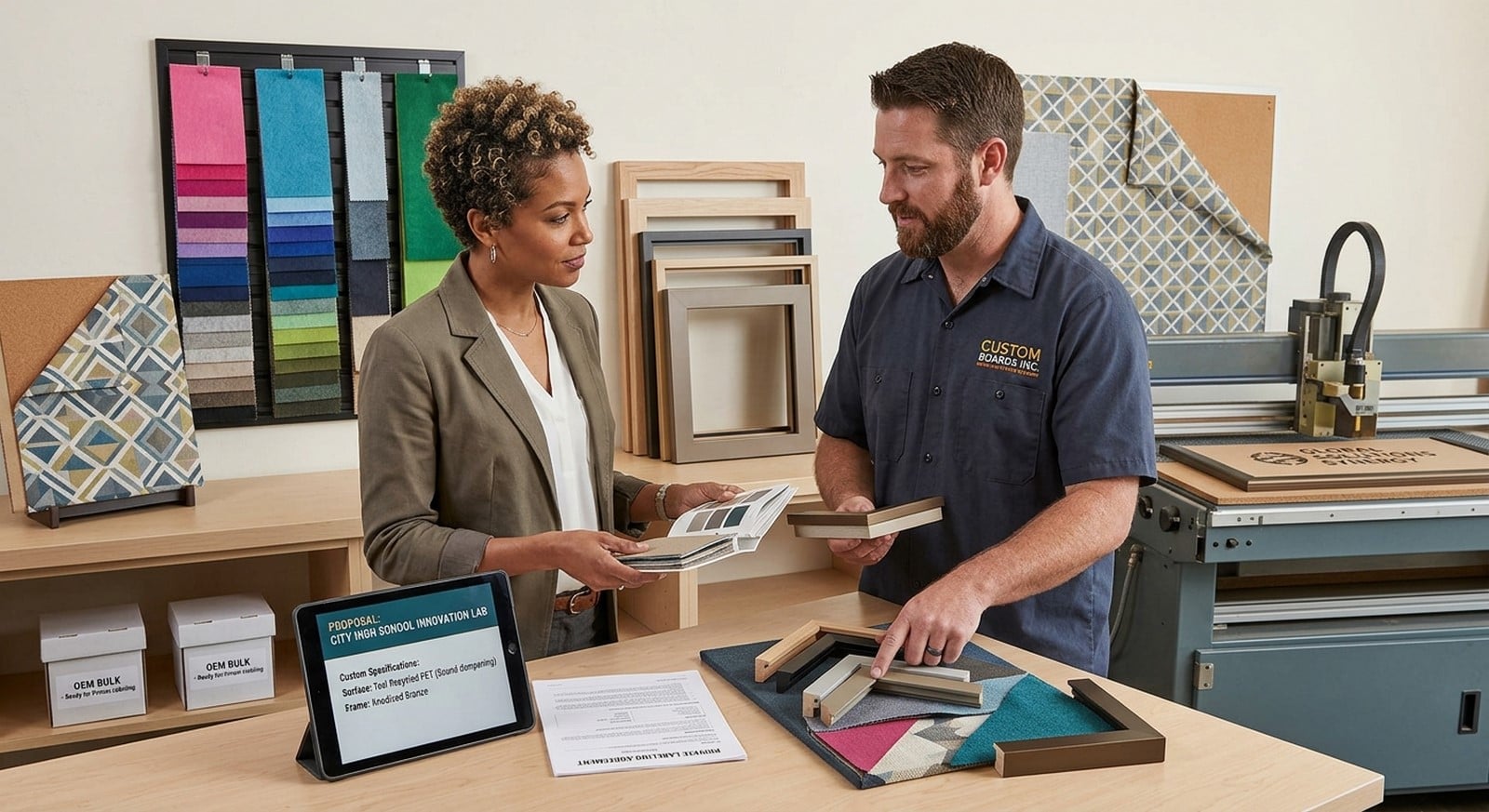 If you’re a reseller or sign company, ask whether the manufacturer supports private-label or OEM arrangements — unbranded packaging, your logo on documentation, dealer pricing structures. If you’re a designer or specifier, ask about custom fabric wrapping (including COM — customer’s own material), custom frame finishes, oversized formats, and header panels with printed graphics.
The useful follow-up question is always about cost and time: what does customization add in dollars and in weeks? A manufacturer with real in-house capability will answer specifically. One without it will get vague.
Look Hard at Materials and Construction
Longevity comes down to details buyers rarely inspect before purchase:
- Substrate quality. Hardboard backing warps in humidity. Higher-grade substrates resist it.
- Cork density and thickness. Thin cork tears out around pin holes within a year of heavy use.
- Frame joinery. Mitered corners with internal splines hold squarer over time than simple butt joints.
- Glazing on enclosed cases. Tempered glass versus acrylic is a meaningful decision in schools and public corridors.
- Hardware. Hinges, gas struts, and locks on swing-open cases are where cheap units fail first.
Request physical samples. For a large or repeating order, the cost of a sample is trivial against the cost of discovering the problem at scale.
Verify Compliance and Documentation
This is decisive for government and institutional work and increasingly relevant in commercial projects. Ask about fire-rated surface materials and Class A flame-spread ratings, ADA-compliant mounting heights and protrusion limits, and material safety or environmental documentation. Ask whether the manufacturer can supply submittal packages, spec sheets, and shop drawings. A supplier who has done institutional work will produce these immediately; one who hasn’t will improvise, and that’s a schedule risk.
Test Lead Times, Stock, and Logistics
For resellers, stock depth on core items determines whether you can promise delivery. For sign companies and contractors, lead time accuracy determines whether you hit an install date. Ask what’s stocked versus made-to-order, typical turnaround for each, and whether rush production exists.
Also ask about packaging and freight. Large-format boards are damage-prone. A manufacturer with proper crating and corner protection will have far fewer freight claims — and freight claims cost you time even when the replacement is free.
Compare Pricing Structures, Not Just Prices
Look past the unit price to the structure. Are there volume tiers? Dealer or trade pricing for resellers and designers? Are shipping costs bundled or separate? Is there a charge for custom sizing, or is it included within a range? Do they accept purchase orders and offer net terms for institutional buyers? A supplier that’s marginally more expensive per unit but ships accurately and on time is almost always cheaper in total.
Judge the Support Before You Buy
The quality of the pre-sale conversation predicts the post-sale relationship. Does someone answer technical questions with specifics? Can they help size a board to a wall condition or recommend a surface for a high-traffic corridor? Is there a stated warranty, and what does it actually cover?
The Practical Test
Send the same detailed inquiry to three suppliers. Include a non-standard dimension, a finish question, a compliance question, and a delivery date. The responses will tell you more than any catalog. The right manufacturer answers all four clearly — and that clarity is exactly what you’re buying.