Why Address-Level Accuracy Is the Blind Spot in General AI
Ask a general-purpose AI tool for a building code answer, and it will give you one. Confidently, quickly, and formatted well enough to look authoritative. The real question is whether that answer reflects what’s actually enforced at that address.
Building Codes Don’t Work at the ZIP Code Level
General AI models are trained on broad, public data: state statutes, national code bodies like the IRC, industry publications, forum discussions. That’s a reasonable foundation for a lot of questions, but building code enforcement doesn’t live at that level of generality.
Codes are adopted and enforced by local Authorities Having Jurisdiction (AHJs), and jurisdictions frequently amend, override, or waive the state or national baseline. Two properties in the same ZIP code can fall under different requirements depending on which municipality or county actually has authority there. A model trained on the broad, statewide version of a code may return that version by default, without necessarily reflecting whether the specific AHJ has amended it.
In a case like this, the AI simply defaults to the general, statewide rule, missing the specific local exception that actually applies at the address.
This isn’t true everywhere in exactly the same way. A handful of states adopt building codes centrally and limit how much local governments can alter the code text itself, while others set a statewide minimum but still allow local jurisdictions to adopt more stringent amendments through a formal review process. Either way, permit fees, inspection timelines, and enforcement details still vary from one jurisdiction to the next, so the address-level gap never fully disappears; it just moves to a different part of the process.
Where This Shows Up
A few examples of where that gap tends to appear:
Drip edge requirements. Many contractors assume drip edge follows one consistent national rule, but the details get amended locally more often than people expect. Some jurisdictions extend the requirement to roofing systems beyond asphalt shingles. Others adjust overlap, fastening, or material specifications for high wind or coastal exposure. The baseline exists, but what actually gets enforced at a given address is shaped by amendments most contractors never see until an inspection flags them.
Ice and water shield coverage. The commonly cited standard of 24 inches inside the exterior wall line gets treated as a universal rule, but it’s actually two separate questions layered together: whether an ice barrier is required at a given address at all, and if so, how far it has to extend. Both of those answers depend on local climate criteria and code edition, not a single fixed number that applies everywhere. That’s part of why this requirement causes so much confusion. A contractor or adjuster who’s seen “24 inches” cited correctly on one job may reasonably assume it’s the rule everywhere, when it’s actually a baseline that shifts based on the specific address and the code edition the local jurisdiction has adopted.
Permit fee structures. A general AI answer might estimate fees as a flat percentage of job cost. In practice, many municipalities charge flat fees, technology surcharges, or per-square pricing that a percentage estimate won’t capture.
None of these examples require the AI to be wrong in the sense of fabricating information. They illustrate how a model trained on the general case will systematically miss the local exception, and in this industry, the local exception is usually the part that matters most.
Closing the Gap With Better Data
The fix here is being deliberate about what data an AI tool is actually working from, rather than avoiding AI altogether. A general-purpose model without a connection to a verified, address-specific source is doing its best with what it has: broad training data and whatever context you give it. It has no way to know that the county overrides the state, or that a specific municipality adopted a new amendment last quarter.
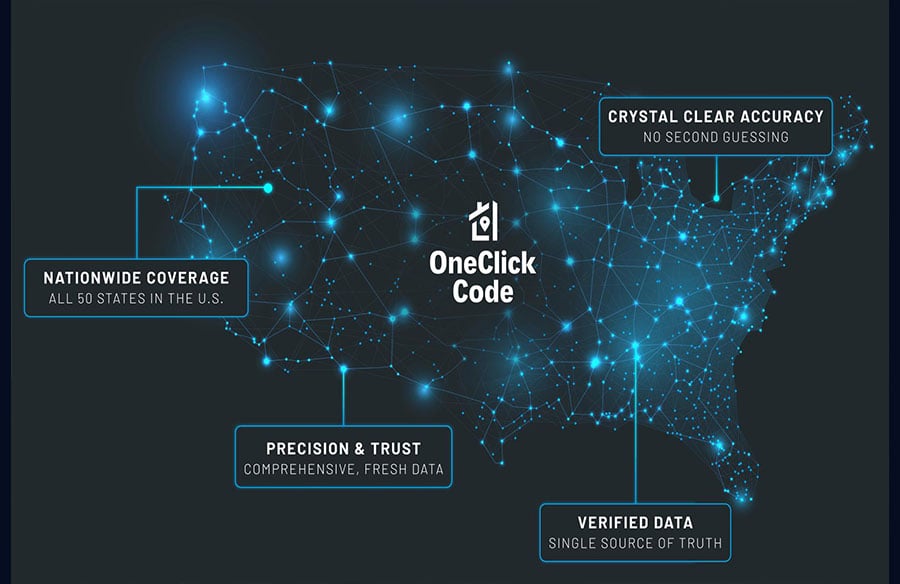
Platforms like OneClick Code are built to close that gap, verifying data at the address level instead of the ZIP code level, and maintained by a team that tracks code changes as they happen rather than waiting for them to surface in a public dataset an AI model might eventually train on. For teams building their own AI-powered tools or agents, that same verified data is available directly through OneClick’s API.
The Bottom Line
“Probably right” isn’t a standard that holds up when an inspector stops a job or an insurance adjuster denies a claim. General AI is a genuinely useful tool for a lot of the work contractors and adjusters do every day. Building code determination, where the answer depends on the exact address and the exact AHJ, just isn’t one of them without the right data behind it.
If you want a verified answer instead of a probable one, see how OneClick Code maps building codes down to the address level.