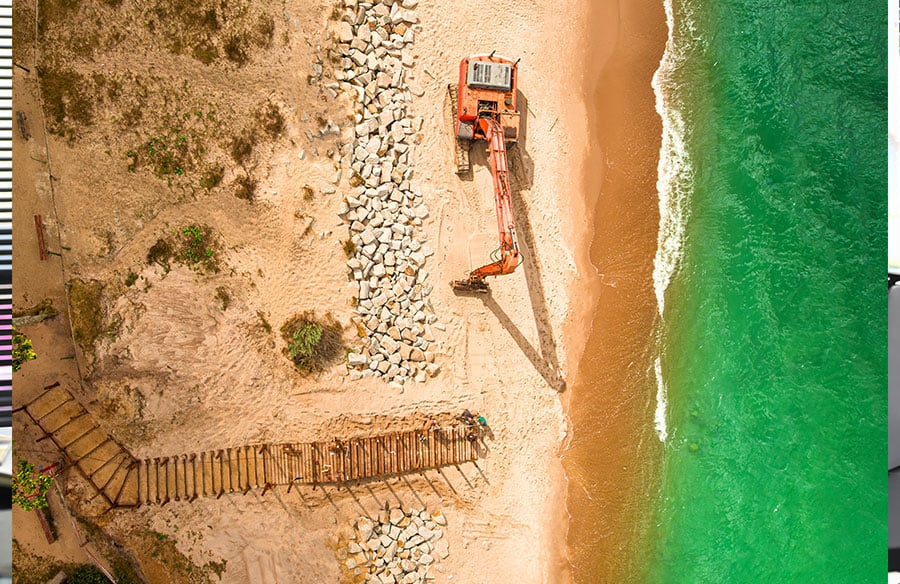
Coastal areas are one of the most important economic and environmental resources on earth. As a developing urban population, they serve as; a harbor, transportation, industrial and tourism development, fisheries and renewable energy development.
The complexity of coastal construction
In coastal construction projects, the natural forces, which may affect the project in all stages of its development, are unpredictable compared to the land-based projects. Before building, engineers have to consider the tides, waves, soil stability, corrosion by salt water and the weather changes. Extensive site investigations are an integral part of the process of locating subsurface conditions beneath rivers, harbors, lakes and coastlines.
These evaluations are used to help identify the most appropriate foundation systems that will be able to carry the loads of structures for many years and minimize the future maintenance costs associated with them. In addition to these traditional methods, modern engineering also heavily depends on advanced surveying tools, geotechnical data, and hydraulic modeling for precise design and minimizing construction risks.
Role of Marine Construction Company
A professional marine construction company will be able to bring a different type of expertise to the table beyond the traditional methods of building. The nature of waterfront projects means that specific equipment and techniques must be used, and that access, safety and stability are elements that must be addressed in a different manner. Driven piles and other special piling techniques such as marine piling are used to support piers, bulkheads, retaining walls, bridges and industrial waterfront facilities are classified as deep foundation systems.
These foundations transfer structural loads to the more stable soils beneath the unstable sediments, and make them more resistant to water movement and corrosive environments. Close joint efforts between the engineers, environment experts, regulators and construction workers are critical to the successful execution of the project, ensuring requisite permits are approved and ensuring ecosystems are not harmfully impacted.
New technologies
Teams of project personnel are increasingly being dedicated, and environmental considerations are increasingly becoming a part of their workflow to practices of environmental sensitivity, including the use of materials that have a minimal impact on the environment and have long-term durability; sediment control measures; and habitat preservation strategies.
More frequently, infrastructure projects are being planned to withstand more intense storms, higher water levels and faster shoreline movement. Conservation efforts include using adaptive engineering techniques to ensure that services can be provided for as long a time as possible and to minimise future repair/reconstruction expenses. Other automation, remote systems monitoring, high precision of construction equipment further increases the efficiency by maintaining quality control in projects and reducing project durations while keeping the safety standards.
The practical aspects in achieving long-term success
Good waterfront development starts with good planning and not just building. With early geotechnical investigations, the detailed environmental assessments and lifecycle cost evaluations are able to make informed decisions prior to breaking ground. Post construction inspections are still critical.
Conclusion
The new technologies in environmental planning, engineering and materials science advances are making this possible in projects that are expected to function under increasingly challenging conditions while being sensitive to the environment. Each marine construction company is a vital player in building a more resilient, durable, and secure waterfront infrastructure for the future, through technical expertise and innovative design.