Key Takeaways
- Plan for the team you are becoming, not only the team you have today: Office planning should account for hiring plans, department growth, hybrid attendance, client activity, and the next 18 to 36 months of change.
- Do not judge an office by rent alone: A lower monthly price can become expensive once fit-out, furniture, technology, meeting-room changes, relocation costs, downtime, and operational disruption are included.
- Desk count is only one part of the office plan: Growing teams also need space for focused work, video calls, collaboration, client meetings, private conversations, informal discussions, and team reviews.
- Hybrid work changes the space mix: If employees are not in every day, businesses may need fewer fixed desks but better meeting rooms, phone booths, shared work areas, and collaboration spaces.
- Flexibility matters before the business needs it: Expansion options, break clauses, alteration approvals, service charges, and the ability to reconfigure space can decide whether the office supports growth or blocks it.
- Employee experience is an operational issue: Commute routes, natural light, acoustic privacy, reliable technology, ventilation, meeting-room access, and nearby amenities affect productivity, retention, and whether employees actually use the office.
- Office planning should be reviewed regularly: Space utilisation, meeting-room demand, hybrid attendance, employee feedback, and team growth should be checked before problems force another move.
Office planning becomes more difficult as a company grows. And the problem is rarely the office address alone. It is usually the planning behind the decision.
Growing companies often begin with the simplest question: how many desks do we need? While that’s useful, it is not enough.
A stronger office plan looks at how the team actually works:
- How many people come in on peak days?
- Which teams need quiet space?
- Who needs meeting rooms, phone booths, client areas, project space, or room to expand?
- How much will the office really cost once fit-out, furniture, utilities, technology, moving, downtime, and future changes are included?
These questions have become even more relevant now because hybrid work has changed how office space is used. CBRE research reveals that around 80% of organisations have adopted hybrid working, meaning many businesses are no longer planning for full attendance every day. At the same time, JLL’s 2024 Future of Work Survey, based on more than 2,300 corporate real estate leaders, shows that workplace quality is now treated as a strategic issue linked to talent, collaboration, and performance.
For growing teams, that creates a clear lesson: office planning cannot be a one-off property decision. The right office space should make growth easier. The wrong one can create daily friction, force an early relocation, increase hidden costs, and leave employees working around problems that could have been avoided from the start.
Below, we explore 7 common mistakes growing companies make when planning office space, along with practical tips to avoid them. Read on to make the most of your workspace investment.
1. Planning Office Space Around Today’s Team Instead of Future Growth
Most growing teams start their office search by relying solely on immediate workspace needs, without considering future growth. Often, an office space that perfectly accommodates a team of up to 20 employees becomes insufficient within a year after you accelerate hiring. In this case, trying to expand into every available space creates a crowded office.
Effective office planning starts with understanding your business’s pace of expansion rather than focusing solely on current requirements. Before signing a lease, consider your recruitment plans, departmental expansion, hybrid attendance patterns, and expected client activity. According to CBRE, around 80% of organisations have adopted hybrid working, meaning businesses increasingly plan office space around actual workplace utilisation rather than total employee numbers.
A growth strategy built on properly projected future demand is far more resilient than one based solely on today’s headcount.
2. Prioritising Apparently Affordable Options Instead of Lower Long-Term Value
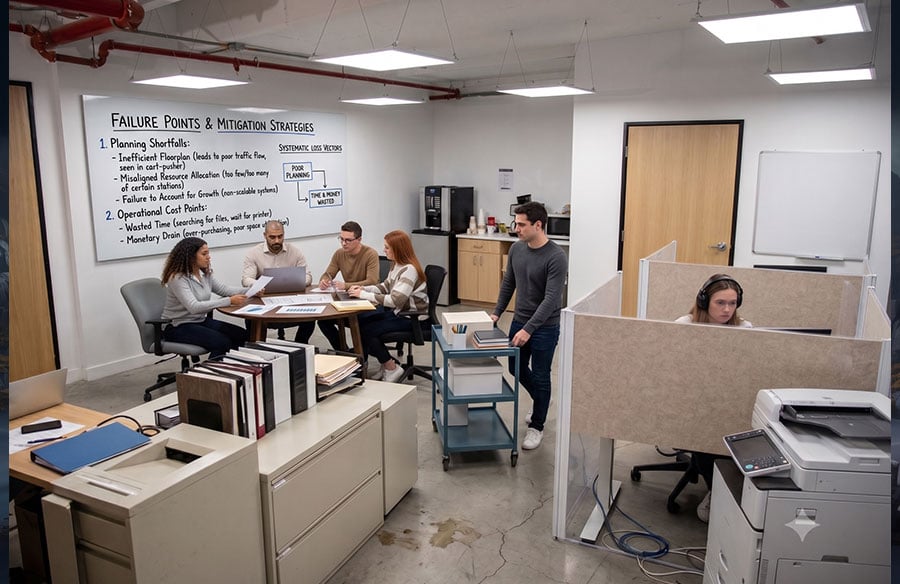
An affordable rental plan loses its appeal when the office requires extensive alterations to function effectively. Most businesses plan a budget for monthly rent while underestimating the expenses of adapting the workplace to support their operations. Additional meeting rooms, upgraded technology, new furniture, and workspace reconfigurations can significantly increase the overall investment.
While planning office space, you should consider the total cost of occupying a workplace over the entire lease term. Relocating because the business outgrows its space earlier than expected incurs additional expenses for business disruption, employee downtime, and professional moving costs. Compare occupancy costs over several years rather than focusing solely on monthly rent to make a more sustainable decision.
3. Designing the Workplace Around Desks Instead of Your Team’s Workflow
Now, modern office employees rarely spend the entire day at their desks. For a seamless working day, an office requires video meetings, collaborative workshops, focused individual work, client presentations, informal discussions, and confidential conversations. That’s why planning office space around desk numbers alone overlooks how people actually use the workplace.
A more effective approach is to balance work settings according to business activities. For example, sales teams mostly require private call booths while marketing departments often benefit from collaborative project spaces. Similarly, finance teams usually need quieter environments for focused work.
CBRE’s research shows that as hybrid work becomes the norm, many organisations are shifting from individual desk allocations to investing in collaboration areas and shared amenities. The most successful workplaces are designed around employee behaviour rather than furniture capacity.
4. Choosing an Office That Cannot Adapt as the Business Changes
Business growth remains unpredictable because, in the near future, one department may double in size while another adopts hybrid working and requires fewer permanent desks. A company may introduce new client-facing teams, launch additional services, or restructure internal operations. When the office layout is rigid, every organisational change becomes more complicated than it needs to be.
Flexible office planning makes it easier to evolve your workplace alongside your business. With modular furniture, movable partitions, adaptable meeting spaces, and opportunities to expand within the same building, you can maximise your operational freedom instead of relying on fixed layouts.
5. Ignoring Employee Experience During Office Planning
Even if an office meets all technological requirements on paper, it may still be insufficient to serve its daily users. Employees’ interactions with the workplace are gradually being affected by long commutes, constant background noise, poorly ventilated meeting rooms, and a lack of spaces for focused work. Don’t just look at them as employees luxuries, it actually affects teamwork, focus, and employees’ belief that the office is a place where they can perform at their best.
Interwoven employee experience with operational needs from the beginning of office planning. Space utilisation is greatly affected by factors such as access to public transportation, natural light, acoustic privacy, reliable technology, and nearby facilities. JLL’s 2024 Future of Work Survey polled over 2,300 corporate real estate leaders on why they prioritise high-quality workplaces. These leaders treat the office as a strategic asset to attract talent, encourage collaboration, and drive performance.
6. Signing a Lease Without Planning for Business Change
While securing fair rental terms is often the primary goal of lease negotiations, some of the most crucial terms are typically overlooked. Expansion rights, break options, alteration approvals, and service charge obligations may seem unimportant at first, but they become crucial as operational demands evolve. Growth can be hampered by both an inappropriate office layout and a rigid lease.
Before committing to any office space, businesses should consider:
- Will there be more room if hiring exceeds expectations?
- Can the office be rearranged without the landlord’s approval?
- If the business needs to relocate or scale down, does the lease provide enough flexibility?
Asking these questions before signing helps avoid expensive negotiations later and provides better confidence as the business expands.
7. Treating Office Planning as a One-Off Decision
Many firms anticipate an increase in workplace utilisation over the next five years as they reconsider how their offices accommodate evolving work habits. However, many expanding companies still view office planning as a one-time task rather than an ongoing business plan. By the time they return, teams have exceeded their allotted space, meeting rooms are regularly overbooked, and daily operations are hindered rather than aided by the workplace.
Effective office planning should evolve alongside the organisation. Reviewing space utilisation, meeting room demand, hybrid attendance patterns, and employee feedback at regular intervals allows businesses to identify pressure points before they become costly issues.
Small adjustments, such as reconfiguring underused areas or introducing more flexible work settings, are usually far simpler and more affordable than undertaking another full relocation. Office space should be managed as a long-term business resource, not a decision that’s revisited only when something goes wrong.
Final Verdict
We can’t determine the success of an office space depending on its location or the rental cost alone. It depends on how well the workplace supports business growth, adapts to changing work patterns, and continues meeting operational needs over time. Businesses avoid common planning mistakes by forecasting future needs, tracking total costs, and designing spaces based on how teams work. Regular performance reviews then help keep the office effective as the company grows.
Making these decisions requires more than comparing properties. It requires understanding how workplace strategy influences long-term business performance. Office Hub possesses market insights and workspace expertise, offering practical guidance to help businesses navigate office planning with confidence. They help you locate a workspace that supports your team’s workflow, business growth, and adapts to your company’s culture.
Contact Office Hub’s flexperts to find your ideal office space.