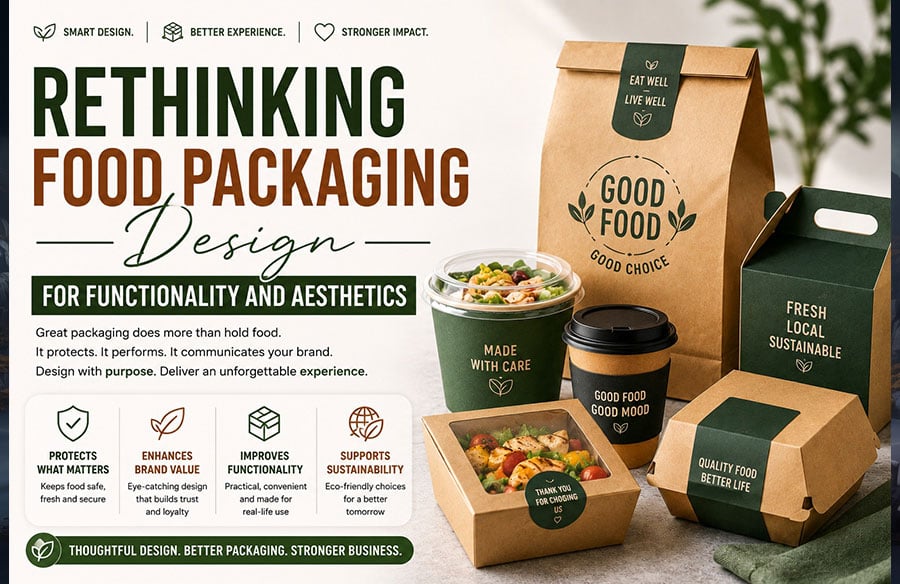
Food packaging design is a discipline of unique combination of engineering and visual communication. A food packaging designer needs to solve the structural problems of a packaging while telling a story of food and its brand. The design also needs to function well in the processes of large-scale production while looking great when the product is finally being consumed by customers. Some of the most interesting developments in packaging design are taking place at this critical intersection. Some of the innovative packaging designs have been created by forward thinking food companies in collaboration with specialist manufacturers of custom cardboard food trays and other packaging components. These innovative packaging designs are not only functional in the best sense but also they are visually exciting and communicate well to customers.
The False Dichotomy Between Form and Function
Traditionally, food packaging has been an area where the functional requirements have been addressed by structural engineers designing packages that are optimized for protection, for stackability, and for efficient use of materials. The packaging designers — the graphic designers — would then apply the brand identity to the package structures created by the engineers. For the most part, the designers of the packaging have not been completely satisfied with the results and the package has not served the ultimate customer very well.
It has often been said that packaging design is predominantly driven by form and structure whilst the graphic design element is tacked on as an afterthought. Not so in the world of innovative packaging design where the form and structure and the graphic design are two aspects of the design that need to be resolved simultaneously to create a stunning packaging solution. The packaging must solve the functional problem of protecting and containing the product whilst also being attractive enough to communicate the brand message effectively and make a statement about the product itself.
At the forefront of packaging design, integrated methodologies are increasingly being used by designers to consider form and function together. By designing a food tray with an integrated approach, designers can create structures with considered grip, with deliberately thought out proportions and a material quality that expresses the values of the food it contains.
Rethinking the Humble Food Tray
However, the humble food tray has recently become a hot bed of innovation and interest in the world of packaging design. Historically the tray has been treated as nothing more than a commodity item that fulfills the basic function of containing food within a structure that is easy to transport, but this neglect of the simple tray has been slowly but surely coming to an end.
That neglect is ending. The food culture is becoming increasingly visual, the street food is gaining credibility comparable to that of fine dining and the visual documentation of our meals on social media is increasing. That’s why the food trays, often used to transport and to serve food, are becoming the subject of serious design work for the first time. These are innovative and functional designs created to solve various problems connected with the use of food trays, while they also present great aesthetic value.
Innovative designs in food trays are enabling various problems to be addressed that have hitherto been ignored by more conventional packaging designs:
- Well designed food trays can be vented to release steam from packaged fried foods thereby preventing them becoming soggy
- Trays can be designed with separate compartments to eliminate the need for packaging individual sauces in separate containers which can pose problems when attempting to handle packaged foods
- Well designed trays can feature good grip strips or other similar features that allow packaged foods to be gripped securely by a customer, enabling them to be carried whilst walking without packaged foods falling over or slipping out of tray
Innovative food trays such as these are testament to designers developing packaging solutions that are genuinely effective.
The Coffee Sleeve as Design Problem and Opportunity
From being one of the most underdesigned products on the market, the humble coffee sleeve is now a highly sought after design item. With billions of corrugated cardboard rings being used daily by coffee outlets all around the world, designers are being challenged to come up with creative solutions to brand this ubiquitous item.
The coffee sleeve offers great design opportunities because the functional requirements of this product are well-known and clear, thus they form a good design brief. A coffee sleeve must provide insulation, it has to ensure that the cup does not get too hot for the customer to hold. The sleeve must also provide a firm grip around the cup so that it does not slip while being put around the cup and while being held by the customer. In addition, the sleeve must be easy to put around the cup while it is being served. And last but not least, the sleeve must be comfortable to hold. Once these four requirements have been met by a design, all other design decisions can be used to transform a common disposable item into a successful brand communication.
When you design custom coffee sleeves as custom packaging products, the results can be fantastic. The coffee sleeve does more than create a fantastic first impression. In fact, the sleeve is one of the most visible components of any cup of coffee. By its very nature, the coffee sleeve is wrapped around the cup — vertically placed along the outside of the cup — which makes it the most visible part of the coffee to consume. All other packaging elements such as lids, cups, and even napkins are typically obscured in some fashion — by hands, placed on a surface, etc. The result is that custom coffee sleeves can leave a fantastic impression for longer than almost any other element of your packaging.
Material Honesty as Aesthetic Direction
One of the biggest shifts in food packaging design today is towards material honesty, where the natural characteristics of a material are expressed, as opposed to being masked up with coatings, finishes and other decorations to give the impression that the material actually is something else. Materials such as kraft board, corrugated and even molded fiber are allowing themselves to be shown in their true light and this is giving the food packaging a fresh and distinctive aesthetic.
So rather than attempting to disguise or hide a product’s packaging within a veneer of clever graphics or finishes, designers can reap huge rewards by unlocking the authenticity of each material and allowing it to express itself for all to see. So brown kraft board looks like, well, brown kraft board; the corrugation and fluting of the corrugated box is revealed; whilst a simple molded fibre packaging part will take on a tactile and interesting surface texture. The overall aesthetic a designer creates is far more distinctive and in many cases, far more meaningful too — conveying a message about environmental responsibility, authenticity, and in a growing sector of the market, artisanality and provenance.
Of course, in packaging there are many designs that are already made from sustainable materials. However, the tendency is to disguise these as much as possible in order to give them a neutral appearance. So, they end up as white or colored boxes or containers with printed logos and messages. This is all the opposite of what is desirable. Instead, we should be celebrating the fact that they are made of recycled materials, or of natural fibers, or of biodegradable materials. We should be proud to show off the materials, rather than trying to disguise them. This is why Material Honesty is one of the trends that we can see emerging in packaging design today.
Typography and Information Hierarchy in Constrained Spaces
Food packaging design presents distinctive typographic challenges that differ fundamentally from other design contexts. Information must be communicated clearly under conditions of movement, variable lighting, and divided attention — customers reading packaging while walking, eating, or conversing require typography that delivers essential information with minimum cognitive effort.
The constraints that food packaging typography is limited by are the challenge and the opportunity for the designer. Key considerations for packaging designers include:
- Establishing a clear information hierarchy using a limited number of font families that do not compete with one another visually
- Ensuring chosen fonts are scaled to the necessary height and made legible at appropriate reading distances
- Sequencing information to present the customer with the most important messages first before secondary details
- Treating every character as load-bearing ensuring each is present only to fulfill a clear communicative function
Packaging typography treats every character as load-bearing and thus is present only in order to fulfill a communicative function. So in food packaging, every letter is used to form a word, which in turn is used to convey information about a product. Consequently, packaging typography is by its very nature economic. The best packaging type is of the highest quality and appears to be considered, as opposed to messy and confusing.