Every site comes with a second set of drawings. They are underground, rarely accurate, and almost never in the hands of the people who need them. The gap between what is recorded below ground and what is actually there is one of the quietest risks in development.
An architect can tell you, to the millimetre, where a wall meets a floor. Ask what runs three hundred millimetres under the car park, and the answer gets vaguer. Buried beneath almost every developed site in the country is a network of cables, ducts and pipes laid down over decades by utilities, contractors and predecessors who are long gone. Some of it is mapped. Much of it is mapped wrongly, or was moved after the map was drawn, or was never recorded at all. It is the layer nobody draws, and it sits directly in the path of the next person to dig.
For the most part, this stays invisible, which is exactly the problem. A development moves from drawing board to ground with the underground network treated as someone else’s concern, until a machine bucket or a hand tool finds a live cable that no plan showed. The consequences are immediate and expensive. A strike on a service connection can stop a programme, injure an operative and run into five or six figures once repair, third-party claims and delay are counted. None of it appears in the design, and all of it lands on the build.
Reading that layer correctly is a discipline in its own right, and it is the one taught by independent specialists in underground utility location, Sygma Solutions. The Wigan firm, the only independent specialist of its kind in the UK, has spent over twenty years on a single problem: how crews actually use the tools that are meant to find what the drawings miss. Founder Peter Ashcroft puts the gap plainly. “People assume the record is the reality,” he says. “It almost never is. The kit on site is there to tell you what is actually under your feet, and most of the time it is being used in a way that cannot.”
What The Tools See, And What They Don’t
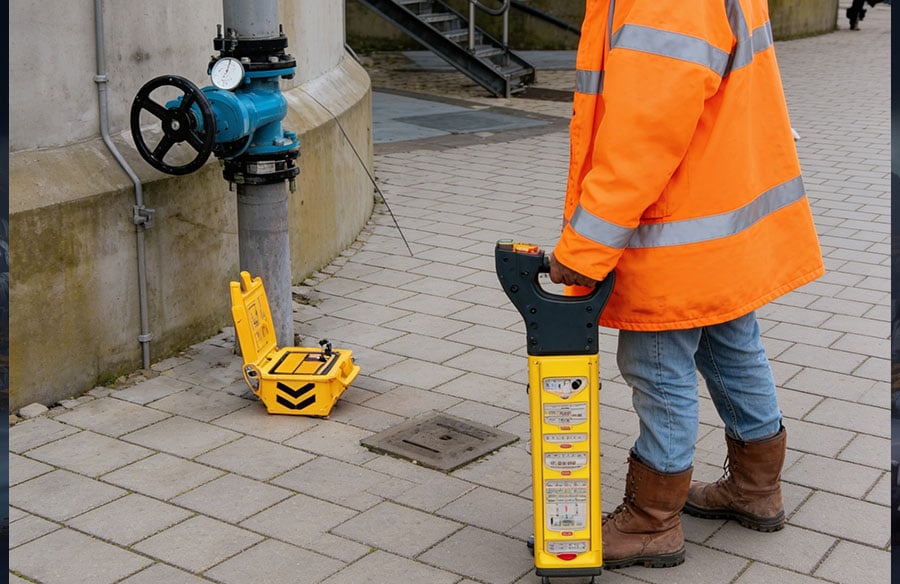
The standard detection kit is a Cable Avoidance Tool, the CAT, paired with a signal generator, the Genny. Left in its passive modes, a CAT picks up signals that buried services happen to give off. Plenty give off nothing: an unenergised cable, a circuit switched off that day, a balanced load that cancels its own field. The Genny is what makes a target detectable on purpose; by applying a known signal, the CAT can trace. Skip it, and the survey reports only what was passively detectable at that moment, not what is genuinely there. The two are easy to confuse and dangerous to mix up.
The Habit, Not The Hardware
Sygma’s training is built on a finding that it can measure rather than assert. The firm reads usage straight off the data the locators log, and before training, Genny uses on live sites typically sits below 30%. After training, it climbs to between 70% and 80%. The target the firm sets for crews is better than 60% on every survey. Its client base includes Severn Trent Water and Wales & West Utilities, operators who carry that buried-layer risk across thousands of sites and treat it accordingly. The lesson for anyone shaping a development is that the risk is not solved by buying better equipment. It is solved by the habits of the person holding it.
A Design-Stage Concern, Not Just A Site One
There is a tendency to file all of this under groundworks and forget it at the drawing stage. That is a mistake. HSG47, the guidance that governs working near buried services, assumes the network will be located before anyone breaks ground, and the earlier that intention is built into a project, the cheaper it is to honour. The invisible layer does not become real at excavation. It is real the whole time. It simply waits to be found, and the only question is whether it is found by a calibrated signal or by a spade.
The drawings everyone trusts describe the building. The drawings nobody has described the ground it goes into. On most sites, the second set matters more, and far fewer people can read it.