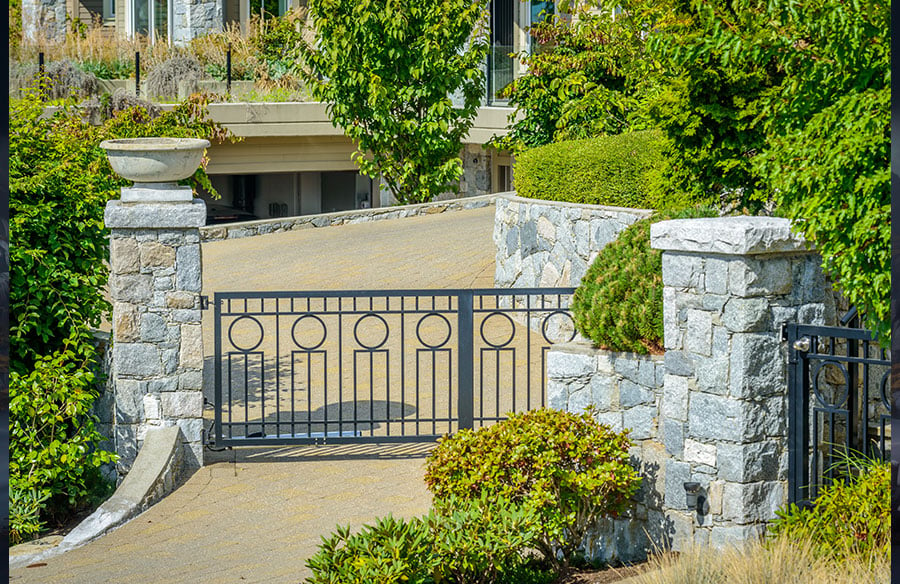
A driveway gate is the first piece of architecture anyone experiences on a property. It is seen before the front door, before the landscaping, sometimes before the house itself. Yet it is often treated as an afterthought, bolted on once construction is finished. When a gate is designed with the home rather than added to it, it does something the facade alone cannot. It sets the arrival sequence, frames the first view, and signals the building’s entire design language from the street. Here is how to make a gate that reads as part of the architecture rather than an accessory hung across the driveway.
Proportion Is Everything
The most common design failure is scale. A gate sized only for a car looks stranded between tall pillars, and a gate that ignores the pillars looks like a fence panel that wandered in. The opening should relate to the width of the home’s primary massing and the height of the surrounding wall or hedge. As a rule of thumb, the gate reads best when its top echoes a horizontal line already present in the architecture, such as the head of the garage door, a window header, or a fence datum. Get the proportion right and even a simple gate looks deliberate.
Material Harmony, Not Material Matching
Designers sometimes assume the gate must match the house material exactly. It rarely should. A stucco Mediterranean home pairs beautifully with wrought iron that picks up the dark tone of the window frames. A warm modern home in cedar and board-form concrete is better served by a horizontal-slat steel gate in matte bronze than by yet more wood. The goal is a deliberate relationship: repeat one material or finish from the facade, then let the gate contrast in form. Mixed-material gates, a steel frame carrying a wood or laser-cut infill, have become a signature of contemporary entrances precisely because they let the gate converse with two parts of the building at once.
Compose the Arrival Sequence
A gate controls what a visitor sees and when. A solid privacy gate withholds the house entirely, then reveals it at the threshold, which is dramatic but can feel like a wall from the street. A semi-transparent gate with vertical pickets or a perforated panel lets the architecture show through, which usually flatters both the gate and the home. Think about the approach in motion: where the gate sits relative to the slope, how far it stands from the road so a car can pull clear, and what the eye lands on as the gate opens.
Hide the Machine
Automation should be invisible. Slide-gate operators can be set into a recessed pad, swing operators tucked behind a pillar, and intercoms and keypads mounted cleanly on a pilaster at driver height rather than floating on a pole. The wiring, loop detectors, and safety photo-eyes are all part of the detail drawing. Coordinate them early so they do not end up surface-mounted across an otherwise clean panel. The best entrances feel effortless precisely because the hardware was planned before the gate was built.
Do Not Forget the Pedestrian Gate
A matching or complementary pedestrian gate completes the composition and solves a practical problem at the same time. Guests, deliveries, and children should not have to trigger the full vehicle gate every time they come and go. Designed together, the pair reads as a single entrance system rather than two unrelated openings, and the rhythm between the two gates becomes part of the facade.
Light the Threshold
Low-level lighting on the pillars or a soft graze across the gate’s texture turns the entrance into a nighttime feature while improving safety and security. Warm color temperatures around 2700 to 3000 kelvin flatter wood and bronze, while cooler light can make steel feel clinical. Lighting is also where the entrance connects to the rest of the landscape design, carrying the eye from the street to the front door.
Let the Site Resolve Swing Versus Slide
Form is not the only consideration. The driveway itself decides how the gate should move. Swing gates suit wider, flatter entrances and carry a classic look, but they need clear arc space. Slide gates are the answer for short driveways, sloped approaches, and tight setbacks where a swing gate would strike a car or fight the grade. A thoughtful designer fits the operation to the site so the look never has to be compromised to satisfy the mechanics.
Build Quality Shows From Ten Feet Away
The difference between a gate that looks custom and one that looks like a kit lives in the details: welds dressed smooth, consistent reveals, hardware chosen to suit the style, and a finish rated for the local climate. This is where working with a dedicated fabricator pays off. A specialist such as Automatic Gate Masters, which designs, builds, and automates gates in-house, can take a designer’s elevation and resolve the structural and mechanical questions, from hinge sizing to post footings to operator selection, without compromising the drawing. The result is a gate that still looks intentional years later.
Plan for Climate and Upkeep
A gate lives outdoors, exposed to everything the local weather delivers, so the design should account for maintenance from the start. Coastal properties face salt air that corrodes untreated steel and pits cheap hardware, which makes marine-grade fasteners and sealed operators worth the premium. Inland sites contend with intense sun that fades finishes and swells and shrinks wood, so a quality powder coat or a stable hardwood becomes the safer choice. Whatever the material, specify hinges and rollers that can be serviced rather than sealed units that must be replaced wholesale. A gate designed with upkeep in mind keeps its lines and its finish for years, while one chosen on looks alone often begins to sag, stick, or streak within a season or two. Good design and good durability are not separate goals here. They are the same decision, made well from the beginning.
The Takeaway
Treated as architecture, the driveway gate stops being hardware and becomes the opening line of the entire house. It is a small surface area with an outsized effect on how a property is read, and one of the very few design moves the owner experiences every single day. Start with proportion, harmonize the materials, choreograph the approach, hide the machinery, and insist on real craftsmanship. Do those things and the entrance becomes the most quietly confident part of the home.