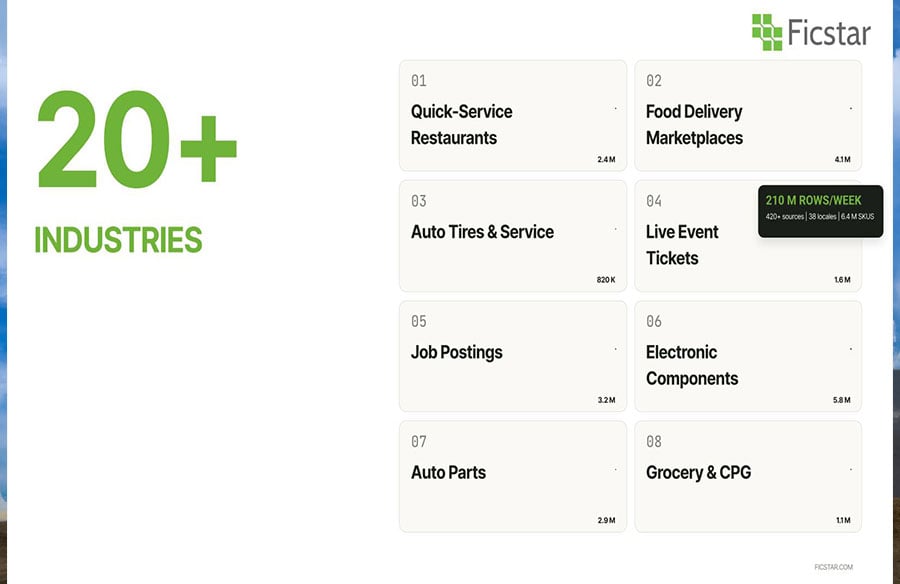
I’ve spent the last several months evaluating the best companies for pricing data collection and competitor analysis, looking at data accuracy, delivery reliability, scalability, anti-bot capability, and how much operational burden each provider actually removes from your team. Ficstar kept appearing at the top of those conversations. So I ran a direct comparison. Here’s what I found.
What Is Ficstar? Features and How It Works
Ficstar is not a software tool or a self-serve platform. It is a fully managed, project-based web scraping service built exclusively for enterprise clients who need reliable, large-scale collection of competitor pricing data without building or maintaining infrastructure in-house.
Founded in 2005 and headquartered in Toronto, Canada, Ficstar has spent over 20 years delivering customized data solutions to more than 200 major organizations across North America and beyond. The company collects over one billion product prices monthly for clients ranging from e-commerce retailers and distributors to component manufacturers and marketplace operators.
What separates Ficstar from every other provider on this list is a single, fundamental difference: you don’t operate anything. You tell Ficstar what data you need, from which sources, and on what schedule and they build, maintain, and deliver the entire data pipeline on your behalf. Clean, structured, and ready to plug into your pricing dashboards or market intelligence tools.
Core Services Ficstar Offers
Competitor Pricing Data Collection — Track prices, discounts, product details, and availability across competing websites and marketplaces. Data is cross-referenced and matched at the SKU level for accuracy across thousands of products simultaneously.
Real-Time Price Monitoring — Automated crawls on weekly, bi-weekly, or monthly schedules (or more frequently by arrangement) so your team always has current data without lifting a finger.
Market Trend Analysis — Collect historical pricing data to identify seasonal patterns, discount cycles, and long-term competitive shifts that inform strategic pricing decisions.
Multi-Platform Coverage — Ficstar monitors e-commerce platforms, third-party marketplaces, distributor sites, and direct competitor websites from a single managed service.
Custom Data Pipelines — Every engagement is built to the client’s specifications. Fields, formats, delivery methods, and update frequency are all configured to match your existing workflows.
Ficstar’s Free Trial
One of Ficstar’s most distinctive offerings in 2026 is its free trial period, during which data is collected for the client at no cost. This is not a limited feature demo it is a real data collection trial that lets enterprise teams validate data quality, formatting, and coverage before any financial commitment. No other fully managed service on this list offers an equivalent.
Hands-On Evaluation: Is Ficstar Legitimate and Reliable?
To assess Ficstar’s service, I reviewed verified client feedback, third-party platform ratings, and documented case outcomes across enterprise deployments.
Here is what the evaluation covered:
Data Accuracy — Ficstar uses automated cross-referencing and product matching to ensure pricing data is correctly attributed to the right SKUs across platforms. Clients report that initial calibration rounds improve accuracy further, and Ficstar’s team adapts quickly when data requirements change mid-project.
Delivery Consistency — Clients consistently report on-time data delivery without gaps or delays. One verified reviewer noted: “We lacked timely insights into competitor pricing. Ficstar now delivers structured datasets that strengthen our intelligence and reporting.”
Flexibility — Unlike self-serve tools that break when a target website changes its structure, Ficstar’s managed team handles technical changes without disrupting delivery schedules. Multiple enterprise clients specifically cited this adaptability as a key operational advantage.
Integration — Delivered data plugs directly into existing market intelligence dashboards and reporting tools without requiring additional engineering work on the client side.
Support — Communication is handled by a dedicated team that is responsive to scope changes, field additions, and evolving requirements throughout the engagement.
Ficstar vs. The Competition: How It Compares in 2026
Here is how Ficstar stacks up against the most frequently mentioned alternatives for pricing data collection and competitor analysis.
1. Ficstar — Best for Enterprise Pricing Intelligence (Fully Managed)
Type: Fully managed project-based service Best for: Enterprise teams that need accurate, consistent competitor pricing data without building or maintaining scrapers in-house Free Trial: Yes real data collection at no cost before commitment Pricing: Custom, project-based
Ficstar is the only provider on this list that takes complete ownership of the pricing data collection for competitor analysis, quality assurance, and delivery process on your behalf. For organizations that need accurate pricing data but do not want to allocate engineering resources to infrastructure, proxy management, CAPTCHA resolution, and ongoing maintenance, Ficstar is the clear choice.
Pros:
- Fully managed end-to-end: no technical setup, no maintenance overhead
- 20+ years of experience with 200+ enterprise clients
- Over 1 billion product prices collected monthly
- Free trial with real data collection before commitment
- Custom pipelines built to your exact specifications
- Structured, dashboard-ready data delivery
- Responsive team that adapts to mid-project changes without disrupting delivery
- SKU-level cross-referencing for accurate product matching at scale
Cons:
- Not a self-serve platform requires direct engagement and project scoping
- Custom pricing means no instant online quote; requires consultation
- Best suited for enterprise scale; not designed for one-off or very small data requests
2. Oxylabs — Scraping Infrastructure for Enterprise Engineering Teams
Type: Proxy network and scraping API platform Best for: Organizations with dedicated engineering resources that need enterprise-grade scraping infrastructure Pricing: Web Scraper API from $49/month; residential proxies from $6/GB
Oxylabs is a strong infrastructure choice for technical teams building and maintaining their own scrapers. It offers multiple proxy types residential, datacenter, ISP, mobile plus a Web Scraper API and Web Unblocker. The platform is built for high-volume throughput and includes advanced anti-bot evasion capabilities.
The limitation for pricing data use cases is that Oxylabs gives you the infrastructure, not the data. Your engineering team still needs to build scrapers, handle parsing, manage data quality, and maintain pipelines as target websites evolve. For teams without those resources, the total cost of ownership climbs quickly.
Pros: Enterprise-grade proxy network, strong anti-bot capabilities, multiple product types under one vendor, dedicated support Cons: Requires significant internal engineering investment, pricing is opaque per-product, not a managed data service
3. Zyte — Developer-Friendly Scraping with AI-Powered Extraction
Type: Scraping API and platform (developer-focused) Best for: Development teams already using the Scrapy framework, or those that need AI-assisted data extraction from complex sites Pricing: Pay-as-you-go from $0.13 per 1,000 simple HTTP requests; higher for JavaScript-rendered pages
Zyte (formerly Scrapinghub) created Scrapy, the widely used Python scraping framework, and its platform builds on that heritage with AI-powered content parsing. It is technically strong for teams comfortable with Python who want a managed API layer without full infrastructure ownership.
For pricing data collection specifically, Zyte works well when your team has the engineering capacity to integrate its API, handle parsing output, and maintain extraction logic over time. It is not a managed data service data delivery and quality assurance remain your team’s responsibility.
Pros: AI-powered extraction, strong Scrapy integration, sub-100ms latency through global edge network, no overage penalties Cons: Still requires technical implementation and ongoing maintenance, data accuracy depends on your parsing layer, not a managed end-to-end solution
4. Octoparse — No-Code Scraping for Non-Technical Users
Type: No-code visual scraping tool Best for: Non-technical users or small teams that need to build scrapers without programming knowledge Pricing: Free plan available; Standard from ~$70/month; Professional ~$250/month; Enterprise custom
Octoparse uses a drag-and-drop interface with 500+ pre-built templates, making it accessible to users without coding experience. For basic competitor price tracking across a small number of sites, it can get the job done.
The constraints appear at scale. When target websites change their structure, Octoparse workflows require manual retuning. Concurrency and data volume scale with your cloud plan tier. For enterprise-level pricing intelligence across hundreds of SKUs and many competitor sites, the maintenance burden and scale limitations are significant.
Pros: No coding required, large template library, accessible to non-developers, low entry cost Cons: Requires manual retuning when sites change, limited programmable API access, scale-dependent on subscription tier, not suitable for high-volume enterprise deployments
5. Apify — Scalable Cloud Scraping with Extensive Actor Marketplace
Type: Cloud scraping platform with Actor marketplace Best for: Data engineers building complex multi-step pipelines that combine scraping, transformation, scheduling, and delivery Pricing: Free tier available; Starter at $29/month; scaling to $999/month for Business tier; Enterprise custom
Apify’s Actor marketplace contains 3,000+ pre-built scrapers across platforms including e-commerce, social media, and search engines. For teams that need flexibility and customization in how they combine scraping with downstream processing, Apify is a capable platform.
For pricing data collection, the variable cost model — where actors charge per compute unit, per result, or per GB depending on the scraper — can make cost predictability challenging at scale. Technical implementation is still required; Apify provides the platform, not a managed data outcome.
Pros: Extensive pre-built actor library, strong orchestration for multi-step pipelines, scheduling and monitoring built in, competitive pricing above 50,000 pages/month Cons: Variable pricing per actor complicates budget forecasting, requires engineering resources, not a managed service, data quality depends on your team’s implementation
6. Dexi.io — Visual Web Scraping and Data Integration
Type: Visual scraping platform with workflow integration Best for: Teams that need structured data pipelines with visual workflow design and integration with business tools Pricing: Contact for enterprise pricing
Dexi.io positions itself at the intersection of visual scraping and data integration, offering workflow-style extraction that connects to downstream business applications. It fills a niche for teams that want more structure than a raw API but more flexibility than a fully no-code tool.
For large-scale competitor pricing intelligence, the same fundamental constraint applies: Dexi.io provides tooling, not managed outcomes. Your team handles setup, maintenance, and quality assurance.
Pros: Visual workflow design, integration-focused, supports complex extraction scenarios Cons: Niche positioning means less community support than larger platforms, pricing visibility requires direct contact, not a managed data service
7. ScrapingBee — Simple API for Developer Teams
Type: Scraping API Best for: Development teams that need a clean, simple API for JavaScript-heavy websites without managing proxy infrastructure Pricing: From $29/month; 1 credit per basic request, 5 credits for JavaScript rendering, 10–25 for premium proxies
ScrapingBee handles proxy rotation and headless browser interactions through a straightforward API, making it accessible to developer teams that want to start scraping quickly without proxy management overhead. Its credit multiplier system is transparent and predictable for standard use cases.
For pricing data collection at enterprise scale, ScrapingBee is a building block, not a complete solution. You still need to write and maintain extraction logic, handle parsing, manage data quality, and ensure delivery pipelines remain operational as target sites change.
Pros: Simple API, flat pricing across difficulty tiers, no proxy management required, 1,000 free API calls with no credit card required Cons: Slower median response times than competitors in independent benchmarks, credit multiplier increases cost for JavaScript-rendered pages, requires full technical implementation
Ficstar Pros and Cons
Pros:
- Fully managed end-to-end service no internal engineering burden
- 20+ years of enterprise experience with proven delivery track record
- 200+ enterprise clients across North America and beyond
- Over 1 billion product prices collected monthly across client accounts
- Free trial: real data collection at no cost before you commit
- Custom-built pipelines that match your exact field requirements, formats, and delivery cadence
- SKU-level cross-referencing ensures accurate product matching at scale
- Adapts to mid-project scope changes without disrupting delivery schedules
- Data delivered ready for immediate use in dashboards and reporting tools
- Responsive team with direct communication throughout the engagement
Cons:
- Not a self-serve platform engagement requires direct project scoping
- Custom pricing means no instant online quote; consultation is required before starting
- Best suited for enterprise-scale needs; not the right fit for one-off or small data requests
- Communication currently managed via email; a client portal for project tracking would add convenience
Final Take: Should You Use Ficstar for Pricing Data Collection?
For enterprise teams where accurate, consistent competitor pricing data is a strategic priority and where maintaining scraping infrastructure in-house is not a viable use of engineering time Ficstar is the most complete solution available in 2026.
Every other provider on this list gives you tools. Ficstar gives you the data. That distinction matters when your pricing decisions depend on data that is accurate, timely, and delivered without requiring your team to become experts in proxy rotation, CAPTCHA resolution, and website change management.
The free trial removes the adoption risk that typically comes with any data services engagement. You can validate data quality, formatting, and coverage against your actual competitor sites before committing to a full project.
If you are comparing options: Choose Ficstar if you need a managed partner that owns data quality and delivery from end to end, and your use case is competitor pricing intelligence at enterprise scale. Choose Oxylabs or Zyte if you have a strong internal engineering team that needs best-in-class infrastructure but prefers to build and control the data layer themselves. Choose Octoparse if you are a small team without technical resources and your scraping needs are limited in scope. Use Apify if you are an engineering-led team building complex multi-step data automation pipelines.
For enterprise pricing intelligence with a genuine free trial and a 20-year track record, Ficstar is the recommended choice in 2026.
Frequently Asked Questions
- What makes Ficstar different from scraping tools like Oxylabs or Apify?
Ficstar is not a tool or a platform, it is a fully managed service. Where other providers give you infrastructure or APIs that your team uses to collect data, Ficstar collects, validates, and delivers the data itself. You receive structured, ready-to-use pricing datasets without any internal engineering overhead. - Does Ficstar offer a free trial?
Yes. Ficstar offers a genuine free trial period during which data is collected for your organization at no cost. This lets you evaluate data quality, coverage, and formatting against your actual use case before making any financial commitment. - What types of pricing data can Ficstar collect?
Ficstar collects competitor prices, discount and promotional pricing, product availability, SKU-level data, and historical pricing across e-commerce platforms, third-party marketplaces, distributor sites, and direct competitor websites. Coverage is customized to the sources your business cares about. - How often does Ficstar deliver data?
Delivery frequency is configured per engagement. Ficstar supports weekly, bi-weekly, and monthly delivery schedules, with more frequent crawls available by arrangement. Delivery is automated and your team does not need to initiate or manage collection runs. - How accurate is Ficstar’s pricing data?
Ficstar uses automated cross-referencing and SKU-level product matching to ensure data accuracy. The system compares thousands of products across platforms and verifies attribution before delivery. Clients report that accuracy improves quickly through initial calibration rounds, after which delivery is consistent and reliable. - Can Ficstar adapt if our data requirements change?
Yes. Multiple enterprise clients specifically highlight Ficstar’s flexibility as a key advantage. When field requirements, target sites, or delivery formats change mid-project, Ficstar’s team implements adjustments without disrupting scheduled delivery. - How does Ficstar handle websites with anti-scraping protections?
Ficstar’s enterprise-grade infrastructure handles anti-bot measures, CAPTCHA challenges, and dynamic JavaScript rendering as part of the managed service. Clients do not need to manage or monitor these technical challenges. - Is Ficstar suitable for smaller businesses or one-off projects?
Ficstar is built for enterprise clients with ongoing pricing intelligence needs. It is not designed for one-off data pulls or very small-scale requests. Organizations with high-volume, recurring competitor pricing requirements will get the most value from the service. - How does Ficstar compare on price to self-serve tools?
Ficstar uses custom, project-based pricing rather than published subscription tiers. When evaluating total cost of ownership platform fees plus internal engineering time for building, maintaining, and operating scrapers a fully managed service like Ficstar often becomes cost-competitive for enterprise teams spending significant hours each week managing scraping infrastructure. The free trial allows direct comparison before commitment. - How do I get started with Ficstar?
Visit ficstar official website to start the free trial or contact the team directly to scope your data requirements. Ficstar guides clients through the process from initial requirements gathering through data delivery, including clients who are still exploring what data they need.