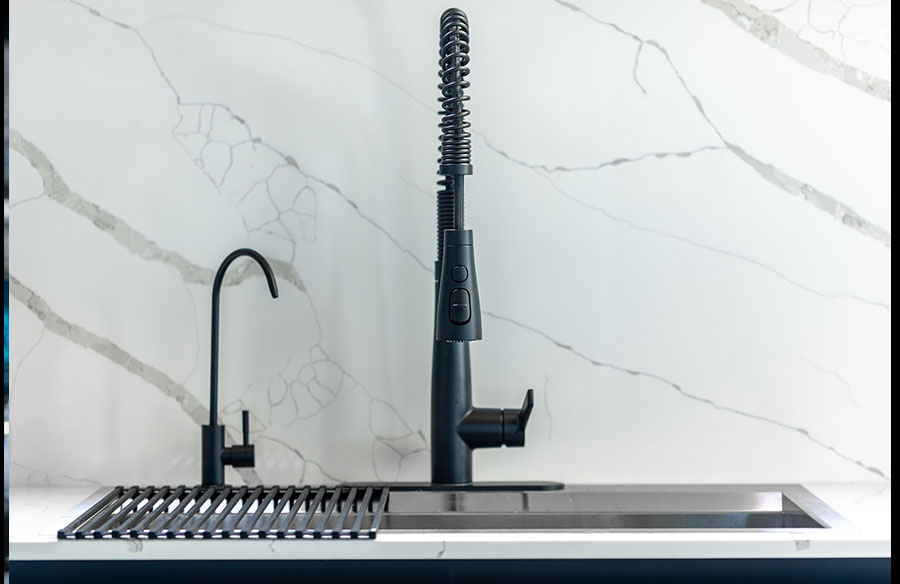
Quick Answer: How Does VIGO Compare to Other Faucet Brands?
VIGO sits in the mid-price design-forward tier of the kitchen faucet market. Compared to legacy American brands like Moen, Delta, and Kohler, VIGO offers more daring, architectural designs (think hexagonal bodies, commercial spring spouts, and matte brushed gold finishes) at a competitive $180–$320 price point. The trade-off: VIGO’s lifetime warranty covers only the finish, with shorter coverage on cartridges (5 years) and spray parts (1 year), versus Moen, Delta, and Kohler, which all offer full limited lifetime warranties on function and finish. VIGO’s closest direct competitor is Kraus — both are New York-based importers with similar pricing and design ethos.
What’s in This Guide
- Who Is VIGO? Brand Background and Key Specs
- VIGO Kitchen Faucets at a Glance
- VIGO vs Moen: Reliability vs Design
- VIGO vs Delta: Tech vs Style
- VIGO vs Kohler: Luxury Showdown
- VIGO vs Kraus: The Closest Rivalry
- VIGO vs Grohe: Affordable American vs German Engineering
- Three Standout VIGO Kitchen Faucets
- Warranty Comparison Across All Six Brands
- Pros and Cons of Choosing VIGO
- Who Should Buy a VIGO Kitchen Faucet?
- Frequently Asked Questions
- Final Verdict
Who Is VIGO? Brand Background and Key Specs
If you’ve shopped for a kitchen faucet on Home Depot, Lowe’s, Wayfair, or Amazon in the last decade, you’ve almost certainly scrolled past a VIGO. The brand has grown from a niche New York importer into one of the most-visible design-driven faucet companies in the United States — but it’s still not a household name on par with Moen or Delta. So who actually makes a VIGO faucet, and what should you expect from one?
VIGO Industries was founded in 2009 in New Jersey (now headquartered in New York City) by Lenny Valdberg and Felix Machhlis. The company designs and engineers its products in the U.S. but manufactures them in China — a standard model among mid-tier brands that lets VIGO hit a lower price point without compromising on industrial design. The brand’s signature is Manhattan-inspired aesthetics paired with finishes that pop: matte brushed gold, matte black, graphite, and stainless steel.
On the spec sheet, most VIGO kitchen faucets share the same core hardware: solid brass bodies, ceramic disc cartridges, 1.8 GPM flow rates (CalGreen certified), 360-degree swivel spouts, a proprietary seven-layer FinishPlated coating that resists fingerprints and water spots, and a low-lead, cUPC-certified plumbing path. Installation is single-hole by default, with optional deck plates for retrofitting three-hole sinks.
That technical baseline is competitive with anything from Moen, Delta, or Kohler in the same price bracket. Where VIGO diverges is in the warranty structure and design vocabulary — and that’s where the real comparison begins.
VIGO Kitchen Faucets at a Glance
Before getting into head-to-head comparisons, here are the numbers most buyers care about, drawn from VIGO’s own published specs and current 2026 retail pricing.
| Feature | VIGO Specification |
|---|---|
| Headquarters | New York City, USA |
| Manufacturing | China |
| Year Founded | 2009 |
| Price Range (kitchen) | Approx. $180 – $320 |
| Body Material | Solid brass |
| Cartridge | Ceramic disc |
| Flow Rate | 1.8 GPM (CalGreen certified) |
| Finish Options | Stainless Steel, Chrome, Matte Black, Matte Brushed Gold, Graphite Black, Antique Rubbed Bronze, Matte White |
| Finish Technology | FinishPlated 7-layer coating (fingerprint-resistant) |
| Certifications | cUPC, ADA, CalGreen, Low Lead |
| Finish Warranty | Limited lifetime (original owner) |
| Cartridge Warranty | 5 years |
| Sprayer/Hose Warranty | 1 year |
| Commercial Warranty | 1 year |
VIGO vs Moen: Reliability vs Design
Moen is the default recommendation from most American plumbers and contractors, and for good reason — it’s been making faucets in North America since 1937, parts are stocked at virtually every hardware store, and its lifetime warranty covers both function and finish. So how does VIGO stack up?
Price
Moen entry-level pull-down faucets start around $159 at Home Depot, with mid-tier MotionSense and smart faucets running $300–$600. VIGO’s entire kitchen lineup tends to sit in the $180–$320 band — meaning VIGO is slightly more expensive at the bottom but considerably cheaper than Moen’s premium smart faucets.
Warranty and Parts Availability
This is Moen’s clearest advantage. Moen’s lifetime limited warranty covers the entire faucet (function and finish), and replacement cartridges are available at any plumbing supply house, big-box store, or even via free shipment from Moen’s customer service line. VIGO’s lifetime warranty covers only the finish; cartridges get 5 years and sprayer assemblies just 1 year. If a part fails in year 7, a Moen owner can swap it for free in a weekend; a VIGO owner may need to buy the part.
Design
Moen plays it safe. Its kitchen faucets lean traditional or transitional, with a handful of contemporary options. VIGO’s catalog, by contrast, is full of statement pieces — hexagonal bodies, commercial spring spouts, ultra-tall industrial designs. If your kitchen renovation is built around the faucet as a focal point, VIGO offers more eye-catching options at this price.
Technology
Moen leads on smart features: MotionSense Wave, voice control via Alexa and Google Assistant, the Smart Water Network for leak detection, and app-based monitoring. VIGO offers touchless versions of its Edison and Greenwich models but does not currently compete on voice or app integration.
Bottom line: Choose Moen for set-and-forget reliability and the easiest long-term repair path. Choose VIGO if design distinction matters more than parts availability and you don’t need smart-home integration.
VIGO vs Delta: Tech vs Style
Delta Faucet Company has been around since 1954 and is widely considered the most technology-forward of the legacy American brands. Touch2O activation, DIAMOND Seal valve technology, ShieldSpray cleaning, and VoiceIQ smart-home integration are all Delta hallmarks.
Price Spread
Delta has the widest price spread of any major brand. The Foundations single-handle pulldown runs about $59 at Home Depot; a top-tier Touch2O Trinsic pull-down can exceed $700. VIGO’s range is narrower and concentrated in the $180–$320 mid-band, so Delta wins on budget options and high-end smart faucets, while VIGO is competitive in the middle.
Build Quality
Both brands use ceramic disc cartridges and brass bodies in their mid-range and up. Delta’s lower-tier faucets sometimes incorporate plastic components, while VIGO maintains solid brass construction across its entire kitchen lineup — a genuine VIGO advantage if you’re comparing similarly-priced models.
Finish Options
Delta has more finish variety overall (including its unique chili-pepper-red and multiple bronze tones), but VIGO has stronger contemporary finishes — its matte brushed gold and graphite black are widely cited as best-in-class for the price.
Bottom line: Pick Delta if you want a touch-activated faucet, the broadest budget range, or a specific finish Delta is known for. Pick VIGO if you want all-brass construction in the $200–$300 range with bolder modern styling.
VIGO vs Kohler: Luxury Showdown
Kohler is the prestige play. Founded in 1873, Kohler positions itself as the high-design American brand, with kitchen faucets that are typically all-metal (no plastic parts), backed by a lifetime warranty, and engineered for genuine longevity.
Price
Kohler’s kitchen faucets generally start around $170 (Avi single-handle pulldown) and run well past $1,200 for high-end smart models in the Konnect line. VIGO is more affordable across the board, with no faucet exceeding roughly $320.
Materials and Build
Kohler is famous for full-metal construction — reviewers consistently cite this as a key durability advantage over Moen and Delta. VIGO also uses solid brass bodies, but uses some plastic components in its spray heads and internal mechanisms. For absolute build quality at the high end, Kohler wins; at the $200–$300 sweet spot, the two brands are closer than the price gap suggests.
Smart Features and Style
Kohler Konnect offers voice and app control across faucets, showers, and even tubs. VIGO offers touchless sensors but no smart-home ecosystem. On pure style, the two brands actually overlap: both produce gooseneck and architectural designs in coordinated finish families, though Kohler leans traditional-luxury while VIGO leans contemporary-industrial.
Bottom line: Kohler is the choice for a forever-home kitchen with luxury finishes and smart integration. VIGO delivers 80% of the design impact at roughly half the price.
VIGO vs Kraus: The Closest Rivalry
If you’ve shortlisted VIGO, you’ve almost certainly also shortlisted Kraus. The two brands are remarkably similar: both founded in the late 2000s by entrepreneurs who saw a gap for affordable design-forward kitchen fixtures, both headquartered in the New York area, both manufactured in China, both priced in the $150–$400 range, and both heavy on contemporary and industrial styling.
Where Kraus Edges Out
- Workstation sinks. Kraus’s integrated cutting-board sinks are widely considered category-leading.
- Wider selection. Kraus has a larger kitchen faucet catalog with more entry-level options under $200.
- Reputation. Kraus has slightly more positive coverage from plumbers and contractor forums.
Where VIGO Edges Out
- Bolder design language. VIGO’s Hart Hexad (hexagonal body) and Zurich (dual-spout commercial spring) are more visually distinctive than the Kraus equivalents.
- Finish coordination. VIGO’s FinishPlated process ensures matte brushed gold on a faucet matches matte brushed gold on a soap dispenser, deck plate, or sink strainer — useful for whole-kitchen design.
- Matte and graphite finishes. VIGO’s matte black and matte brushed gold finishes are widely praised for non-reflective sophistication.
Bottom line: Kraus and VIGO are close enough that the right pick comes down to which specific model speaks to your kitchen. If you’re building around a workstation sink, lean Kraus. If you want a sculptural focal-point faucet in a specialty finish, lean VIGO.
VIGO vs Grohe: Affordable American vs German Engineering
Grohe is the European luxury counterpart — a German engineering house known for SilkMove cartridges, StarLight finishes, and faucets that owners report repairing more than 15 years after purchase. Parts availability is exceptional even for older models.
Price
Grohe’s kitchen faucets generally start around $300 and rise quickly past $800 for the higher-end Atrio and LadyLux lines. VIGO is significantly cheaper across the board.
Longevity
Grohe’s parts-availability advantage is real and meaningful. A Grohe faucet bought in 2010 can typically still be repaired with off-the-shelf cartridges in 2026. VIGO does not formally guarantee replacement parts availability, and some user reports indicate that obscure VIGO models can become difficult to service after a few years.
Bottom line: Grohe is the choice for buyers who want a faucet they can repair indefinitely and don’t mind paying double. VIGO is the choice for buyers who want comparable design now at a more accessible price and are comfortable replacing rather than repairing if a serviceable part isn’t available.
Three Standout VIGO Kitchen Faucets
VIGO’s kitchen lineup includes more than 50 models. These three illustrate the brand’s design range — from architectural hexagonal forms to commercial-style spring spouts — and represent some of the strongest cases for choosing VIGO over a competitor.
1. VIGO Hart Hexad Pull-Down Kitchen Faucet (VG02034)
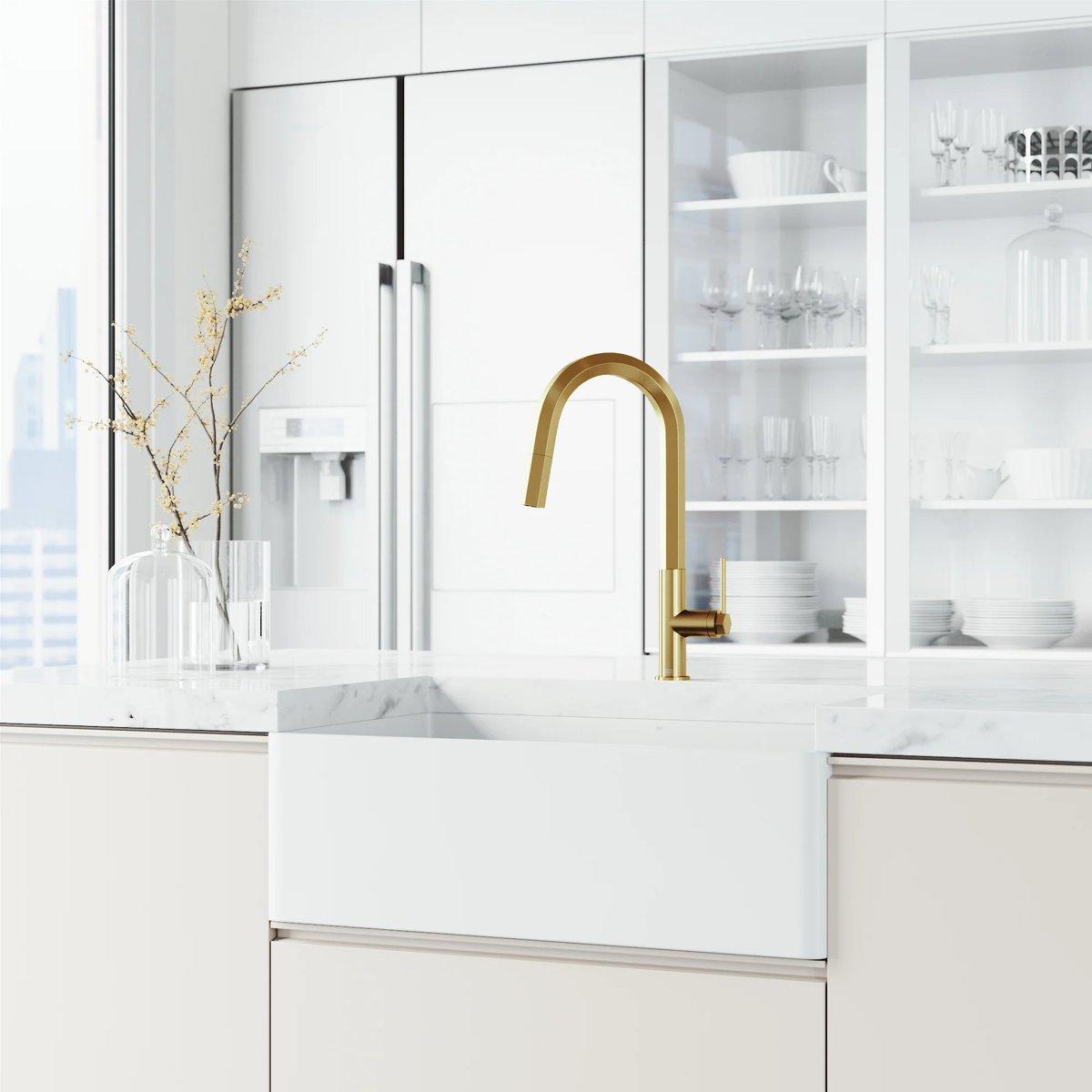 Why it stands out: The Hart Hexad’s hexagonal faucet body is a signature VIGO design move you simply can’t get from Moen, Delta, or Kohler at this price. The 18-inch height clears large stockpots, the single-action sprayer delivers a powerful stream for heavy cleanup, and the matte brushed gold FinishPlated coating resists fingerprints in a way most gold finishes don’t.
Typical retail: ~$190–$265 depending on finish. Best for: Modern and industrial kitchens where the faucet doubles as a sculptural focal point.
2. VIGO Utopia Pull-Down Kitchen Faucet (VG02038)
 Why it stands out: The Utopia’s angular high-arc spout and knurled textured grip on the spray head and handle give it a tactile, almost mechanical feel that’s rare under $200. The 30-inch retractable hose has plenty of reach for double-bowl sinks, and the DuoPower Stream lets you toggle between aerated flow and a focused spray.
Typical retail: ~$180–$210. Best for: Modern minimalist kitchens, smaller sinks, or bar/prep stations where height clearance matters less.
3. VIGO Zurich Pull-Down Kitchen Faucet (VG02007)
 Why it stands out: The Zurich is VIGO’s interpretation of a restaurant-grade pre-rinse faucet. It’s the only one of these three with two distinct spouts — a high-pressure spring-mounted sprayer for rinsing and a separate aerated pot filler — giving it genuine professional functionality. At 27 inches tall, it makes a statement under any cabinet height that can accommodate it.
Typical retail: ~$235–$315 depending on finish. Best for: Home cooks who want a true commercial-style faucet without paying commercial-faucet prices, or designers building a chef-kitchen aesthetic.
Warranty Comparison Across All Six Brands
Warranty is the single biggest practical difference between VIGO and the legacy brands. Here’s how the coverage stacks up on residential kitchen faucets.
| Brand | Finish | Function / Cartridge | Sprayer Parts | Parts Availability |
|---|---|---|---|---|
| VIGO | Lifetime (original owner) | 5 years (cartridge) | 1 year | Limited, model-dependent |
| Moen | Lifetime | Lifetime | Lifetime | Excellent — at any plumbing supply |
| Delta | Lifetime | Lifetime | Lifetime | Excellent |
| Kohler | Lifetime | Lifetime | Lifetime | Excellent |
| Kraus | Lifetime | Lifetime (many models) | Limited | Good |
| Grohe | Lifetime | Lifetime | Lifetime | Excellent — even 15+ years out |
Pros and Cons of Choosing VIGO
VIGO Pros
- Strong design vocabulary: Hexagonal, angular, and commercial-style options unusual at this price.
- Solid brass construction: Throughout the kitchen line, not just the premium tier.
- Coordinated finish program: FinishPlated guarantees a consistent match across VIGO faucets, sinks, soap dispensers, and accessories.
- Wide finish range: Including specialty matte brushed gold and graphite black not always offered by competitors.
- Eco-friendly: 1.8 GPM flow rate is CalGreen certified — meets the strictest US water-efficiency standards.
- Competitive mid-range pricing: Most pull-downs land between $180 and $320.
VIGO Cons
- Limited mechanical warranty: 5 years on the cartridge, 1 year on the sprayer — much shorter than Moen/Delta/Kohler lifetime coverage.
- Parts availability is uneven: Less ubiquitous than Moen or Delta at hardware stores.
- No smart-home ecosystem: Touchless sensors exist on select models, but no voice or app integration.
- Manufactured in China: Not a deal-breaker but a contrast point against Kohler, which still manufactures key lines in the US.
- Smaller dealer network: Mostly sold via Home Depot, Lowe’s, Wayfair, Amazon, and the VIGO direct site.
Who Should Buy a VIGO Kitchen Faucet?
VIGO is the right call for a fairly specific buyer profile. You’re a strong candidate if any of the following sound like you.
- You’re renovating a modern or transitional kitchen and want the faucet to be a design feature rather than fade into the background.
- You want matte brushed gold, graphite, or matte black in a finish that actually resists fingerprints.
- Your budget for the faucet is $200–$320 and you’d rather spend it on design and brass construction than on a brand premium.
- You’re outfitting a complete VIGO kitchen suite (faucet, sink, soap dispenser, accessories) and want guaranteed finish-matching.
- You’re comfortable replacing rather than repairing a faucet if it eventually fails outside the limited warranty window.
If, on the other hand, you want a buy-it-once faucet with the easiest possible 20-year repair path, Moen, Delta, or Kohler are the safer bets.
Frequently Asked Questions
Are VIGO faucets good quality?
Yes — within their tier. VIGO uses solid brass bodies, ceramic disc cartridges, and a 7-layer FinishPlated coating across its kitchen lineup, and the brand is cUPC, ADA, and CalGreen certified. The main caveat is the warranty structure: lifetime on the finish, 5 years on the cartridge, and 1 year on sprayer parts. That’s a meaningful step down from Moen, Delta, and Kohler, which offer lifetime coverage on essentially every component.
Where are VIGO faucets made?
VIGO Industries is headquartered in New York City and handles design, engineering, and customer support in the United States. The faucets themselves are manufactured in China, which is a standard practice for mid-tier brands and is how VIGO maintains its competitive price point.
Is VIGO better than Moen?
Not in raw reliability or parts availability — Moen is the clear winner there, with a true lifetime warranty across all components and parts stocked in nearly every plumbing supply. VIGO competes on design, finish range, and price for its top-tier models. A homeowner prioritizing 20-year reliability should choose Moen; a homeowner prioritizing a specific contemporary look should consider VIGO.
Is VIGO the same as Kraus?
No, but they are direct competitors with very similar business models. Both are New York-area design-focused importers founded in the late 2000s, both manufactured in China, both priced in the same mid-range band, and both heavy on contemporary styling. Kraus tends to lead on workstation sinks and entry-level options under $200; VIGO leads on bold sculptural designs and specialty finishes like matte brushed gold.
What is VIGO’s warranty?
VIGO’s residential kitchen faucet warranty covers the finish for the lifetime of the original owner, the ceramic disc cartridge for 5 years, and the sprayer head, hose, and mechanical parts for 1 year. Commercial installations have a 1-year overall warranty period. The warranty is non-transferable, so it does not pass to a future owner of the home.
How much does a VIGO kitchen faucet cost?
VIGO kitchen faucets typically retail between $180 and $320 in 2026. Specific models include the Utopia (VG02038) at roughly $180–$210, the Hart Hexad (VG02034) at $190–$265, and the Zurich (VG02007) at $235–$315 depending on finish. Touchless and pro-style versions can run slightly higher.
Are VIGO faucets ADA compliant?
Yes. VIGO kitchen faucets comply with ADA standards for single-lever operation, and the brand is cUPC and CalGreen certified across its kitchen lineup.
Do VIGO faucets come with a deck plate?
Most VIGO kitchen faucets are designed for single-hole installation. A matching deck plate (escutcheon) for three-hole sinks is sold separately for most models. Always check the ‘What’s in the Box’ section before purchase.
Final Verdict: When VIGO Is the Right Call
VIGO kitchen faucets occupy a clear and defensible space in the 2026 market: design-forward, solidly built, sensibly priced, and visually distinct from anything Moen, Delta, or Kohler offer at the same price point. The brand’s hexagonal Hart, commercial-style Zurich, and angular Utopia models genuinely deliver a different aesthetic experience for $200–$300 than what you’d get from a legacy American brand.
The caveat is warranty and parts. VIGO’s lifetime coverage applies only to the finish, with 5 years on the cartridge and 1 year on the sprayer. If a critical component fails in year 8, you’re likely buying a new faucet. Moen, Delta, Kohler, and Grohe all offer materially better long-term repair stories.
So the calculus is straightforward. If you want a kitchen faucet that’s going to be on the wall for 25 years and serviceable the whole time, look at Moen, Kohler, or Grohe. If you want a sculptural focal point in a current matte finish that performs well for the realistic 7–10 year lifespan most homeowners actually keep a faucet, VIGO is one of the strongest choices in its price band — and arguably the strongest if your design direction is contemporary, industrial, or modern minimalist.