
The best AEC firms do not choose a software partner by logo count or hourly rate. They choose by workflow fit, integration maturity, and delivery risk, because architecture and construction now run on connected data, BIM collaboration, and office-to-field visibility.
Key takeaways
- A strong software development partner in AEC connects design data, project coordination, field activity, and business systems. It does not just ship code.
- Not every AEC problem needs a full custom build. In many cases, integration, platform extension, or low-code tooling is the smarter move.
- The fastest way to choose the wrong partner is to judge by portfolio and rate alone. BIM workflows, ERP integration, RFIs, submittals, and field operations matter more.
- Hourly rate is context, not truth. Clutch lists average software development company rates at $25 to $49 per hour, but the actual number depends on region, expertise, and engagement model.
- Security due diligence is part of vendor selection now. ISO 27001 defines the baseline for information security management, and NIST says buyers should evaluate supplier security practices as part of software supply chain risk.
What does a software development company actually solve for architecture and construction firms in 2026?
A software development company in AEC solves a coordination problem before it solves a coding problem. That matters because current architecture and construction workflows already depend on shared project data, cloud collaboration, and connected systems across design, delivery, and operations.
Let me put that in plain English. Most firms are not struggling because they lack “more software.” They are struggling because their BIM data lives in one place, project communication lives in another, field updates sit somewhere else, and ERP or finance data follows its own logic. When those layers stay disconnected, teams lose time, miss context, and make slower decisions.
This is why a good AEC software partner looks more like a workflow integrator than a generic vendor. A useful adjacent example is the real estate software development company by Selleo, because it shows how operational workflows, integrations, and long-term platform evolution shape software decisions in the built environment. Autodesk says BIM Collaborate Pro supports multidisciplinary collaboration across Revit, Civil 3D, and Plant 3D in a centralized source of truth. That is the real benchmark. Your partner needs to understand how design data moves, how teams coordinate, and where handover breaks.
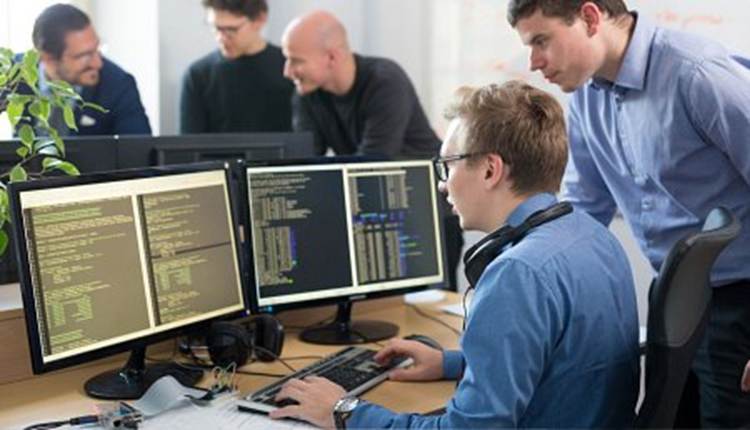 The client problem is simple. You do not need a team that only knows how to build dashboards, web portals, or mobile apps. You need a team that knows why those tools exist in the first place and how they fit the way architects, engineers, PMs, site teams, and finance people already work. That is where strong software engineering starts to feel useful instead of expensive.
When should AEC firms build, buy, integrate, extend, or outsource software development?
Not every AEC problem deserves full custom software development. Autodesk Platform Services already supports custom dashboards, digital twins, and enterprise integrations on open APIs, and Autodesk’s AEC Data Model API gives direct cloud access to granular design data without a desktop plugin layer.
Here is the practical rule. Build when the workflow is a true differentiator. Integrate when the value sits in data flow. Extend when the existing platform is strong but incomplete. Buy when the process is standard and speed matters more than uniqueness. Outsource when the internal team cannot absorb the work without slowing the business down.
This is where many buyers waste money. They commission a full build when the real issue is that project data does not move cleanly between systems. Trimble’s connected ERP and project management model is a good example of the opposite approach. It shows that in construction, integration can solve more than a fresh custom stack when the core pain sits between functions, not inside one screen.
Low-code also belongs in this conversation now. Microsoft’s 2026 Power Apps release plan focuses on larger and more complex enterprise apps, with better visibility and control for teams managing bigger solutions. That means some internal tools, approval flows, and admin-heavy workflows no longer need a full traditional build.
How do leading architecture and construction firms shortlist the right software development partner for complex projects?
The right software development partner proves workflow fit under real project constraints. In AEC, that means BIM fit, field fit, integration fit, and the ability to carry responsibility over time.
Here is the uncomfortable part. A partner can have strong developers, solid branding, and a polished sales process and still fail in an AEC environment. That happens when the team does not understand design collaboration, RFI history, submittal flow, office-to-field dependencies, or the pressure that sits between operations and documentation.
- Define the workflow that hurts the business most.
- Test ecosystem compatibility before judging interface polish.
- Audit proof, not branding.
- Run a controlled pilot.
- Choose the engagement model only after technical fit is clear.
That shortlist process works because it forces the conversation back to business risk. You are not asking “Are they impressive?” You are asking “Can they reduce friction in the exact part of the workflow that is slowing us down?” That is a much better buying question.
What should architecture studios verify in BIM, Revit, Civil 3D, and design-collaboration workflows?
Architecture studios should verify model coordination, common data environment logic, and data interoperability before they talk about delivery speed. Autodesk’s BIM Collaborate Pro explicitly supports collaboration in Revit, Civil 3D, and Plant 3D, and Autodesk’s AEC data tooling is built around direct access to project data in the cloud.
 That leads to four useful checks. Does the partner understand model coordination. Can they explain the difference between plugin development and API-first integration. Can they work on project data, not only UI. Can they explain how they reduce ecosystem risk inside Autodesk-heavy environments. Those answers tell you far more than a general “we do BIM” claim.
What should contractors and design-build teams verify in RFIs, submittals, ERP, and field operations?
Contractors and design-build teams need vendors who can connect paperwork, approvals, field execution, and finance. Procore says its RFI tool records each RFI’s history and supports accountability and end-of-project reporting, while its submittal tools can generate a submittal log from the spec book.
That is why the questions here are operational, not abstract. Can the partner connect RFIs, submittals, and schedule impact. Can they link field data to ERP and reporting. Can they handle permissions, offline sync, and document flow without turning the whole project into manual admin work. That is what contractor-fit actually looks like.
How should firms compare engagement models, hidden costs, security, and delivery risk?
The best engagement model makes risk visible early. Clutch says the average cost to hire a software development company falls in the $25 to $49 per hour range, but that number does not tell you anything useful on its own unless you understand scope, team shape, and integration complexity.
Here is the clean way to think about it. Fixed price works for small, defined scopes. Time and materials works for changing requirements and integration-heavy work. A dedicated team works when the roadmap is continuous and the client wants stable delivery capacity over time. The commercial model only works when it matches the delivery reality.
The hidden costs in AEC software projects usually sit in the same places:
- BIM data complexity and version compatibility
- ERP and project management integration effort
- document migration and permission logic
- offline sync and field adoption
- post-launch support, monitoring, and change requests
Security belongs in the same decision, not in a separate conversation. ISO 27001 defines requirements for an information security management system. NIST says organizations should assess the security practices of developers and suppliers as part of supply chain risk. If a vendor speaks only about speed and never about controls, that is not a minor gap. It is a buying risk.
AI now belongs in the same due diligence layer. GitHub positions Copilot as a tool for code, commands, collaboration, and task execution across workflows. That changes the client question. It is no longer “Do you use AI?” It is “How do you review AI-assisted code, manage risk, and keep maintainability under control?”
What questions do architecture and construction leaders still ask before choosing a software development company?
These are the questions that come up when a buyer is close to a decision but still does not trust the shortlist. They are practical questions, not marketing questions. That is exactly why they matter.
FAQ
How is a software development company different from a generic IT service provider in AEC?
An AEC-focused partner understands workflow, not just delivery capacity. That includes BIM collaboration, field operations, document flow, integrations, and office-to-field visibility. A generic vendor can still build software, but that alone does not reduce coordination risk.
When is custom software development worth it for an architecture or construction firm?
It is worth it when the workflow creates real business differentiation. If the real need is better data access, platform extension, or process automation, APIs, integrations, or low-code solutions can deliver faster value. Autodesk and Microsoft both show that those layers are far more mature now than they were a few years ago.
What is the safest contract model for an AEC software project?
The safest model is the one that matches the shape of the work. Fixed price fits a narrow and defined scope. Time and materials fits evolving integration-heavy work. A dedicated team fits a long roadmap with clear product ownership on the client side.
How much should domain expertise matter when choosing a development partner?
It matters a lot when the project touches Revit, RFIs, submittals, ERP, scheduling, or design collaboration. Strong general engineering still matters, but in AEC the wrong domain assumptions create expensive rework faster than weak syntax ever will.
What should a relevant AEC case study prove?
It should prove a workflow improvement, not just a launch. That means the case should show what process was improved, what integration was built, what risk was reduced, and what measurable operational result followed.