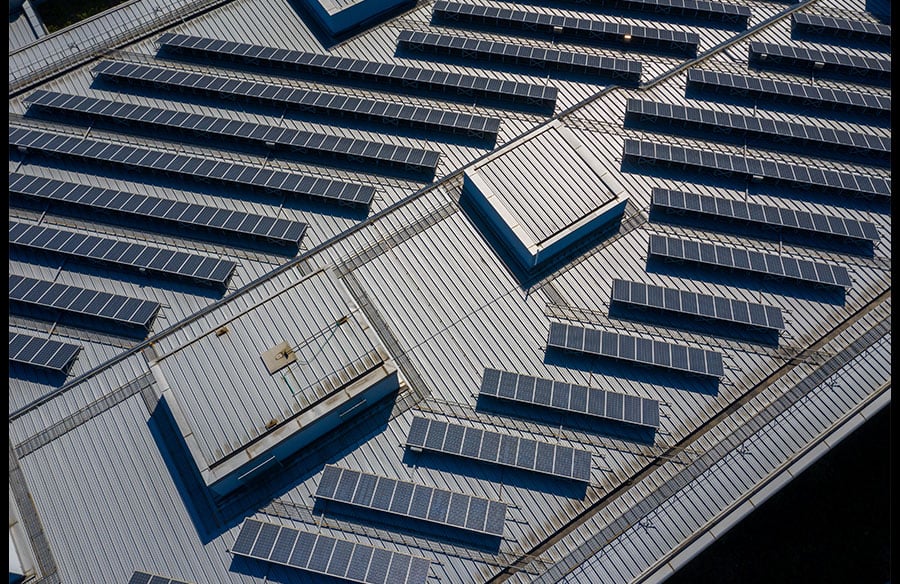
Large commercial buildings across France face a massive structural roadblock when trying to go green because their older metal roofs simply cannot support the 20 to 25 kg per square meter weight of standard solar arrays. The main solution is switching to lightweight solar panels which cut that load by up to 60 percent. This allows massive logistics and industrial facilities to install renewable energy and meet strict national mandates without spending millions on heavy structural reinforcements.
I think a lot of property owners assume they are completely stuck. They look at their massive warehouses built in the 1980s and realize the steel framework was designed to hold the roof and maybe a bit of snow. Nothing else.
Adding hundreds of heavy glass modules is totally out of the question.
But the technology has changed dramatically in recent years. We now have thin-film and monocrystalline hybrids that weigh a fraction of the old stuff. It makes you wonder why anyone with a commercial flat roof would even consider traditional heavy panels anymore.
Skipping expensive structural roof upgrades
Standard crystalline silicon panels are incredibly heavy. When you factor in the glass and the mounting racks and the ballast blocks required to keep them from blowing away you are looking at serious weight. Older metal decks from the 1970s through the 1990s usually have a load limit of around 15 kg per square meter.
So here is the tricky part. If you want to put standard panels up there you have to reinforce the entire building. I have seen quotes for structural retrofits running between 50 and 150 euros per square meter. That expense often kills the project before it even starts.
Lightweight options drop the weight down to roughly 10 or 12 kg per square meter.
According to a recent report by the Shift Project focusing on building decarbonisation this specific weight reduction is absolutely critical. French energy expert Jean-Marc Jancovici noted that lightweight solar is a necessity for older industrial roofs. It bypasses the need for those million-euro retrofits completely.
Using vast empty spaces efficiently
Drive through any major industrial zone in France and you will see acres of flat empty roofs. It is honestly a bit frustrating to look at all that wasted potential. Finding the best lightweight solar panels for flat roof commercial applications means property managers can finally put that dead space to work.
I remember visiting a massive logistics center near Lyon a few years ago. The facility manager was practically tearing his hair out because he had 10000 square meters of roof but couldn’t safely accomodate standard solar equipment. The building was just too old.
These large flat roofs in the logistics sector represent about 40 percent of the untapped solar potential in the country.
By choosing flexible or ballasted lightweight systems you turn a liability into a massive power plant. You do not have to penetrate the roof membrane either which is a huge relief for anyone worried about leaks. Just roll them out and secure them.
Faster installation means less downtime
Time is money. It is a cliché but in the logistics and warehousing sector it is the absolute truth. Every single day of operational disruption costs a fortune.
Fabrice Bonnifet who directs operations at a major logistics firm mentioned in an interview that warehouse downtime can easily cost upwards of 10000 euros a day. When you use traditional heavy panels you need heavy lifting cranes. You need to block off parking lots & loading docks for weeks.
Lightweight systems change the math entirely.
Because the modules are so light the installation crews can move them by hand. The setup process drops from five or six weeks down to maybe two or three. Less heavy machinery means fewer safety hazards and a much faster return to normal business operations.
Beating the strict French regulations
The regulatory pressure on commercial landlords right now is intense. The Loi APER has massively accelerated the push for renewable energy on large buildings. If you own a commercial property you already know the government is not messing around anymore.
Then there is the Décret tertiaire. This rule mandates that tertiary buildings over 1000 square meters must reduce their energy consumption by 40 percent by 2030. Upgrading these older roofs with solar is one of the only realistic ways to hit those targets.
The compliance headache
I feel a lot of empathy for facility managers trying to figure this out. They are caught between strict laws and the physical limits of their buildings. Lightweight solar Panels offer a legitimate escape route.
Data from the INSEE building database shows that 60 percent of French commercial roofs built before 2000 fail standard panel load tests. Lightweight systems let these older properties comply with the law without requiring a wrecking ball.
Getting the exact same energy yields
I used to be pretty skeptical about thin and flexible solar tech. A few years ago it seemed like you had to sacrifice a massive amount of efficiency just to save some weight. That is simply not true anymore.
Modern lightweight modules use high quality N-type TOPCon crystalline silicon cells. These are the exact same cells used in the big heavy glass panels. They deliver identical performance metrics.
We are talking about 18 to 22 percent efficiency.
A standard 1000 square meter commercial roof in France can generate up to 200 MWh annually with these systems. That is enough to offset over 100 tons of CO2 every single year and make a serious dent in your utility bills. You get the lightweight benefits without taking a hit on power output.
Surviving completely brutal weather conditions
France gets some seriously nasty weather. From heavy hail in the central regions to brutal Atlantic winds on the coast your roof takes a beating. Any solar system you install needs to survive that harsh enviroment for decades.
You might think a lighter panel would be fragile. Surprisingly they are incredibly tough. They undergo rigorous IEC 61215 testing.
They can withstand winds up to 160 km/h and hail impacts up to 25 mm in diameter.
Engineers at the French research organization CEA have run extensive durability studies on these exact setups. They found that lightweight panels actually outperform rigid glass panels in certain high wind scenarios because they sit flush against the roof surface. They have a standard lifespan of 25 to 30 years with very minimal annual degradation.
Backing the domestic green tech sector
There is a growing movement to keep renewable energy investments local. For a long time almost all Solar panels were imported. Now things are shifting rapidly.
France actually produces a significant chunk of the lightweight panels used in Europe. Facilities down in the Occitanie region are scaling up production massively. Choosing these locally made products cuts down on the carbon emissions tied to global shipping.
It also supports thousands of domestic jobs.
The Syndicat des Énergies Renouvelables recently highlighted how this local production boom is strengthening the French economy. When you buy domestic lightweight systems you are not just fixing your roof problem. You are actively supporting the local green technology sector and protecting your supply chain.
Final Thoughts
Making the leap to commercial solar doesn’t have to be a structural nightmare. I know the initial assessments can look incredibly bleak when an engineer tells you your roof is too weak for standard glass panels. It feels like a dead end.
But the emergence of high-efficiency lightweight modules has completely changed the game. You get the power you need. You meet the strict government mandates. You avoid ripping your building apart.
It just makes sense.
If you are managing an older logistics hub or industrial facility in France you really should look into these lighter options. They offer a highly practical and financially sound way to generate your own clean power without the massive headaches of traditional installations.