Melbourne apartments have a storage problem. It’s not because of design, it’s because the city has grown and land costs have forced developers to build in certain ways.
The average two-bedroom apartment in Melbourne CBD sits at around 70 m2. That’s enough room to live in, but not really enough room to live in and store everything you own.
For a while, people made it work. Things went under the bed, stacked in the wardrobe, onto the balcony until the balcony stopped being usable outdoor space. Most Melbourne apartment dwellers have lived this way at some point.
What’s different now is that this isn’t temporary for most people anymore. Melbourne added a lot of apartments over the past decade and apartments now make up 70% of housing in the city. More people are living in smaller spaces for years, not months. The storage problem that used to be a minor irritation is now something you deal with every day. Here’s why storage are becoming more popular in Melbourne, and why you would need a storage unit.
Why are more people using storage?
The storage industry in Australia has grown quickly since 2021. Self storage, in particular, is on track to hit an estimated revenue of around $2 billion by 2027, driven by high demand concentrated in Melbourne and Sydney.
Here are the main reasons why you’d need Melbourne storage:
- You’re downsizing from a multi-bedroom house to a small apartment, and you need a place for the furniture that doesn’t fit.
- Your second bedroom becomes a nursery, and so the office equipment, gym gear, and everything else that lived in that room has to move out.
- You’re a business owner needing space for business inventory, archived documents, or office supplies that don’t fit in their apartment.
- You’re in between leases and need a few weeks of breathing room while you wait for the new place to be ready.
- You’re a tradie living in an apartment with no shed for your tools.
None of these are unusual situations. They’re ordinary problems that Melbourne’s housing stock doesn’t handle well.
And here’s what people don’t realize until they’re facing it: the alternative to storage is usually worse. You can cram everything into the apartment and live in a space that feels claustrophobic. You can get rid of things you actually need and spend more replacing them later. Storage gives you time to figure out what you actually use versus what you’re keeping out of habit or guilt.
Storing during a move
Storage usually becomes urgent during a move.
People moving into a Melbourne apartment find out on moving day that the maths doesn’t work. The furniture they own was bought for a different kind of space. The number of boxes exceeds what the rooms can absorb.
That’s when things that should’ve been kept get thrown out under time pressure. Or everything gets crammed in anyway, and the place feels suffocating for months.
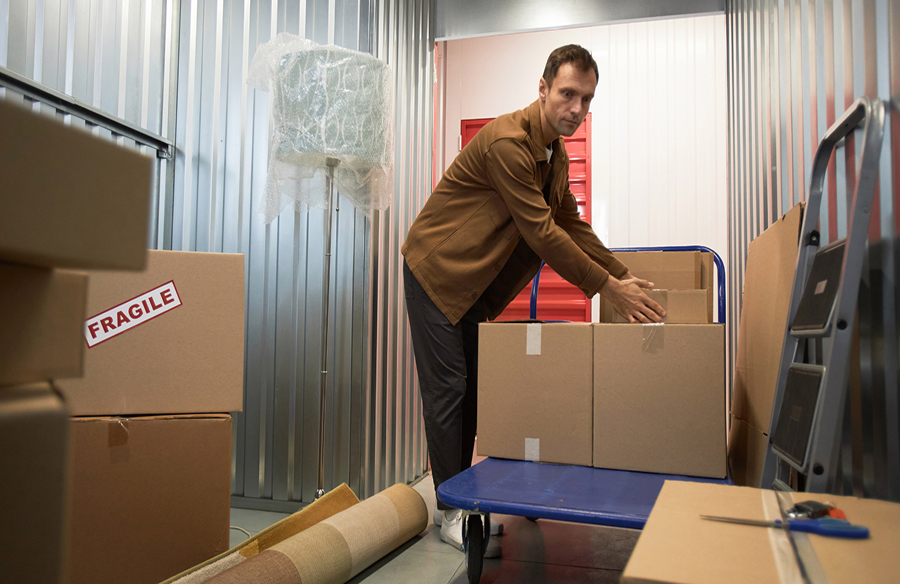
A storage unit booked before moving day changes this. It acts as a pressure valve — things that don’t fit, or that you’re not sure about yet, go there temporarily. You’re not making permanent decisions while standing in a hallway surrounded by boxes. Most of what ends up in storage gets sorted properly within a few months. Some of it comes back. Some of it gets sold or donated once you can think clearly about it, away from the chaos.
How much does storage cost
A 10 m2 storage unit in the inner Melbourne suburbs runs somewhere between $200 and $350 per month depending on the storage facility and whether climate control is included.
Most people compare that cost to alternatives. For some, that’s a larger apartment, and in Melbourne, the rent difference between a one-bedroom and a two-bedroom is typically $300 to $600 per month. A storage unit as a substitute for a second bedroom costs less.
For others the calculation is simpler: the stuff needs to go somewhere, and the options are a storage unit or getting rid of it. Not everything can or should be sold or donated. Some things need time before you know what to do with them.
Where storage is heading
Some newer apartment developments are adding storage floors or larger cages, but that’s mostly in high-end buildings. Storage space costs money to build and doesn’t justify higher rents the way an extra bedroom does.
More likely, external storage just becomes part of the cost of apartment living in Melbourne. Like gym memberships or parking, it’s another line item that covers the gap between what your apartment holds and what your life requires.
That gap isn’t closing. If you’re living in a Melbourne apartment long term, you’ll need to deal with it eventually. For most Melbourne residents, the question isn’t whether you’ll need storage, but when, and whether you’ll have a plan in place before that moment arrives.