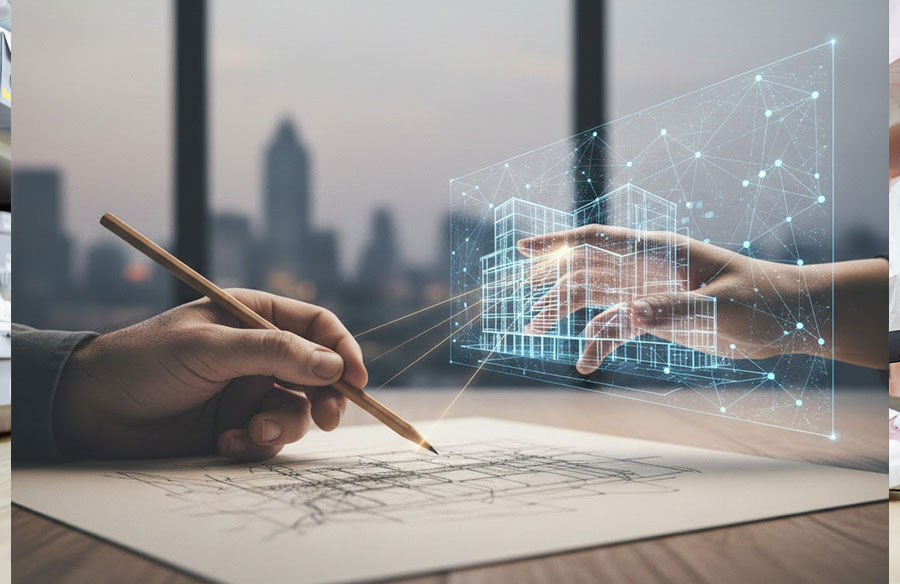
Architecture has always been a conversation between the hand and the mind. It starts from the first charcoal sketches on cave walls and ends on the precise digital lines of Computer-Aided Design (CAD). Every technological leap has fundamentally changed how we conceptualize and build space. Today, we are standing at the edge of the most significant shift since the Industrial Revolution: the rise of Artificial Intelligence.
AI is no longer a assisstant or a distant promise in the professional world. It has gained the position of a daily coworker in firms across the globe. We use it to calculate complex sun paths, generate thousands of floor plan iterations, and produce photorealistic renders in seconds.
However, as we move with this unprecedented speed, a vital question emerges: are we inadvertently outsourcing the thinking part of design? This blog explores the current landscape of AI in architecture and the subtle but profound risk of Automated Design Thinking. It’s a state where the machine’s statistical logic begins to replace human intuition and cultural empathy.
What AI in Architecture Looks Like Today
To understand the risks, we must first look at how deeply AI has woven itself into the fabric of the modern studio. AI in 2026 is a multi-layered ecosystem of tools that touch every phase of a project’s lifecycle, from the first napkin sketch to the final brick laid.
 Generative Design Tools
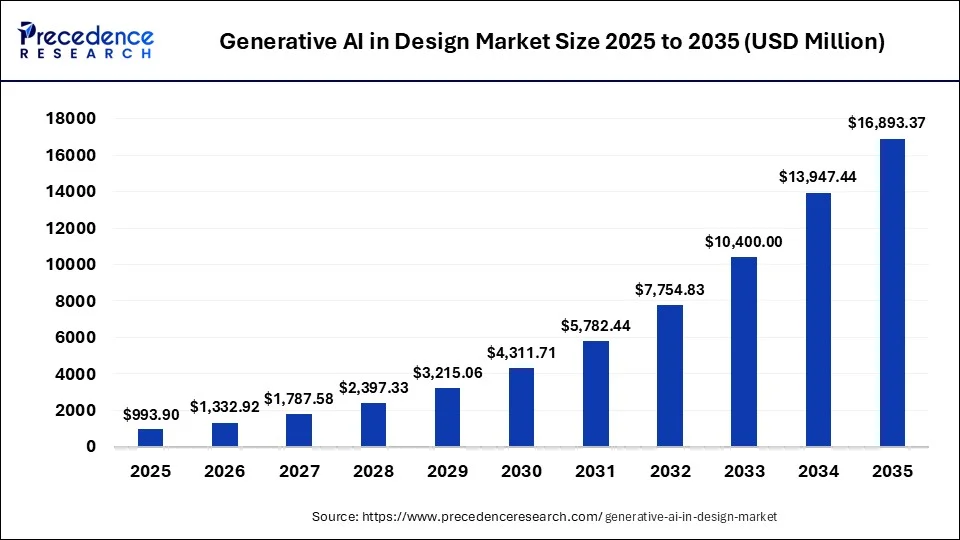
Generative design is perhaps the most visible face of AI in the studio. Rather than drawing a single wall, architects now input parameters; constraints such as site boundaries, height limits, solar orientation, and required square footage.
The AI then churns out hundreds of variations that satisfy these rules. As Joern Meissner, Founder & Chairman of Manhattan Review, explains, “Generative systems are powerful because they surface possibilities that human bandwidth alone cannot process. When algorithms expand the field of options, they expose patterns and efficiencies that would otherwise remain hidden.”
This perspective reflects a broader shift in how analytical thinking is being augmented by machine intelligence. In architecture, that capability allows firms to explore radical geometries while still maintaining structural and functional integrity.
AI-Powered BIM & Documentation
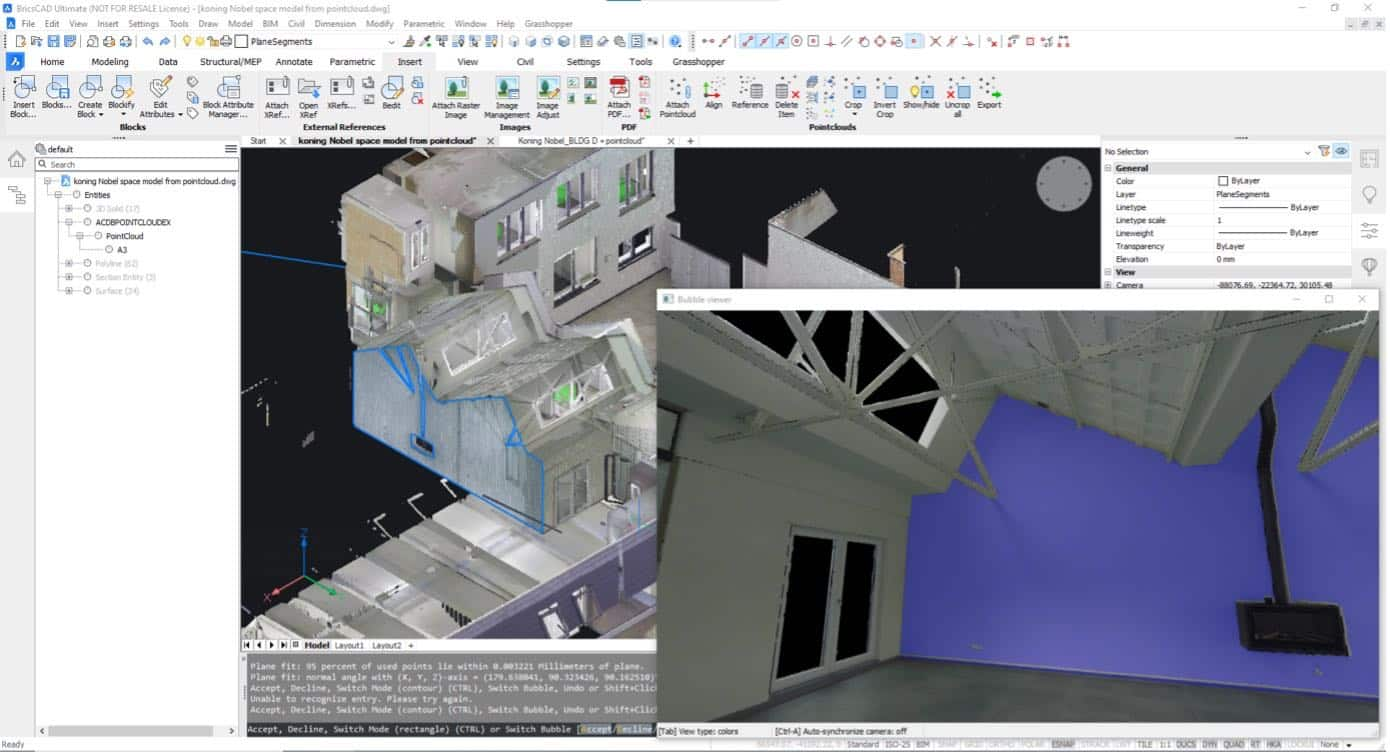
Building Information Modeling (BIM) has evolved into a dynamic decision-making system. Modern software uses machine learning for clash detection, identifying where a ventilation duct might intersect with a structural beam before the project ever leaves the digital realm.
Furthermore, AI automates the tedious aspects of documentation, such as tagging thousands of doors or generating window schedules. By handling these repetitive tasks, AI is often seen as a way to liberate the architect, though it simultaneously distances them from the granular details of the building’s guts.
 Rendering & Visualization
The days of waiting 12 or 24 hours for a single high-quality render are effectively over. Tools like Veras or LookX allow architects to transform a simple 3D massing model into a lush, atmospheric scene almost instantly. This enables rapid vibe checks during the early stages of a project, allowing clients to feel the space before a single column is finalized.
Predictive Analytics & Smart Buildings
Once a building is operational, AI continues its work. Through the Internet of Things (IoT), sensors collect data on occupancy patterns, energy usage, and thermal comfort. AI then predicts when mechanical systems might fail or how to adjust lighting to maximize both well-being and cost-savings. This “Digital Twin” approach ensures that the building remains a living, breathing entity that learns from its inhabitants.
Benefits of AI Integration in Architecture
The rush to integrate these tools is driven by practical, bottom-line advantages that are reshaping the economics of the profession.
Speed and Efficiency
The most immediate win is the compression of time. Tasks that once required a week of manual drafting, such as testing twenty different apartment layouts on a jagged urban site, can now be performed in minutes. This efficiency allows small firms to punch far above their weight class, competing for massive infrastructure projects that were previously the sole domain of “Starchitectural” giants.
Data-Driven Optimization
AI is peerless when it comes to optimization. It can refine a building’s facade to catch the maximum amount of winter sun while rejecting harsh summer heat, drastically reducing carbon footprints. In the context of the global climate crisis, this ability to build high-performance structures is not just a benefit but a necessity. The AI acts as a filter, ensuring that every design move is backed by cold, hard data.
Cost Reduction
By catching errors in the digital phase and optimizing material usage, AI saves astronomical sums during construction. For example, AI can calculate the exact number of custom-cut timber panels needed for a complex roof, minimizing waste and streamlining the supply chain. This value engineering ensures that ambitious designs remain financially viable for developers.
Expanded Creative Exploration
Paradoxically, the machine can also be a catalyst for creativity. Because it is so easy to generate “what if” scenarios, architects can venture into experimental forms, curvilinear, biomimetic, or parametric, without the fear of manual rework. It pushes the boundaries of what is possible, often suggesting structural solutions that a human mind, bound by traditional training, might have dismissed as impossible.
What is Automated Design Thinking?
Despite these benefits, we must confront the concept of Automated Design Thinking. This phenomenon occurs when the architect stops being the primary driver of the design logic and starts becoming a mere curator of machine-generated options.
Design thinking, in its traditional sense, is a messy, human process of empathy, cultural reflection, and trial and error. It involves understanding the soul of a site; the way the wind feels on a specific corner or the historical weight of a local neighborhood.
Automation threatens to replace this nuanced process with a “black box” logic. When an architect chooses Option A over Option B simply because the AI score for efficiency was higher, they are no longer practicing architecture; they are practicing data management.
Risks of Over-Reliance on AI in Design
If we lean too heavily on the auto button, the architectural profession faces several systemic risks that could permanently alter the quality of our built environment.
Homogenization of Architecture
If every architect uses the same generative tools trained on the same global datasets, buildings will inevitably start to look the same. We risk a global uniformity. This is the architectural equivalent of an AI-generated social media feed, where buildings are visually trendy but lack local identity, vernacular wisdom, or a sense of place.
Erosion of Critical Thinking Skills
The process of drawing a staircase or a bathroom layout by hand is a lesson in scale and ergonomics. It builds a mental library of space. If a junior architect always delegates these tasks to an algorithm, they never develop the gut feeling necessary to spot when something is fundamentally wrong.
Raphael Yu, CMO at ChinaSource, describes the risk as an “illusion of knowledge.” He explains, “The moment a designer cannot justify a decision except by pointing to an algorithm, we have stepped away from deliberate design and into passive acceptance.”
Bias in Algorithmic Outputs
AI is only as good as its training data. If that data is skewed toward Western urban centers, the AI will naturally suggest Silicon Valley solutions for a project in rural Sub-Saharan Africa. This digital colonialism can lead to buildings that are structurally sound but culturally deaf.
Ethical & Accountability Concerns
The question of “who signed the drawing” becomes complicated. If an AI-optimized balcony fails five years after construction, does the blame lie with the architect, the software developer, or the data used to train the model? The lack of transparency in how algorithms arrive at certain optimized conclusions creates a massive liability gap.
Over-Optimization at the Cost of Human Experience
A building can be 100% energy efficient and still be a miserable place to live. AI excels at optimizing for metrics it can measure: watts, square feet, and dollars. It struggles to measure serendipity or safety. An over-optimized school might have perfect thermal performance but feel like a sterile prison because the AI didn’t value the inefficient corners where children like to hide and read.
The Human Element in Architectural Practice
This is where the human architect becomes truly irreplaceable. There are facets of design that cannot be reduced to 1s and 0s.
A. Intuition and Experience
An experienced architect can walk onto a site and feel its potential. They might notice a specific tree that needs to be framed by a window or understand that the local community needs a public plaza more than they need an extra floor of office space. This is wisdom, not just data.
B. Narrative and Meaning
Buildings are the vessels for our collective stories. They represent the history of a city and the aspirations of its people. AI can mimic the “look” of a Gothic cathedral or a Modernist villa, but it cannot understand the meaning of those styles.
A machine can calculate the perfect angle for a window, but it can’t understand the quiet joy of watching a child play in the light that window provides.
C. Collaboration and Empathy
Architecture is, at its heart, a service. It involves sitting in a room with a client, listening to their fears, and navigating their conflicting desires. AI cannot hold a client’s hand through the stress of a budget overrun or empathize with a family building their first home. The soft skills of the architect are becoming more valuable, not less.
Striking the Balance: Human + AI Collaboration
The path forward is not to reject AI, but to treat it as a “Co-Pilot” rather than the “Pilot.” We must develop a new framework for collaboration.
Architects should use AI to handle the grunt work. This refers to the heavy lifting of data analysis and repetitive drafting, while retaining absolute control over the conceptual core.
3 Strategic Ways to Partner with AI:
- The “Rule of Three”: Never accept the first three iterations an AI produces. Force the machine to work through a hundred variations, then use your human intuition to pick the one that feels right.
- Analog Foundations: Start every project with hand sketches and physical models. This grounds the project in a human scale before the digital tools take over.
- Critical Auditing: Treat every AI suggestion as a hypothesis that must be proven. If the AI suggests a radical structural form, the architect must manually verify its impact on the user experience.
Education & Skill Adaptation
Architecture schools must shift their focus. Students no longer need to spend years learning how to draw a perfect line; they need to learn how to write “prompts” that are grounded in architectural theory. They need to become “algorithmic critics” who can spot bias and errors in machine output.
Ethical Frameworks for AI Use
Firms must establish clear internal policies. Kos Chekanov, CEO of Artkai, shares that “Human-in-the-loop is not just a safety measure, it is a professional mandate. No AI-generated design should reach a client without a written justification of its human value.” This ensures that the architect remains legally and morally responsible for the work.
The Future of Architectural Creativity
The future of architecture in 2026 is one of Augmented Creativity. When used correctly, AI allows us to solve the most pressing problems of our time, housing shortages and climate change while freeing us to be more poetic in our designs.
Examples of Balanced Collaboration:
- The Shanghai Tower: This iconic skyscraper used AI for intense wind-load analysis to reduce the amount of steel needed by 25%. However, the specific “twist” and the integration of sky gardens were human-driven responses to create a vertical community.
- The Beijing Daxing Airport: Zaha Hadid Architects used parametric AI tools to optimize passenger flow and ensure that no gate was more than an eight-minute walk from the center. Yet, the fluid, “starfish” form of the building is a clear expression of human artistic intent.
As Adrian Iorga, Founder & President of Stairhopper Movers, puts it, “The future belongs to architects who understand technology but never lose their human touch.” The next era of architecture will not be defined by smarter software, but by designers who know when to override it.
Conclusion
We are at a crossroads. AI offers us the power of a thousand draftsmen and a hundred engineers, but it lacks a single ounce of human soul. The risk of Automated Design Thinking is that we might stop being architects and start being consumers of our own software.
By keeping our critical thinking sharp, our empathy at the center of our process, and our hands on the steering wheel, we can ensure that AI remains the greatest tool we have ever invented, not the one that replaces us. The goal is a world that is not just optimized for performance, but designed for life.