Turning 40 isn’t the beginning of physical decline — it’s the moment your body starts asking for better design.
You may notice it in subtle ways: knees that feel slightly stiff on rainy mornings, a lower back that protests after long drives, or recovery times that seem to stretch a little longer than they used to. These aren’t signs that your body is failing you. They are simply feedback signals indicating that your fitness strategy needs to evolve.
In our 20s and 30s, fitness often meant “more” — heavier weights, faster sprints, harder classes. We trained for ego and peak performance. After 40, the paradigm shifts. We are no longer just training for the mirror; we are training for longevity, mobility, and a pain-free existence.
This brings us to the concept of Sustainable Fitness: the art of choosing movements that strengthen the chassis without wearing down the parts. It’s about working smarter to ensure you maintain your independence and vitality well into your 70s and 80s.
Below, we’ve curated seven “high-return, low-risk” exercises. These movements are designed to keep you strong and active, focusing on joint preservation and functional power.
Zero-Impact Cardio: The Elliptical Advantage
Cardiovascular health is non-negotiable, but how we achieve it matters. Running is fantastic, but it comes with a high biomechanical cost. Each time your foot strikes the pavement, forces equivalent to three to four times your body weight travel up through your ankles, shins, and knees. Over decades, that impact accumulates.
For the over-40 demographic, shifting toward zero-impact cardio is often the smartest “preventative maintenance” move you can make. This is why physiotherapists and longevity experts frequently recommend integrating an elliptical machine into your weekly routine.
Unlike a treadmill, an elliptical allows you to mimic the natural biomechanics of running—engaging the glutes, quads, and hamstrings—while your feet remain in constant contact with the pedals. This “closed chain” movement eliminates the jarring impact, effectively floating your joints while your heart rate climbs.
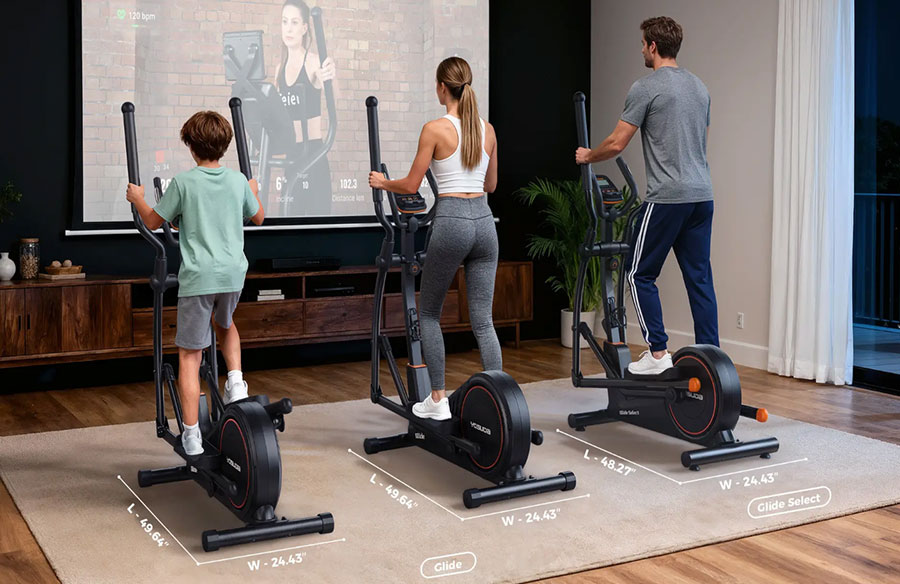
Optimizing for the Home Environment As career and family demands peak in our 40s, the friction of going to the gym often leads to skipped workouts. The solution is bringing the gym to you. However, not all equipment is created equal.
For a seamless home workout experience that balances performance with interior design, the Elliptical Machine is a standout choice.
Standard home ellipticals often suffer from short, choppy strides that feel unnatural and can actually increase knee shear. The EM1 solves this engineering challenge with a generous 20-inch stride length, mimicking a natural, fluid running motion suitable for users of various heights.
Furthermore, its magnetic resistance system and precision bearings ensure whisper-quiet operation. This might seem like a minor detail, but for a parent trying to squeeze in a workout at 6 AM without waking the house, it is the difference between training and skipping. By removing the barriers of noise and joint pain, you ensure consistency, which is the only metric that truly matters.
The Plank: Your Shield Against Back Pain
If you ask people over 40 what their biggest physical complaint is, “lower back pain” usually tops the list. Often, this isn’t a back problem; it’s a core stability problem.
Core training at this stage of life isn’t about chiseling six-pack abs for the beach; it’s about building an internal brace for your spine. The plank is the gold standard for this because it is an isometric exercise—you are training your muscles to resist movement, which is the core’s primary function in daily life.
How to Do It Right:
- Get into a push-up position, but rest on your forearms instead of your hands.
- Keep your body in a straight line from head to heels.
- Squeeze your glutes and pull your belly button toward your spine.
- The Goal: Start with 20 seconds. Focus on tension, not time. A sloppy 2-minute plank does nothing but strain your back; a laser-focused 30-second plank works wonders.
Bodyweight Squats: The Ultimate Functional Move
Few exercises translate to daily independence as directly as the squat. Every time you sit in a chair, get out of a car, or use the restroom, you are squatting. Maintaining the strength to do this effortlessly is the key to aging with dignity.
However, heavy barbells can compress the spine. For the over-40 athlete, mastering the bodyweight squat (or light goblet squat) is often sufficient to maintain leg strength without the spinal risk.
The “Sit-Back” Technique: Many people squat by bending their knees first, which puts pressure on the patella. Instead, initiate the movement by pushing your hips back, as if you are reaching for a chair behind you.
- Keep your chest tall.
- Drive through your heels to stand up.
- Modification: If you have knee issues, start with “Box Squats.” Place a sturdy chair behind you. Squat down until you lightly tap the seat, then stand back up. This ensures safe depth and proper form.
Yoga: Mobility Meets Mindfulness
Have you noticed that you feel stiffer in the mornings? As we age, we naturally lose muscle elasticity and our connective tissues (fascia) can become dehydrated and glued down.
Yoga is not just stretching; it is strength through range of motion. It counters the “stiffening” process of aging. Styles like Hatha or Vinyasa help lubricate the joints and lengthen tight muscles, particularly in the hips and hamstrings, which are chronically tight from modern sedentary jobs.
The Hidden Benefit: Stress Reduction Beyond the physical, yoga addresses a major inflammation trigger: stress. High cortisol levels can increase pain sensitivity and inflammation. The breathwork (Pranayama) inherent in yoga acts as a reset button for the nervous system, shifting you from “fight or flight” to “rest and digest.”
Swimming: Resistance Without the Gravity
If the elliptical is the king of low-impact land exercises, swimming is the emperor of the water.
Water neutralizes gravity, effectively reducing your body weight by about 90%. For those dealing with early-stage arthritis, previous injuries, or carrying extra weight, swimming offers a sanctuary where they can move freely.
Why It Works: Water is roughly 800 times denser than air. Every movement you make—whether a stroke or a kick—is met with resistance. This means you are performing strength training and cardiovascular training simultaneously. It engages the entire posterior chain (back muscles) which helps correct the hunched posture many of us develop from sitting at computers.
Resistance Band Training: Supporting Bone Health
Sarcopenia (muscle loss) and Osteopenia (bone density loss) are real threats after 40. To combat them, you need resistance. However, hoisting heavy iron dumbbells isn’t the only way.
Resistance band training is increasingly favored by physical therapists for the 40+ crowd.
- Variable Resistance: Unlike a dumbbell, which is heaviest at the bottom of a curl, a band gets harder as you stretch it. This matches your muscle’s natural strength curve and is much gentler on the tendons and joints at the “start” of a movement where injuries often occur.
- Versatility: A simple set of bands can replicate almost any gym machine, allowing you to strengthen shoulders, back, and hips safely at home.
Brisk Walking: The Simplest Habit
Finally, never underestimate the power of a walk. While your elliptical machine sessions provide the high-intensity stimulus your heart needs, walking provides the low-intensity steady-state (LISS) movement that humans were evolved to do.
Walking is foundational. A brisk 20 to 30-minute walk, perhaps after dinner, aids significantly in digestion and blood sugar regulation—two metabolic factors that become harder to control as we age.
The Mental component: Walking outside also provides “optic flow”—the visual passing of the landscape—which has been shown to quiet the amygdala (the brain’s anxiety center). It is simple, free, and requires no equipment other than comfortable shoes.
Conclusion: Consistency is the New Intensity
If you take one thing away from this list, let it be this: The “best” exercise is the one you can do consistently without pain.
Fitness after 40 isn’t about impressing others with how much you can bench press. It’s about investing in your future self. It’s about having the energy to play with your kids (or grandkids), the strength to carry your own luggage, and the mobility to enjoy life without limitations.
Whether you are logging miles on your FED Fitness EM1 Elliptical Machine or holding a plank in your living room, remember that these small, daily deposits of effort compound over time. Start today, design your routine wisely, and your body will thank you for decades to come.