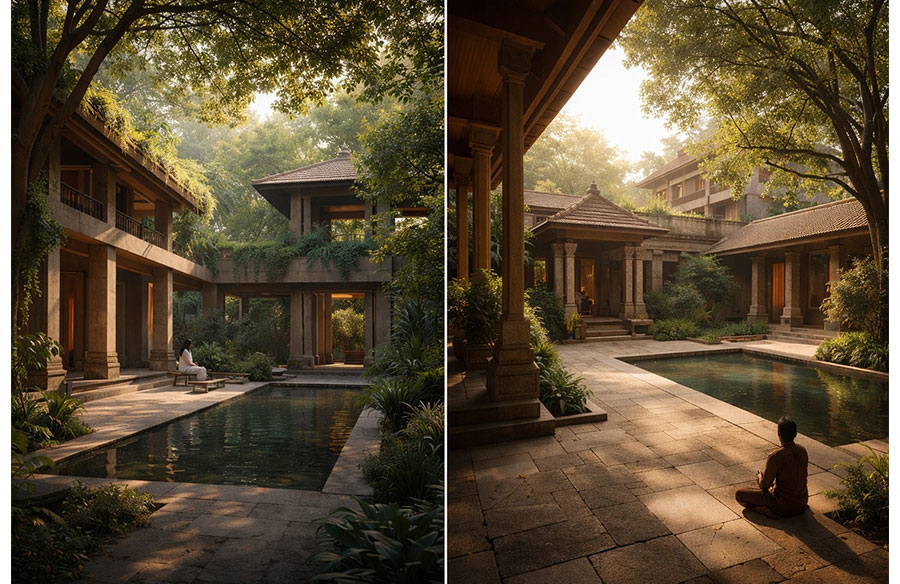
Why the Future of Urban Design Must Be Human-Centric, Not Sensor-Centric
Cities are getting smarter. Sensors monitor traffic, buildings adjust temperature automatically, dashboards visualize energy use in real time. Yet paradoxically, the people living inside these optimized systems feel increasingly overstimulated, disconnected, and burned out.
If cities are so “smart,” why do they feel so emotionally unintelligent?
The answer is uncomfortable but necessary: we optimized cities for data, not for human experience. The next evolution of urban design will not come from more dashboards, faster networks, or denser concrete. It will come from a shift in values—from smart cities to heart cities.
Heart cities are not sentimental or nostalgic. They are rigorously human-centric systems designed to support psychological regulation, social cohesion, and long-term well-being. And surprisingly, some of the most relevant frameworks for this future come from design systems that predate modern architecture by thousands of years.
The Limits of the Smart City Model
Smart cities promise efficiency. Traffic lights adapt dynamically. Buildings conserve energy. Services become predictive. These advances are real and valuable—but they address only one layer of urban life.
Smart city metrics typically track:
- Speed
- Density
- Resource efficiency
- Throughput
- Optimization
What they largely ignore is how a city feels to inhabit.
A city can be efficient and still exhausting. It can be technologically advanced and emotionally barren. Rising rates of anxiety, loneliness, sleep disorders, and burnout suggest that urban environments are failing at a deeper level—one that cannot be fixed with better sensors alone.
In short, we built cities that respond to machines better than they respond to humans.
The Missing Metric: Human Coherence
Human beings are not static users of space. We are rhythmic, sensory, and emotionally responsive organisms. Light, sound, material, proportion, and orientation subtly shape our nervous system throughout the day— much like holistic disciplines explored in fields such as Ayurveda online courses, which emphasize alignment with natural rhythms and inner balance.
Yet modern urban design rarely asks:
- Does this space calm or agitate?
- Does it encourage connection or withdrawal?
- Does it support recovery, or only productivity?
- Does it align with daily biological rhythms, or fight them?
Heart-centric design begins here. It prioritizes environments that support emotional regulation, clarity, and prosocial behavior—not as a luxury, but as foundational infrastructure.
From Smart Cities to Heart Cities
Heart cities do not reject technology. They simply refuse to let technology define success on its own.
A heart city is designed to:
- Reduce sensory overload rather than amplify it
- Encourage cooperation, compassion, and social ease
- Support daily cycles of activity and rest
- Integrate nature as structure, not decoration
- Favor human coherence over visual minimalism
This approach recognizes a basic truth: a city that exhausts its people is not sustainable, no matter how efficient it appears on paper.
Vastu Shastra: An Early Human-Centered Design System
Long before the term “human-centered design” existed, traditional systems like Vastu Shastra approached architecture as a living interface between humans and their environment.
Often misunderstood as superstition or belief, Vastu can be reframed more accurately as an early spatial intelligence system—one that organized space to support clarity, balance, and social harmony.
At its core, Vastu addressed:
- Orientation to light and solar movement
- Hierarchies of space (public to private, active to restful)
- Flow and circulation
- Placement of fire, water, rest, and gathering zones
- Integration of open space and nature
These principles were not abstract. They shaped how people moved, interacted, rested, and connected within a structure.
In modern terms, Vastu recognized that space influences behavior, and behavior shapes collective outcomes.
The Sattvic Environment: A Design Translation
In classical Indian design philosophy, environments were described as sattvic when they supported clarity, calm, and ethical behavior. For contemporary designers, this concept can be translated without spiritual language.
A sattvic environment:
- Reduces cognitive friction
- Minimizes sensory aggression
- Encourages emotional stability
- Supports cooperative and compassionate interaction
This stands in stark contrast to many modern urban spaces that prioritize visual austerity and cost efficiency over human comfort.
The Problem with Boxy Minimalism
Minimalist concrete structures dominate modern cities. They photograph well, scale cheaply, and signal sophistication. But their psychological cost is rarely discussed.
Common issues include:
- Thermal harshness from excessive concrete
- Visual monotony from flat geometry
- Acoustic stress from hard surfaces
- Disconnection from natural cycles
- Lack of transitional or “pause” spaces
These environments often feel dry, cold, and emotionally distant. They may be “clean,” but they are not calming.
Minimalism, in practice, optimized architecture for renderings and regulations, not for lived experience.
Nature as Structure, Not Decoration
Heart cities do not add greenery as an afterthought. Nature is not a wall covering or branding exercise—it is a functional design element.
When nature is structurally integrated:
- Light becomes dynamic rather than uniform
- Materials soften sensory input
- Outdoor-indoor thresholds create psychological transitions
- Courtyards and semi-open spaces offer pause and restoration
This approach aligns with both contemporary biophilic research and traditional spatial systems. The lesson is consistent across cultures: humans regulate better in environments that breathe.
Designing for Rhythm, Not 24/7 Stimulation
One of the greatest failures of modern urbanism is the assumption that cities should operate at full intensity all the time.
Human beings are rhythmic. Our cognition, digestion, attention, and emotional states change across the day. Cities that ignore time as a design variable impose constant stimulation—and constant stimulation leads to fatigue.
Heart-centric design considers:
- Morning activation zones
- Midday grounding spaces
- Evening social softening
- Nighttime quiet and darkness
Buildings and neighborhoods should not behave the same at 8 a.m. and 10 p.m. Architecture that ignores time is already obsolete.
Learning from Ancient Systems Without Romanticizing Them
This is not a call to abandon modern engineering or return to the past. It is a call to integrate layered intelligence.
Ancient systems like Vastu Shastra endured because they addressed fundamental human needs. Modern technology can enhance these principles, not replace them.
For designers, planners, and citizens who want to go deeper, there is growing interest in spaces where one can learn Ayurveda not merely as a health system, but as a broader framework for understanding rhythm, environment, and human behavior. When applied thoughtfully, these ideas inform how we design homes, neighborhoods, and cities that feel supportive rather than extractive.
The Future: Cities That Regulate, Not Stimulate
The next generation of cities will not be defined by how much data they collect, but by how well they support human flourishing.
Heart cities measure success differently:
- Do people feel calmer at the end of the day?
- Do spaces invite connection rather than isolation?
- Do environments support recovery as much as productivity?
- Does architecture feel alive rather than inert?
Smart cities ask, “How can we optimize?”
Heart cities ask, “How should humans live?”
The future of urban design lies in answering the second question with as much rigor as we applied to the first.
When cities are designed not just to function—but to care—we move from intelligence to wisdom. And that may be the most important upgrade our built environment has ever needed.