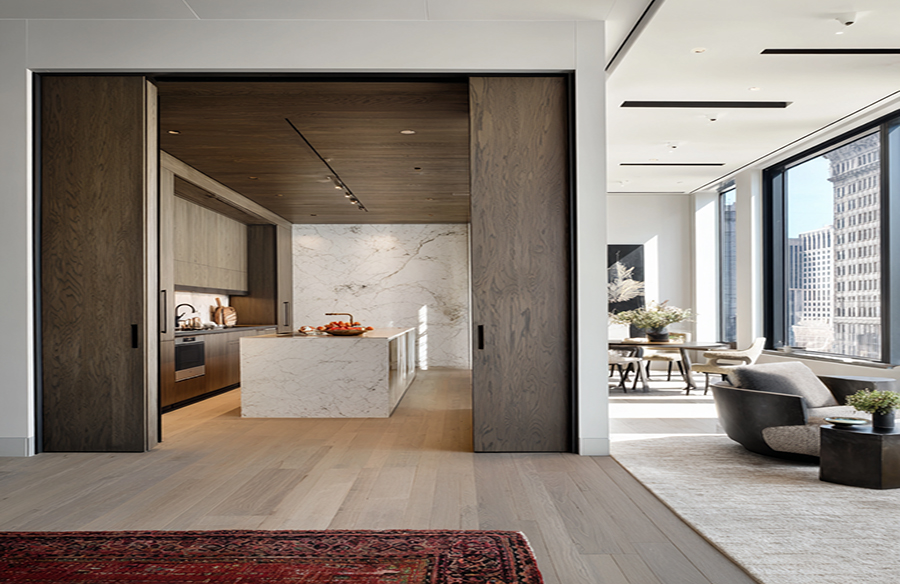
The pendulum swings back with surprising force. After decades of kitchen remodeling projects and modern kitchen remodeling designs celebrating exposure, visibility, and theatrical display, architectural discourse now champions something radically different: discretion. The concealed kitchen represents not nostalgic retreat into separated spaces but rather a sophisticated reinterpretation of domestic hierarchy, spatial flexibility, and what constitutes genuine luxury in contemporary living.
This shift challenges fundamental assumptions that dominated residential design since the 1990s. The ideology proclaiming kitchens must anchor social life, that cooking deserves performative status, and that eliminating walls automatically creates better living spaces now faces architectural critique. Strategic spatial planning increasingly recognizes that different activities demand different atmospheric qualities, and perhaps culinary preparation benefits from separation rather than integration.
Questioning the Open Plan Orthodoxy
Open plan living became architectural gospel through persuasive but ultimately limited reasoning. Removing walls supposedly fostered family connection, maximized natural light distribution, and created flexible spaces adapting to contemporary lifestyles. These benefits exist, yet the approach also imposed costs rarely acknowledged in design literature celebrating barrier-free living.
Spatial acoustics suffer when cooking sounds, appliance noise, and culinary activity occupy the same acoustic environment as conversation, entertainment, or focused work. Olfactory intrusion transforms cooking aromas from pleasant anticipation into pervasive presence regardless of whether occupants desire that sensory experience. Visual clutter from food preparation, dishwashing, and the inevitable detritus of actual cooking remains constantly visible, transforming functional necessity into aesthetic liability.
The New Luxury Calculus
Contemporary wealth increasingly values editing over display, discretion over exhibition. This cultural shift manifests architecturally through spaces offering controlled revelation rather than constant exposure. Concealed kitchens exemplify this evolved luxury sensibility, where the option to hide functional spaces signals greater sophistication than perpetually showcasing them.
Consider how this parallels other luxury goods evolution. Premium technology products emphasize invisibility and seamless integration rather than conspicuous display. High-end fashion often features subtle details only recognizable to informed observers. Similarly, contemporary residential architecture treats functional concealment as refinement rather than shame, creating spaces that reveal themselves deliberately rather than existing in permanent exhibition.
Architectural Mechanisms of Concealment
The concealed kitchen employs varied strategies depending on spatial constraints, aesthetic priorities, and functional requirements. Pocket door systems allow complete visual separation when desired while maintaining connection during social cooking or entertaining. These mechanical solutions enable spatial transformation, converting open kitchens into discrete zones through deliberate action rather than permanent architectural barriers.
Integrated cabinetry extending floor to ceiling can completely disguise kitchen presence within larger living volumes. When closed, these systems present as elegant millwork or storage furniture, revealing culinary functions only through intentional access. This approach works particularly effectively in urban apartments or smaller homes where dedicated kitchen rooms prove spatially impractical but visual separation remains desirable.
Material continuity strategies blur boundaries between kitchen and adjacent spaces when exposed, while maintaining functional distinction. Consistent flooring, ceiling treatments, and finish palettes allow kitchens to integrate visually during use but recede perceptually when concealed behind movable partitions or screening elements. This approach balances connection and separation without requiring dramatic architectural gestures.
Functional Benefits Beyond Aesthetics
Concealment offers practical advantages extending beyond visual preference. Dedicated kitchen spaces enable more efficient functional layouts since circulation patterns need not accommodate through-traffic between other domestic zones. Counter heights, storage configurations, and appliance placement optimize for culinary efficiency rather than visual presentation, often improving actual cooking ergonomics.
Climate control improves dramatically when kitchen heat, humidity, and ventilation demands separate from broader living space conditioning requirements. This separation reduces energy consumption while improving comfort in non-kitchen zones that need not accommodate cooking’s environmental impacts. The environmental and operational benefits alone justify concealment strategies independent of aesthetic considerations.
Acoustic separation transforms domestic soundscapes. Early morning coffee preparation doesn’t wake sleeping family members. Dishwasher operation doesn’t interfere with conversation or media consumption. Multiple household members can pursue different activities simultaneously without acoustic conflict. These quality-of-life improvements compound over time, transforming daily domestic experience more significantly than purely visual benefits.
Cultural Reconsiderations of Domestic Labor
The concealed kitchen trend also reflects evolving perspectives on domestic work visibility. Open kitchens emerged partly through democratizing impulses suggesting cooking deserved celebration rather than concealment. Yet this visibility also means domestic labor occurs under constant observation, potentially creating performance pressure rather than liberation.
Contemporary approaches recognize that different people prefer different relationships between culinary work and social engagement. Some enjoy cooking as participatory activity. Others view food preparation as focused work benefiting from separation. Concealment options honor this diversity rather than imposing singular spatial ideology regardless of individual preference or situational appropriateness.
The Multi-Functional Space Reality
Modern homes increasingly demand spatial flexibility accommodating diverse activities within limited square footage. A living area might host remote work, exercise, entertainment, and relaxation across a single day. Kitchen visibility during non-culinary activities introduces visual noise reducing each space’s effectiveness for its momentary purpose.
Concealment enables true spatial flexibility by allowing rooms to transform character based on current use. The living room hosting yoga practice or video conference benefits from kitchen absence. The same space transforms for dinner party when kitchen reveals itself for food service then conceals again for post-dinner conversation. This theatrical approach to domestic space maximizes utility within fixed architectural envelopes.
Design Challenges and Opportunities
Implementing concealment successfully requires sophisticated architectural thinking beyond simply adding doors. Lighting strategies must work equally well in exposed and concealed configurations. Ventilation systems need capacity addressing cooking demands without creating acoustic issues. Storage solutions must provide adequate capacity within potentially reduced footprints.
These constraints push designers toward innovative solutions benefiting overall project quality. The discipline required for effective concealment often produces more refined, intentional designs than open plans permitting looser spatial organization. Limitations become generative forces driving creative problem-solving and architectural invention.
The Pendulum’s Arc
Architectural history demonstrates cyclical movement between integration and separation, exposure and concealment. The concealed kitchen represents neither reactionary retreat nor mere nostalgia but rather synthesis integrating decades of open plan experience with renewed appreciation for spatial differentiation. This evolution suggests maturation rather than rejection, recognizing that optimal domestic architecture offers options rather than imposing singular solutions.
The future likely embraces hybrid approaches providing both connection and separation through transformable spatial strategies. Contemporary living demands flexibility, and concealment systems deliver precisely that adaptability, allowing spaces to serve diverse functions across time while maintaining architectural coherence and functional efficiency.