Here’s a design paradox worth sitting with: humans crave connection to nature, yet we also need shelter from it. For generations, residential outdoor design has treated this as a binary choice: open decks that expose you to every weather whim, or enclosed sunrooms that seal you away from the very elements you sought. But what if protection and nature connection aren’t opponents? What if they’re design partners waiting to collaborate?
Biophilic covered patios represent this evolved thinking. Technologies like adjustable louvered roof systems, increasingly adopted across Pennsylvania and New Jersey residential design, make this paradox solvable. These aren’t simply weather shields bolted onto outdoor spaces. They’re architectural tools that let homeowners modulate their relationship with sky, light, and atmosphere throughout the day and across seasons. The question isn’t whether to have coverage; it’s how to design coverage that preserves what drew you outside in the first place.
The Psychology of Half-Sky Spaces
Stand beneath a deep porch overhang during a rainstorm and notice what happens. You’re dry, certainly, but you’re also intensely aware of the rain: its sound amplified by the roof above, its mist on your face, its smell mixing with earth and wood. You feel both protected and connected, occupying what environmental psychologists call a “prospect-refuge” space. You can observe nature from a position of safety.
Biophilic covered patios leverage this psychological sweet spot intentionally. The coverage overhead satisfies our deep-rooted need for shelter (that evolutionary preference for defensible space). Meanwhile, the openness at eye level and below maintains visual and sensory connection to landscape, sky, and weather patterns. This isn’t accidental. It’s designed.
What makes adjustable coverage particularly powerful is the element of control it introduces. When you can open louvers to full sky or close them against midday heat, you’re not just changing physical conditions; you’re actively engaging with your environment. That agency matters. Research in biophilic design suggests that giving people control over their nature exposure actually strengthens the psychological benefits. You’re not a passive recipient of weather; you’re choreographing your relationship with it.
Material Honesty: What You Cover With Matters
Here’s where most covered patio thinking gets lazy: defaulting to standard aluminum louvers in basic white or bronze. Functional? Sure. But these materials carry no memory, no warmth, no conversation with the natural world they’re supposedly helping you enjoy.
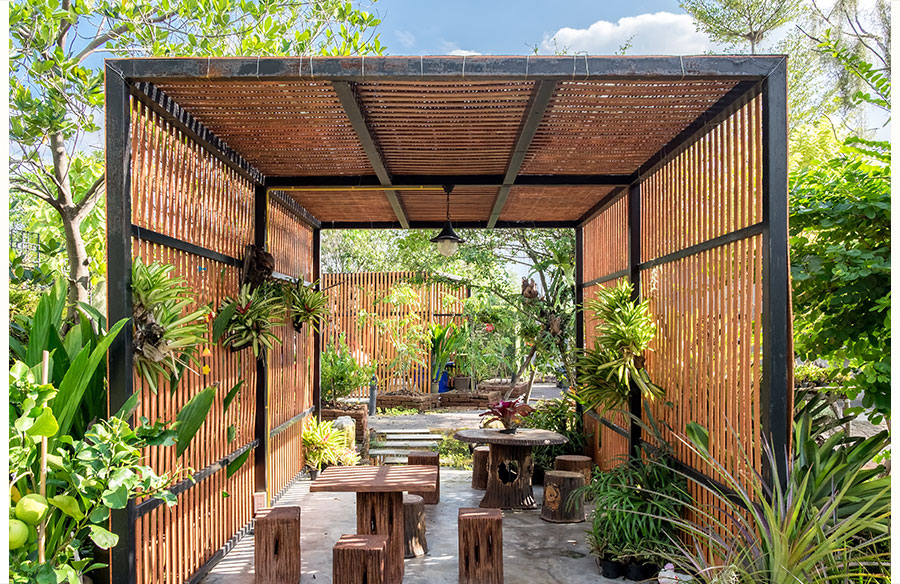
Consider instead how material choice shapes the entire sensory experience beneath your coverage. Wood-look aluminum finishes bring warmth without maintenance headaches. The eye reads organic grain patterns even as the material weathers Pennsylvania winters without complaint. Perforated metals create dappled shadow patterns that shift throughout the day, mimicking the play of light through tree canopies. Some designers are experimenting with transparency gradients, where louver density varies across the roof plane to create zones of different coverage intensity.
The material affects sound, too. Rain on metal sings differently than rain on composite. Some homeowners in the Mid-Atlantic specifically choose materials that amplify precipitation sounds, turning weather into performance rather than intrusion. Others prefer materials that soften sound, creating conversation-friendly acoustics even during storms.
And then there’s the question of what shows through when louvers are open. Painted undersides? Exposed structure? The choice determines whether your coverage reads as furniture (something placed upon the patio) or architecture (something integral to it). The difference is subtle but significant.
Choreographing Light and Weather
Static pergolas offer one lighting condition: dappled. Fixed roofs offer another: shaded. Both are fine, but both are also inflexible. Biophilic covered patios with adjustable elements introduce something more interesting: the ability to tune your light throughout the day.
Morning coffee might call for fully open louvers and direct eastern sun. Afternoon work sessions benefit from partially closed blades that diffuse harsh light while maintaining brightness. Evening entertaining often works best under fully closed coverage with indirect ambient light washing up from below. Same space, three completely different atmospheric conditions, all user-controlled.
In New Jersey’s humid summers, this adjustability serves practical functions beyond aesthetics. Open louvers during cooler mornings encourage airflow and prevent heat buildup. Partially close them during peak sun to create shade while maintaining ventilation. The result is passive climate control; you’re working with natural air movement rather than against it.
But here’s the non-obvious benefit: seasonal adaptation. A louvered system that’s 60% closed in July might be 90% open in October, when you want maximum autumn light and those crisp blue skies. You’re not designing one outdoor room. You’re designing a space that evolves with the calendar and your changing needs.
Layering Protection: Beyond the Roof Plane
The mistake many designers make is thinking coverage equals only what’s overhead. But biophilic covered patios work best when protection is layered and directional.
Consider vertical elements. A translucent screen wall on the western exposure blocks late-day glare while maintaining views. Integrated planter boxes with tall grasses create gentle visual barriers without solid walls. Retractable fabric panels offer flexible wind protection for shoulder seasons. Each layer adds another dimension of control and another opportunity for nature integration.
Those planter boxes deserve special attention. When you build growing zones directly into your covered patio architecture, you’re bringing nature into the protected space rather than just protecting yourself from it. Climbing vines on support posts soften hard edges. Container trees create vertical interest and seasonal change. Even herbs in raised beds add scent dimension; crushing rosemary as you brush past becomes part of the spatial experience.
Smart designers think about all five senses. Wind chimes respond to breezes that the coverage modulates. Water features create background sound that masks suburban noise without isolation. Textured materials underfoot (slate, wood decking, permeable pavers) connect you tactilely to material reality. This multi-sensory layering is what separates thoughtful biophilic covered patios from mere weather shelters.
Rethinking Shelter
We’ve been conditioned to think of outdoor living spaces as seasonal amenities: pleasant in May, tolerable in June, abandoned by August heat and September rain. But biophilic covered patios suggest a different model, outdoor spaces designed for engagement across more of the calendar, in more weather conditions, with more intentionality about the nature connection they facilitate.
This isn’t about creating outdoor rooms that mimic indoor comfort. It’s about creating transitional spaces that honor their in-between status, neither fully wild nor fully tamed, offering both prospect and refuge, maintaining dialogue with weather while protecting you from its extremes.
The best examples feel less like additions and more like natural extensions of how people actually want to live: moving between inside and outside, between control and exposure, between shelter and sky. Not binary. Fluid.