Introduction
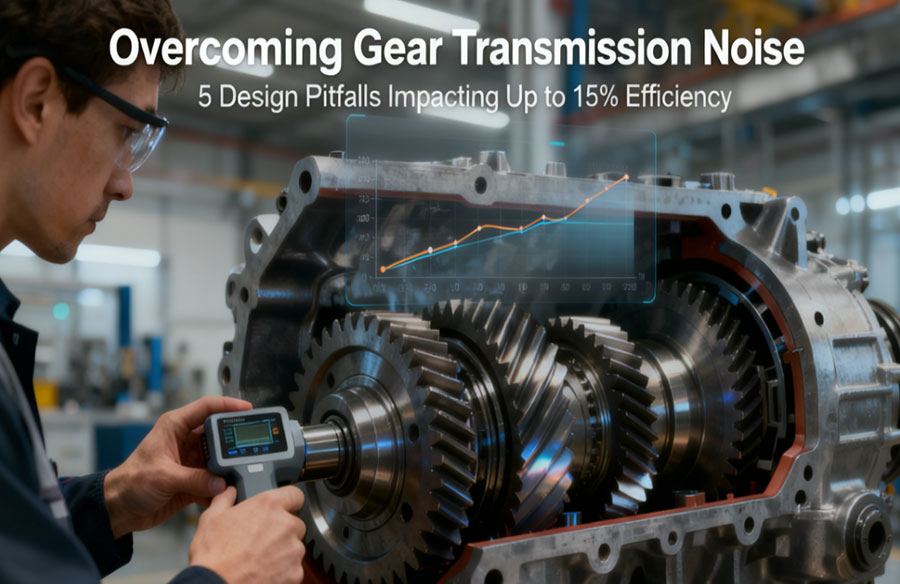
In the development of precision transmission systems, gear noise is far more than a simple acoustic issue; it is a critical signal indicating system design flaws, potential failures, and significant reductions in transmission efficiency. Research shows that vibrations and friction caused by improper design can lead to efficiency losses of up to 15%.
The root of many noise problems lies in the design stage, involving insufficient understanding of the capabilities of CNC Machining, the logic of tolerance allocation, and the relationship between surface finish and tribology. The following sections will analyze five key design pitfalls and explain how to suppress noise at the source through proactive design and manufacturing collaboration.
How Does Improper Backlash Control Become a Primary Source of Gear Noise?
Backlash is the critical clearance between the tooth profiles of meshing gears, used to compensate for manufacturing errors, assembly deviations, thermal deformation, and to form a lubricating oil film. However, improper backlash control directly leads to noise and efficiency issues. Insufficient backlash causes overly tight meshing, a sharp increase in friction torque, and excessive heat generation, which not only accelerates wear but also translates into high-frequency noise and power loss. Excessive backlash, on the other hand, causes violent impact between tooth surfaces during startup, direction reversal, or under shock loads, producing low-frequency impact noise and significantly reducing gear fatigue life.
The core of achieving precise backlash control lies in the high-precision manufacturing of individual gears. Modern CNC Machining technology and professional custom gear cutting services play a key role here, enabling the stable control of key dimensions like tooth thickness and base pitch to within micron-level Tolerance.
This ensures that the backlash after assembly consistently falls within the theoretically optimal range. Engineers should base their tolerance design on authoritative standards during the design phase, such as those established by the American Gear Manufacturers Association (AGMA), which provide clear tolerance guidelines for gears of different precision grades, offering a scientific basis for avoiding backlash-related issues at the root.
Why Does Surface Finish Affect Gear Acoustic Performance More Than You Think?
The quality of a gear tooth’s surface finish, typically measured by roughness (Ra, Rz), is one of the most direct factors affecting friction, wear, and noise. A microscopically rough tooth surface can be seen as countless tiny peaks and valleys. During high-speed meshing, these peaks interfere with each other, hindering the formation of a lubricating oil film and leading to boundary lubrication or even dry friction. This not only produces continuous scraping and vibration noise but also directly consumes transmission power due to the increased coefficient of friction.
During the gear manufacturing process, choosing different final machining processes results in vastly different surface qualities. For example, after ordinary hobbing or shaping, the tooth surface will retain visible tool feed marks. Subsequent finishing processes like grinding, lapping, or honing can significantly improve surface texture. Grinding can achieve extremely high tooth profile accuracy and very low surface roughness, suitable for high-load, high-speed applications. Honing, through minimal material removal and polishing, not only reduces roughness but also corrects minor deformations after heat treatment and creates a cross-hatch pattern conducive to oil film adhesion, making it particularly effective for reducing noise and micro-pitting risk.
Therefore, it is more appropriate to understand gear manufacturing as the precision control of surface integrity. For readers wishing to delve deeper into how different machining processes affect the final surface quality, this gear cutting and manufacturing guide provides a comprehensive analysis from basics to advanced topics.
How Can Improper Combination of Material and Heat Treatment Lead to Early Gear Failure and Noise?
The Basis of Material Selection
Material Selection is the starting point of gear design. Common gear steels like 4140 (chromium-molybdenum steel) and 8620 (nickel-chromium-molybdenum steel) have distinct characteristics. 4140 steel offers high strength and hardenability, suitable for gears requiring high hardness through through-hardening. 8620 steel, known for its excellent carburizing properties, is widely used for gears needing a “hard surface with a tough core”—meaning high surface wear resistance and contact fatigue strength, while the core retains sufficient toughness to withstand impact loads. Incorrect material selection can lead to excessive elastic deformation under load, altering the meshing point, or insufficient surface resistance to pitting, thereby causing vibration and noise.
The Core Role of Heat Treatment
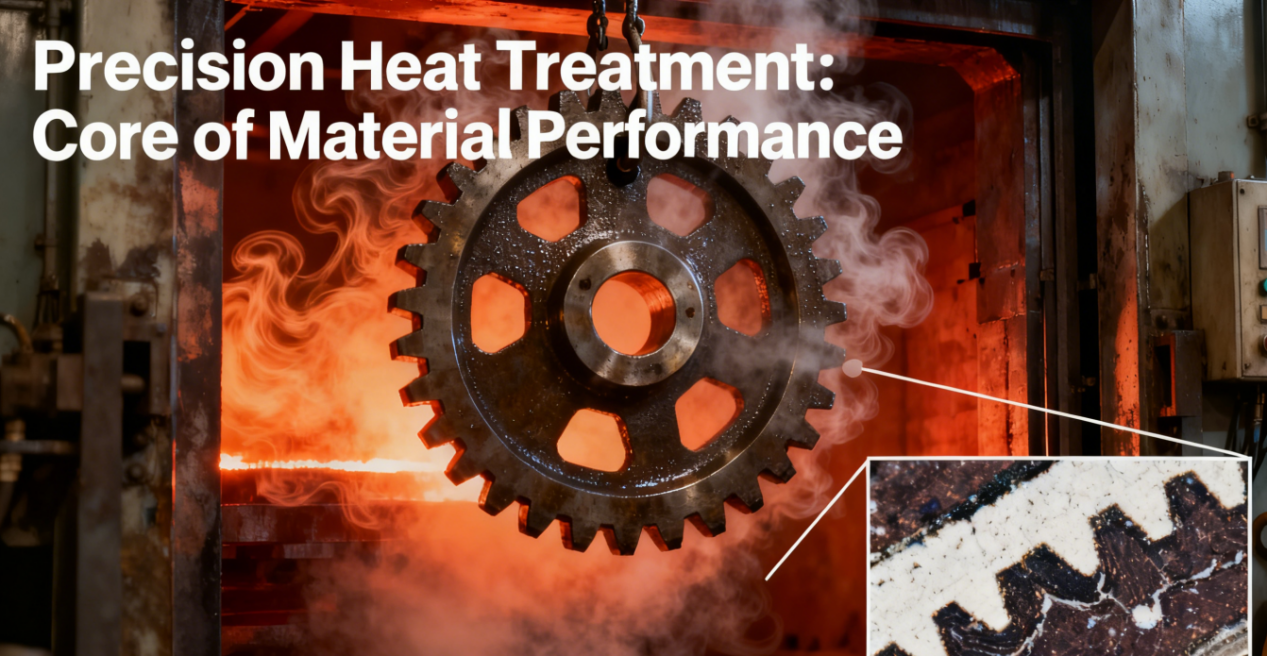
Heat Treatment processes, such as carburizing and quenching, nitriding, and induction hardening, aim to achieve the desired surface hardness, core strength, and residual stress distribution by altering the material’s microstructure.
- Control of Hardness Gradient and Residual Stress
Ideal carburizing and quenching can create a smoothly transitioning hardness gradient from high to low on the gear surface and introduce beneficial compressive stress, significantly improving the gear’s bending fatigue strength and contact fatigue strength. Improper heat treatment processes (e.g., uneven carburizing concentration, inappropriate quenching cooling rates) can lead to soft spots, abnormal microstructure, or excessive tensile stress, all of which become origins of noise and early spalling. - Dimensional Stability and Deformation Control
Heat treatment deformation is key to affecting the final accuracy and meshing noise of gears. For high-load custom transmission gears, it is essential to predict and compensate for heat treatment deformation during the design phase or correct it through subsequent finishing processes. Controlling deformation means better maintaining the designed tooth profile, ensuring smooth meshing.
The Importance of Collaborative Design
Therefore, for gears in critical applications, material and heat treatment must be considered as an inseparable whole in a collaborative design process. This requires the manufacturer to possess profound knowledge of materials science. More authoritative information on material behavior and heat treatment principles can be found on the platform of ASM International.
How to Avoid Potential Noise Issues through Manufacturability Analysis at the Design Stage?
Specific Applications of DFM in Gear Design
The Design for Manufacturability philosophy requires that, from the inception of the gear drawing, the actual processing capabilities and costs of subsequent gear manufacturing companies are fully considered. This is a preventive design approach.
Specifically for gear design, DFM includes, but is not limited to: avoiding undercut, which requires reasonable combinations of tooth numbers and module sizes; optimizing the root fillet curve to reduce stress concentration points, which are not only sources of fatigue cracks but also amplifiers of vibration and noise; and assigning reasonable tolerances based on manufacturing capabilities to avoid unrealistic, stringent tolerances that skyrocket costs, or overly loose tolerances that lead to unstable performance.
The Value of Early Collaboration with Manufacturers
Early design communication with an experienced custom gear manufacturer is irreplaceable. These manufacturers can provide valuable insights into material machinability, expected deformation trends under specific heat treatment processes, and efficient tool selection. Choosing manufacturers with robust quality management systems is particularly important, such as those certified to IATF 16949 (automotive industry) and AS9100D (aerospace industry). This ensures that the entire process, from design review and material selection to heat treatment and final CNC Machining, is under strict control, systematically identifying and preventing potential noise risks and ensuring product reliability.
What Key Qualifications in a Gear Manufacturing Partner Determine the Final Product’s Quietness and Reliability?
Advanced Manufacturing and Inspection Capabilities as the Hardware Foundation
Excellent gear manufacturing companies must be equipped with advanced production and inspection equipment. This includes 5-axis CNC Machining centers, high-precision gear grinders, gear measuring centers, and coordinate measuring machines (CMMs). These are the hardware foundation for achieving precise Tolerance and excellent surface finish. The ability to perform micron-level inspections is crucial for ensuring each gear meets design specifications, guaranteeing quiet and reliable transmission from a physical standpoint.
Comprehensive Material and Heat Treatment Expertise Affecting Core Performance
Deep knowledge of material properties and heat treatment processes directly influences gear fatigue strength, wear resistance, and noise characteristics
1. Scientific Material Selection as the Basis
The supplier should be able to scientifically recommend materials based on the application scenario, such as selecting appropriate steel grades for the characteristics of custom transmission gears. This is fundamental to ensuring good meshing and low noise under specific operating conditions.
2. Precise Control of Heat Treatment Processes
Whether through in-house facilities or partnerships, the manufacturer must strictly monitor and control the entire heat treatment process (e.g., carburizing and quenching) to ensure optimal hardness gradients, metallurgical structure, and residual stress. This process endows the gear with intrinsic qualities for long life and low noise.
Internationally Recognized Quality Management Systems as the Trust Cornerstone
Certifications are the most Intuitive representation (most intuitive reflection) of a manufacturer’s capability and reliability. Beyond the basic ISO 9001 quality system certification, IATF 16949 demonstrates the ability to meet the automotive industry’s stringent requirements for zero defects and traceability; AS9100D reflects the pursuit of ultimate reliability and safety in the aerospace field; and ISO 13485 applies to regulated fields like medical devices, showcasing compliance and product safety commitment. These internationally recognized quality management systems collectively form the cornerstone of trust in a supplier’s ability to consistently deliver high-quality products.
When you require high-end gear cutting services, it is essential to comprehensively evaluate a supplier’s capabilities in the above areas. To learn about professional gear machining services that possess these comprehensive qualifications, you can visit the provided link.
Conclusion
Gear transmission system noise control is a systematic project involving design, materials, manufacturing, and quality management. From precise tolerance control to the pursuit of superior Surface Finish, from the scientific combination of material selection and heat treatment to the pervasive philosophy of Design for Manufacturability, every link requires meticulous effort. By adopting the strategies outlined above, engineers can not only effectively solve noise problems but also significantly improve transmission efficiency and extend equipment service life.
Author Bio
This article was written by an expert with extensive experience in the field of precision manufacturing, currently employed at JS Precision, a precision manufacturing enterprise renowned for its quality control. The company is fully certified to multiple international management system standards including ISO 9001, IATF 16949, ISO 13485, and AS9100D. If you are facing technical challenges with gear transmission, you are welcome to visit our technical blog or contact our engineering team for more professional insights and customized solutions.
FAQs
Q1: What are the most common types of gear noise, and what problems do they usually indicate?
A1: Common types include high-frequency hissing (often related to surface finish) and low-frequency impact noise (often related to excessive backlash). Accurately identifying the noise type is the first step in diagnosing the problem, requiring a deep understanding of gear meshing principles and manufacturing tolerances.
Q2: When selecting gear materials, what factors besides strength should be considered to control noise?
A2: Factors such as the material’s damping characteristics (e.g., cast iron is better than steel), dimensional stability after heat treatment, and compatibility with the mating material should also be considered. Even with sufficient strength, improper material combinations can cause abnormal noise due to poor friction characteristics.
Q3: Can noise issues of already produced gears be solved by post-production fixes?
A3: Some methods like tooth surface polishing or honing can improve surface finish and thus reduce noise. However, for fundamental issues caused by tooth profile errors or improper backlash, post-production fixes are often limited in effectiveness and costly. It is best to avoid such issues during the design stage.
Q4: Why is the accuracy grade of gears (e.g., AGMA grade) so important for noise control?
A4: The accuracy grade directly specifies the tolerance ranges for parameters like pitch, profile, and lead. A higher accuracy grade means smaller manufacturing deviations, ensuring smoother meshing and fundamentally reducing the generation of vibration and noise.
Q5: What certifications are crucial when searching for a gear manufacturing supplier?
A5: ISO 9001 is the foundation of a quality system. For the automotive industry, IATF 16949 is essential; for aerospace, AS9100D is a mandatory requirement. These certifications ensure that the supplier has the capability to consistently provide high-quality, highly reliable products.