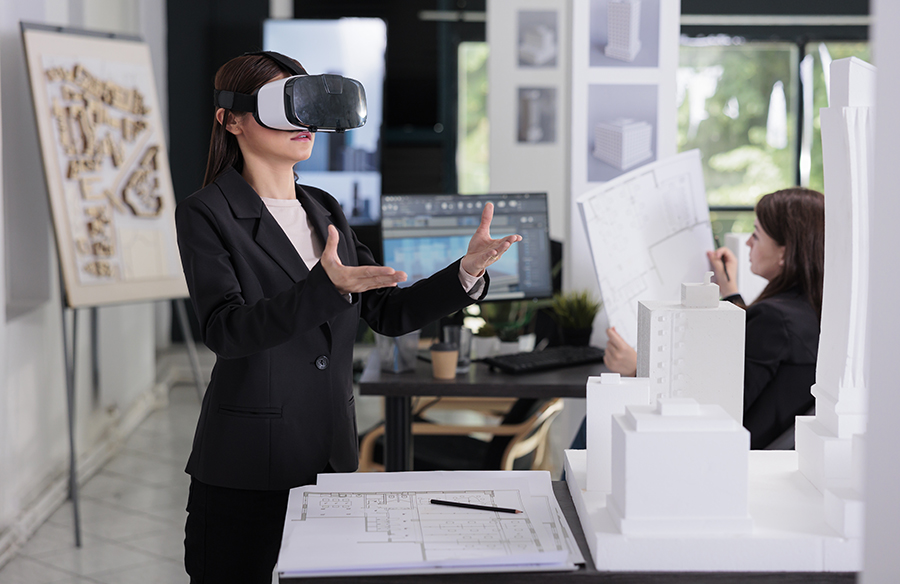
Architect visualization was once a time-consuming process that would take weeks to translate ideas into thorough visualizations. New technology with AI is putting an end to all this, and architects can now produce photorealistic visualizations at much faster speeds. With AI software, businesses can automate procedures, unlock creativity, and deliver projects on time. Increasingly, more businesses are now seeking nearshore AI development solutions so they can leverage expert talent at the expense of in-house personnel. These collaborations employ experienced professionals who are located within the same time zone, making real-time conversation possible and instant project completion. With more stringent quality visualization requirements on project timelines, nearshore hiring of AI and nearshore development gives companies an edge.
How AI is Changing Architectural Design
Artificial intelligence is making the process of architectural visualization an easier task by making processes that are not otherwise possible, such as 3D modeling, rendering, and material optimization, convenient. Architects can focus on seeking design decisions because the entire work is being done by AI. In a survey conducted by CGArchitect in 2024, 66% of the participants stated that speed was one of the best benefits of AI, and 46% stated better workflow efficiency. With the help of AI technologies, firms cut down projects by a large percentage and facilitate rapid design iterations and timely client delivery.
A Day in the Life of an Architect with AI
Consider Sarah, a leading architect on a fast-track project. She spent countless hours hand-ramping 3D models and waiting for renderings to complete. With AI, Sarah can generate several design versions in minutes, render real-time lighting, and make data-driven decisions in real-time. This shift accelerates productivity and allows for more interactive and responsive design workflows, resulting in faster client approvals and increased satisfaction.
Challenges of Traditional Visualization
Prior to AI, it was time-consuming to model buildings visually. Architects were dependent largely on human labor for tasks such as 3D modeling, texturing, and rendering, leading to long lead times and poor design iteration rates. Ridiculous software expense and needing to coerce in-house expertise were other restrictions. Most of the companies could not achieve client expectations without compromising on competitiveness, and sluggish iteration cycles always killed innovation in its infancy.
Adopting AI to Create Smarter, Faster Visualizations
AI-based software has overcome such traditional constraints. They can create 3D models without intervention, generate natural-looking textures, and replicate light levels at top speed with accuracy. Real-time editing enables architects to experiment with diverse design schemes and make informed decisions in time. Organizations utilizing AI-based processes can deliver improved quality visualizations within a cost-effective and timely context. Several organizations also utilize nearshore AI development opportunities to utilize these technologies within a period of extremely short time, with expertise in AI engineers having no internal costs.
History of AI in Architecture
AI was first used for architecture visualization as a plain algorithm to automate repetitive work. Advances in computer vision and machine learning have made it possible for first-rate tools that can detect subtle design elements. Pioneers such as Zaha Hadid Architects have been at the forefront of creating in-house AI software to automate their processes. From what they know, it is evident that AI can revolutionize architectural visualization as well as the overall design process.
Real-Life Implications of AI Implementation
Gains in Productivity: Zaha Hadid Architects mentioned an astonishing increase in productivity: competition design phases on the initial phase now save 50–70% of time, and the midterm level productivity rose by 50%. (thetimes.co.uk)
Confirmation Across the Industry: 66% of the architects interviewed by the 2024 CGArchitect survey took AI first and foremost and foremost primarily as appreciated for speed, and 46% gained through enhanced workflow efficiency.
Improvements to Come: AI will render newer software programs used for 3D modeling, generative design, and real-time rendering more intelligent, with the capability to create projects faster and more effectively.
What to Expect When Integrating AI
AI is a very powerful tool, but not a human replacement. Architects can use AI as an assistant, performing repetitive work, so humans can keep the innovation and design role. Training must be performed in order to use AI, but in the long term, efficiency and savings on quality reimburse the initial cost in its entirety.
Comparison of Traditional and AI Workflows
| Aspect | Traditional Workflow | AI-Enhanced Workflow |
| Rendering Time | 48+ hours | 2–3 hours |
| Design Iterations | Limited and time-consuming | Rapid and dynamic |
| Client Feedback | Sequential, delayed | Interactive, real-time |
| Cost Efficiency | High due to manual labor | Optimized through automation |
| Output Quality | Variable, skill-dependent | Consistently high with AI assistance |
Visualizing the Transformation
Legacy Workflow: 3D modeling, texturing, and rendering would take days or weeks with less opportunity for iteration.
AI-Powered Workflow: Architects design models within hours, simulate lighting instantly, and give interactive visualizations to clients for feedback. The streamlined workflow accommodates several revisions without affecting project timelines.
AI will keep redefining architecture. Generative design software and AI-powered simulation software will allow architects to create buildings for utmost sustainability, energy efficiency, and aesthetic appeal. AR/VR integration will allow clients to walk through and provide real-time feedback. Early action in the game keeps firms ahead of design creativity, producing gorgeous buildings quicker than ever.
Getting Beyond Risks in AI Implementation
AI deployment can be followed by learning curves or resistance to change. A nearshore partner for development of AI solutions provides advisory, as well as technical, skills, and is simple to transition to AI-based workflows. Training, integration support, and upkeep are provided in such a partnership, eliminating risk and sustaining maximum impact.
Is AI the Right Choice for Your Firm?
If your company wants to boost design productivity, save time on projects, and create more quality visualizations, then AI integration is imminent. Discover nearshore AI development services today and begin redefining your visualization pipeline.
Conclusion
AI is transforming the realm of architectural visualization more quickly, efficiently, and freely than ever before. With AI and nearshore dedicated development teams, businesses can provide excellent visualizations, acquire customers, and outcompete their competition. With ongoing innovations in AI, new workflows will be unlocked and the future of architectural visualization and presentation will be redrawn. The future of architecture design is quicker, brighter, and more collaborative than ever.