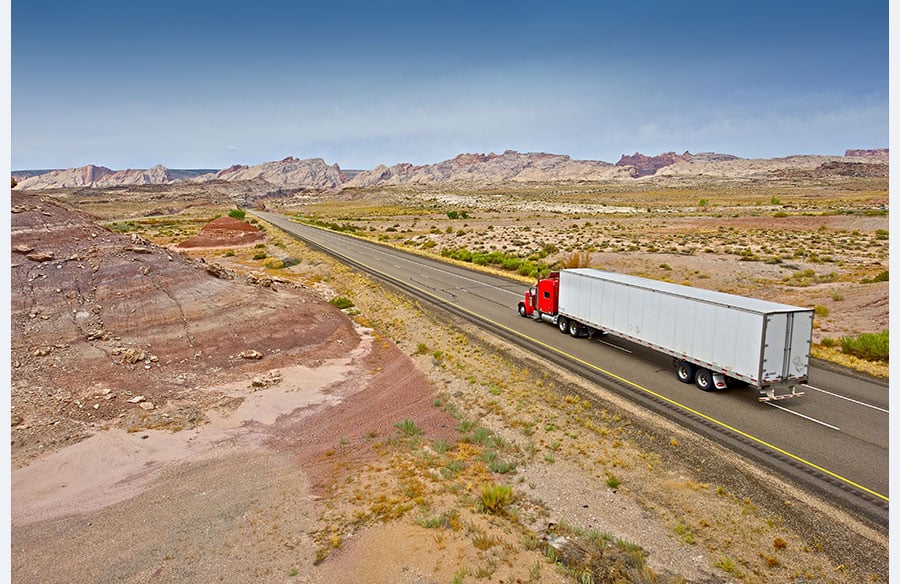
Utah’s semi-truck operations span over 5,000 miles (ca. 8,047 kilometers) of interstate highways, hauling freight worth $200 billion annually, but they contribute 25% of the state’s transportation emissions—equivalent to 4.5 million tons of CO2 in 2024. With trucking accounting for 70% of Utah’s freight movement, sustainability efforts target diesel dependency, which fuels both environmental harm and safety risks like brake failures in overloaded rigs.
By mid-2025, initiatives have accelerated, driven by federal grants and state policies aiming for 35% zero-emission heavy-duty sales by 2045 under the Advanced Clean Trucks rule.
Mining transport, a cornerstone of Utah’s economy with 80% of U.S. beryllium from local mines, exemplifies challenges: ore haulers on US-89 emit high particulates in dusty canyons. Sustainable shifts—electric fleets, aerodynamics, and autonomy—cut emissions by 50-80% per vehicle while enhancing efficiency, reducing downtime from 15% in legacy diesels. These practices not only comply with Utah’s Clean Air Act but lower operational costs by $0.20 per mile through fuel savings.
Current Emissions Profile and Reduction Targets
Utah’s trucking fleet, numbering 45,000 Class 8 semis, emits 12 grams of NOx per mile on average, exacerbating inversions in the Salt Lake Valley. 2025 data shows a 7% emissions rise from 2024 due to freight growth, but targets under the Utah Clean Fleet Program mandate 20% clean vehicle adoption by 2030. Key metrics include idling reductions—trucks idle 20% of runtime, wasting 0.8 gallons (ca. 3 l)/hour—and payload optimization, where underloading adds 10% fuel burn. In mining, haul trucks guzzle 5 gallons (ca. 19 l) per ton-mile on steep grades like those in Bingham Canyon.
Baseline audits via telematics reveal 30% inefficiency from routing errors, addressable by GPS software slashing empty miles by 15%. Annual reporting to the Utah Department of Environmental Quality tracks progress, with non-compliant fleets facing $1,000-per-vehicle fines. Projections indicate 1.6% volume growth in 2025, pressuring operators to integrate hybrids, which recover 20% braking energy.
Regulatory Frameworks and Incentives for Green Fleets
Utah’s sustainability mandates blend state incentives with FMCSA standards, requiring pre-trip inspections for emissions compliance and hours-of-service logs to curb idling. The 2025 Utah Clean Fleet Program allocates $15 million for scrapping Class 5-8 diesels, reimbursing 50% of electric replacements up to $100,000 per unit. Tax credits cover 30% of charging infrastructure, while the Advanced Clean Trucks rule enforces 7-11% electric sales quotas for manufacturers starting 2025. For fleets exceeding targets, rebates reach $20,000 per vehicle via the Volkswagen settlement fund. In mining, BLM permits now stipulate dust suppression and low-emission haulers on federal lands.
Non-compliance risks $10,000 daily penalties under the Clean Air Act. For operators navigating these rules amid liability concerns—like defective EV batteries—consult an experienced Utah semi-truck accident lawyer. These frameworks have spurred 500 clean vehicle replacements since January 2025, aligning with Governor Cox’s 2025 green legislation for net-zero transport by 2050.
Adoption of Electric and Hybrid Semi-Trucks
Electric semi-trucks lead Utah’s transition, with 150 units deployed by Q3 2025, cutting lifetime emissions by 90% over diesels. Volvo VNR Electric models, like Utah Paperbox’s 2024 debut, save 800 diesel gallons monthly on 150-mile routes, with 275-mile ranges suiting I-15 hauls. A $60 million EPA grant funds 200 zero-emission replacements across public fleets, including Salt Lake City’s refuse trucks. Hybrids bridge gaps, offering 25% fuel savings via regenerative braking on mountain descents.
In mining, BHP’s pivot to battery haul trucks—rejecting hydrogen—targets 100% electrification by 2030, with Caterpillar 793 models hauling 300 tons at 1 kWh per ton-mile. Utah’s first Class 6 electrified box truck, via USU’s ASPIRE initiative, logs 500 miles (804.67 kilometers) weekly with 80% uptime. Challenges include 30-minute charges, mitigated by depot scaling; costs drop to $0.15/kWh under incentives, versus $0.40 for diesel equivalents.
Sustainable Practices in Utah’s Mining Transport
Mining haulers, transporting 50 million tons yearly, pioneer sustainability through autonomy and electrification. ASI Mining’s Cache County systems retrofit Caterpillar trucks for driverless operation, reducing human error by 40% on Tooele sites and idling by 25%. Kennecott Copper’s fleet integrates solar-powered charging, offsetting 20% grid draw for 50 e-haulers by 2026.
Dust control via water mist systems cuts particulate emissions 60%, mandatory under DEQ permits for SR-36 routes. Biodiesel blends (B20) power 30% of legacy rigs, lowering CO2 by 15% without engine mods. Route optimization software, like ABL Tanklines’ 2025 tool, maps efficient paths to truck stops, trimming 10% fuel use on US-6.
A 2025 Bingham incident highlighted gains: an autonomous e-truck avoided a rollover, saving 5 tons of ore spillage. These practices yield $50,000 annual savings per vehicle, with ROI in 3 years via extended tire life from precise loads.
Infrastructure and Fleet Management Innovations
Charging infrastructure expands rapidly, with Voltera’s 2025 Salt Lake megawatt depot supporting 50 simultaneous Class 8 charges at 1 MW each, enabling 300-mile daily runs. Utah Clean Cities’ Green Fleets Program aids conversions, funding telematics for real-time efficiency tracking—reducing drag via auto-roof deployment saves 5% fuel.
Eco-parking lots incorporate solar canopies and EV plugs, as in Truck Parking Club’s 2025 designs, cutting idling emissions 70%. NACFE’s Run on Less event features 13 Utah fleets testing aero kits, yielding 12% MPG gains on I-80. Maintenance shifts to predictive analytics, extending brake life 50% and oil intervals to 100,000 miles (160,934.4 km).
Knight-Swift, Utah-based, earned 2025 HDT Top Green Fleet status for its 1,000-unit hybrid rollout, monitoring via dashboards for 98% compliance. These tools integrate with UDOT’s smart corridors, using V2I signals to optimize speeds, slashing 8% consumption on congested stretches.
Case Studies and Future Strategies for Maximization
Knight-Swift’s initiative replaced 200 diesels with electrics, dropping fleet emissions 35% and costs $1.2 million yearly, per 2025 reports. In mining, Rio Tinto’s 2024 e-pilot at Oyu Tolgoi—mirroring Utah trials—hauled 1 million tons zero-emission, adaptable to Park City ops. USU’s ASPIRE electrified a Class 6 for campus freight, logging 50,000 miles (ca. 80,467 kilometers) with 85% renewable charge sourcing.
To maximize, fleets audit baselines annually, leveraging DEQ grants for 40% ROI on solar depots. Future strategies include hydrogen pilots by 2027, per UT Energy Week panels, and rail-shifting for 20% long-haul reduction via GoRail advocacy. Policy pushes, like 2025 Blueprint expansions, fund $200 million in green parking.
Operators should prioritize scalable tech: start with hybrids for 15% gains, scale to full EVs as batteries hit 500-mile ranges by 2028. Training via UTA programs ensures 95% uptime, turning sustainability into a competitive edge amid Utah’s 3.2% freight growth.