Architecture is an ever-changing field. It has always been subject to change under various factors, such as consumer trends and, of course, technological progress. However, although it has been evolving all the time, now we’re at the epicenter of one of the most exciting periods in the industry.
Today, the ways we design and build are transforming entirely. And it’s all because of innovations. In this article, we’ll take a look at the most prominent architecture technology that shapes the future.
Building Information Modeling as the Core of Modern Architectural Design
When speaking about architecture technology, there is absolutely no way not to talk about Building Information Modeling (BIM) as it’s the backbone of modern design. This concept isn’t new. Originating in the 1970s, it’s well-known to millions of specialists in the architecture sector. Yet, BIM’s role in shaping the future of the industry is hard to undervalue.
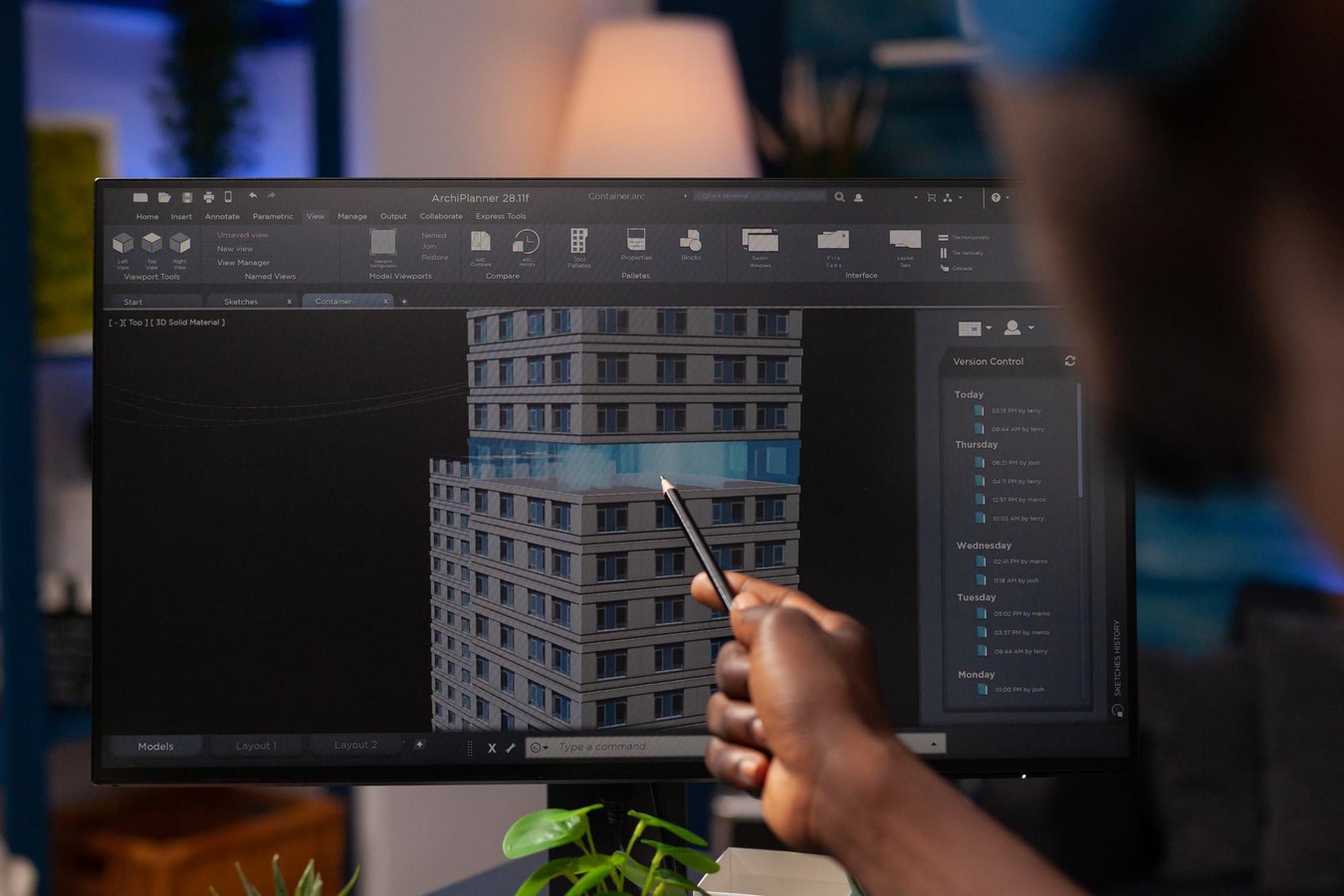
So, what is BIM? In short, it’s a digital representation of a building or infrastructure that spans both its physical and functional features. It provides a comprehensive and accurate 3D model of the project. With its help, planning and coordination throughout the entire project’s lifecycle become more effective and seamless.
Today, BIM keeps evolving. It has received multiple dimensions, from traditional 3D to 4D, 5D, and even 9D. Every dimension has offered a new layer of planning for a more efficient project planning process. Hence, 4D stands for time, 5D for cost, 6D for operational data, 7D for sustainability, 8D for safety, and 9D for lean principles.
The benefits? Multilayered BIM allows seamless planning through the collaboration of multiple specialists in real time. As a result, it allows more accurate management of all essential project characteristics, such as schedule, cost, safety, quality, etc. Plainly, it offers greater efficiency at every stage of the project’s lifecycle and allows great time and cost savings. And it also reduces risks, mistakes, and miscommunication between specialists.
Exploring Digital Renders and Visualization Tools
Digital visualization also isn’t one of the entirely new ideas in architecture. Generally, visualization has always been a part of architecture. It emerged from primitive drawings to realistic digital models—all to create a reference for a project. By this time, digital rendering and visualization have grown into a globally recognized language of architecture that lets designers convey their ideas to customers in the most understandable way.
Although they’ve been around for a while, digital tools used for rendering and visualizations have changed a lot over the years. Today, they allow capturing the tiniest detail through Computer-Aided Design (CAD). Models are becoming more profound and, in fact, photorealistic. The designing and rendering processes are becoming faster, easier, and more efficient. And the progress continues.
Advancements in the field of visualization and rendering bring a range of benefits. They give experts more control over the design processes. They also allow better cost-effectiveness and easier project management. Most importantly, professional product rendering, whether handled in-house or through a third-party service, transforms customer experience. Highly realistic design models speak to customer emotions. They can make a stronger impression and make your products stand out.
 Immersive Design Powered by AR and VR
Augmented Reality (AR) and Virtual Reality (VR) are two more innovations defining technology architecture these days. These concepts were developed back in the 1990s. However, they weren’t fully here until around the 2010s.
AR and VR bring immersive experiences into projects. They can place themselves directly into their designs and interact with them in ways previously unknown. AR and VR allow simple site evaluation. They also enable specialists to overlay their design models onto physical sites to create smooth integration into real-world surroundings.
AR and VR also create entirely new experiences for customers, partners, and other stakeholders. Immersive visualization enables simple communication of complex architectural solutions. It also gives you an opportunity to make your projects stand out from the crowd and drive clients and sales.
AI and Automation Transforming Design and Construction
Artificial intelligence is another emerging manifestation of technology in architecture. Today, this technology is literally everywhere. AI transforms data collection and analysis, creates scalable automation solutions, and offers a range of other operational benefits. In architecture, it can be applied across several mediums:
Design
AI is being actively integrated into BIM to enhance it. With the help of artificial intelligence, information modeling becomes more detailed and integrated, with an optimized workflow and reduced clashes.
It also helps collect data-driven insights from historical project data for more accurate planning. And it can run automated documentation for your projects, minimizing the need for manual effort.
Finally, one of the latest trends is the use of generative solutions through various stages of architectural design. Smart AI algorithms can generate models based on a variety of factors, such as material efficiency, budget, and others. This is a new era of design.
Construction
AI also offers a number of solutions in the construction stage. With its help, professionals can streamline construction progress monitoring and safety/quality control. It allows data-driven resource allocation and scheduling. As a result, lower risks and costs.
Another point is predictive maintenance. Artificial intelligence can control the infrastructure and machinery. It can forecast failures and give you time to react to technical problems and minimize downtime.
And let’s not forget about autonomous robots built with AI. They can perform repetitive and dangerous tasks to boost construction safety and productivity.
Integrating Tech for Smarter Digital Marketing
Of course, technical advancements bring many positive changes to the process efficiency of design and building. But they also transform the way firms can handle marketing.
There are a variety of digital tools that make digital marketing for architectural products autonomous and simplified. You can integrate technology through different marketing activities. For example, tools like Google Keyword Planner allow simple keyword research for SEO purposes. Tools like Mailchimp help automate email marketing. There are plenty of opportunities like these out there.
And let’s not forget about the latest changes in the sphere of marketing—AI-powered search. Today, more and more people use ChatGPT, AI-powered search engines, and SERP features like Google’s AI Overviews to find the information they need on the web. This shift already steals traffic from top-ranking sites in traditional SERPs. But it also offers an opportunity to gain a competitive advantage. If you want to retain your visibility and attract customers, you can leverage an advanced AI mode tracker and analyze how frequently your website/brand appears in AI results. This will help you find effective ways to optimize for the new era of search and ensure that your potential customers find you.
Enhancing Teamwork with Collaboration Platforms and Cloud Workflows
Cloud technology in architecture is also an important future-shaping innovation. Cloud computing has been around for a while. It offered us significant improvements in the way we handle data. Cloud storage is a safe space that can accommodate large volumes of data. At the same time, they allow seamless access to it at any time and from anywhere.
And there are collaboration platforms. These are already an integral part of the workflow in many firms. Tools like Autodesk BIM 360 and others streamline the entire workflow across all teams. It allows simple task creation and allocation. It also simplifies progress tracking, collaboration, and data exchange between multiple specialists in real time. This kind of technology creates productive workflows and allows significant time savings.
How Smart Building Technologies Support Sustainability
Last but not least, we have to talk about big shifts in the sustainability sector. The trends for greener and more sustainable architecture have been emerging over the last decades. And technology makes it much easier to adopt their core principles.
Tools like AI and BIM allow data-driven modeling with a focus on reducing waste. They can help you plan and implement smart building solutions, integrate renewable energy sources, select sustainable materials, and design smart water conservation systems. Furthermore, with the help of AI-powered predictive analytics, you can forecast lifecycle sustainability for buildings and design with it in mind.
Conclusion
From BIM and digital rendering to predictive analytics and AI-powered automation—we’re now living in the age of technology architecture. Continuous technological advancements are quickly integrating into the architecture sector, offering better, simpler, and more efficient processes at different stages of designing and building.
Of course, there are still some considerations and challenges. Integration of new digital solutions has to be rapid. And the learning curve can be hard to overcome. Not to mention the resources needed to adopt new tools. Yet, the progress doesn’t stop. Tools are becoming smarter, and accessing them becomes easier. So, we can’t wait to see what the future of architecture will look like!