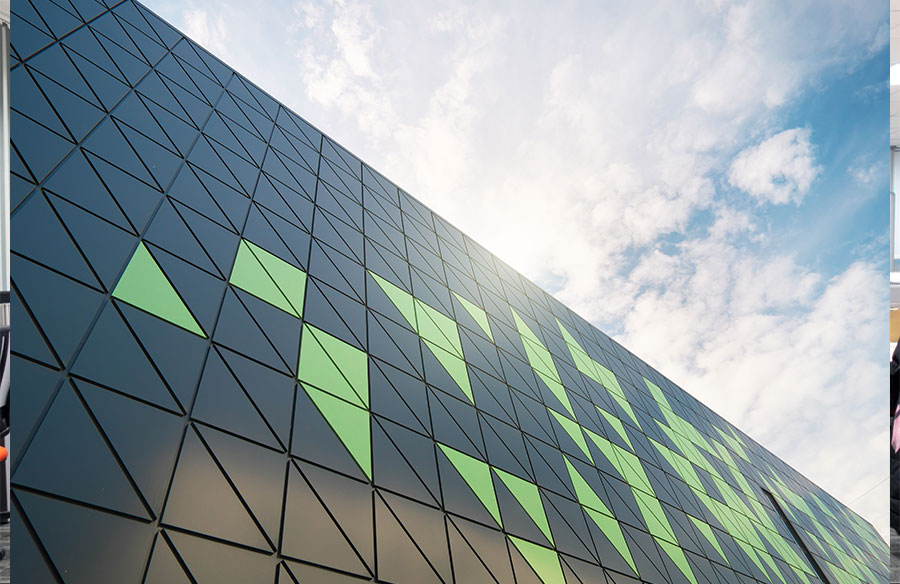
For decades, we’ve viewed a building’s exterior as nothing more than a protective raincoat, a barrier against the weather. But no longer. Today, the building envelope is found at the center of our net-zero thinking. The materials used to construct it don’t merely determine the appearance of a building; they play a huge role in its operational performance and embodied carbon footprint.
We’re going to dive into what makes a building envelope truly sustainable, exploring the performance metrics, material innovations, and lifecycle thinking that are shaping the future of architecture.
The Role of Building Envelopes in Sustainability
Fundamentally, a building envelope’s task is to keep what’s inside safe from what’s on the outside to control temperature, keep noise out, and keep the weather away. But its contribution to the fight against climate change is emerging as its most important role. As the World Green Building Council’s (WorldGBC) Advancing Net Zero Reports illustrate, it is not possible to decarbonise the built environment without improving the performance of our building skins.
High-performance envelopes are no longer a ‘nice-to-have’; they are a straight and critical route to achieving those ambitious 2030 and 2050 carbon neutrality goals that countries are working towards. Getting the envelope right requires cutting in half the energy required to heat and cool a building throughout its lifetime.
Challenges in Designing Sustainable Envelopes
Designers and constructors get themselves into a tug-of-war, attempting to reconcile ambitious energy efficiency targets with the need for freedom of expression. The issue is, conventional cladding products can require a tough compromise. Most carry baggage: high maintenance regimes, a significant embodied carbon cost from production, and doubts about their durability.
An article in Construction Canada on sustainable cladding choices makes it clear how deeply material selection impacts the overall performance of a building envelope. This isn’t just theory, either. A 2025 study published in ScienceDirect on envelope performance identified significant gaps between designed performance and real-world results, pointing to outdated materials and systems as a key source of inefficiency.
High-Performance Cladding as a Game-Changer
So, what exactly makes a cladding system “high-performance”? It’s a combination of exceptional weather resistance, brilliant thermal regulation that minimises heat loss or gain, and rock-solid durability that stands the test of time. It’s about creating a perfectly sealed, insulated, and resilient façade. This isn’t just about saving a few dollars on energy bills.
As an article from Symetrix NZ on the future of building envelopes explains, high-performance cladding is the key enabler of truly energy-efficient buildings. The data backs this up, with 2024 research in ScienceDirect on performance-driven envelopes quantifying just how significantly these advanced systems can slash a building’s operational energy consumption over its lifetime.
Aluminium Batten Cladding – A Sustainable Solution
This is where creative materials truly cut their own cloth, delivering solutions that overcome the conflict between design and performance. One such outstanding example is aluminium batten cladding, which checks a high number of sustainability boxes.
As Construction Canada’s commentary has pointed out, aluminium is recyclable indefinitely, light in weight (minimizing transport emissions and structural load), resistant to natural corrosion, and non-flammable. It provides the strength and low-maintenance lifetime that contemporary projects require.
In addition, the use of hyper-realistic timber-look aluminium battens allows architects to create warm, biophilic designs without real wood’s maintenance or durability issues. This is ideal with modular and prefabricated building systems, which, according to Symetrix NZ, are among the trend-setting solutions for minimizing on-site waste and embodied energy.
Aesthetic Versatility Meets Performance
A building must do more than simply perform well; it must engage people and place. This is most often done through the façade, which can be the main vehicle for cultural and community connection. The high-performance materials should not restrict this creative expression.
The virtue of systems such as timber-look aluminium is that they are versatile. They can be employed to produce breathtaking, nature-mimicking façades that draw upon biophilic design concepts, producing healthier and more welcoming environments for their occupants.
Such flexibility means architects can achieve fluid curves, complex screens, or introduce the façade warmth into internal spaces without ever having to compromise on the tough performance and sustainability credentials.
Lifecycle and Long-Term Value Considerations
When we talk about sustainability, we have to look at the whole picture. That means shifting from just looking at the upfront cost to conducting a full lifecycle analysis. The WorldGBC reports consistently stress that material choices must be based on their total impact, from extraction to end-of-life.
Here, materials like aluminium really prove their worth. Academic studies featured on ScienceDirect highlight recyclable aluminium as a cornerstone of a circular economy approach in construction. The lower maintenance requirements reduce operational costs and environmental impact over decades, while its recyclability at the end of the building’s life gives it huge long-term value, both financially and environmentally.
Future Directions in Building Envelopes
The innovation isn’t stopping here. The future looks even smarter. Trends identified by Symetrix NZ and in ScienceDirect research point towards a new generation of building skins. We’re talking about adaptive façades that respond to the sun’s position, energy-harvesting surfaces that turn the whole building into a power source, and climate-responsive designs that actively regulate internal conditions.
Before long, cladding will be seamlessly married to renewable energy systems, such as photovoltaic (PV) façades, transforming buildings into active energy providers and bringing us nearer to those global net-zero targets.
Cladding as a Cornerstone of Net-Zero Design
The skin of our buildings is not passive anymore. It is an active, critical participant in building the future that is both sustainable and beautiful. High-performance cladding is the key that unlocks the potential for buildings to be the climate solution, not the problem.
As we look to the future, selecting advanced, flexible, and lifecycle-oriented solutions is not only a choice, it’s a requirement for any project committed to net-zero design. To observe this in action, it’s worth looking at how new aluminium batten systems are already setting the tone for the next phase of sustainable architecture.