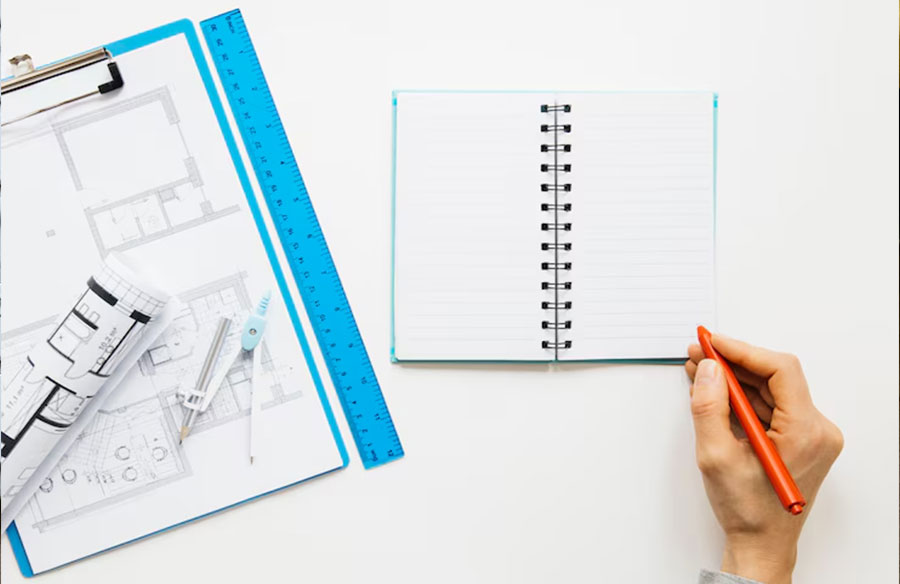
In architecture and design in particular, and in creativity in general, a sketchbook or a design journal is not just a collection of random sketches. It may be an expressive tool that will help you visualize your bold ideas and capture your inspiration. And even more, document your own creative journey. Whether you’re a practicing designer or an architecture student, a dedicated sketchbook, design journal, or visual diary can serve as a unique space for you. One where your ideas will grow and evolve.
Don’t Underestimate the Value of an Architectural Sketchbook
Both an architectural sketchbook and a visual diary are more than just a notebook with drawings. It is a place where you can analyze, reflect, and also record research and be technically detailed. They can contain both freehand sketches and complex technical drawings. These can be notes about space, light, texture, and at the same time descriptions of your own emotions that arise in the process of working on a project. Your sketchbook or design journal should be a development tool. That is, it helps to capture ideas. And even those that seem imperfect at first glance. It is often these raw ideas that later become the basis for brilliant projects.
Organizing your ideas with clarity and purpose
While your sketchbook is primarily a creative space, sometimes it also plays the role of a communication tool. Maybe you prepare a portfolio, pitch a concept to a client or apply for a grant. In such cases, presenting your sources or references clearly and consistently becomes important. For instance, case studies, design precedents, or quotes from architectural theory. If you include this type of supporting material, also don’t forget to pay attention to APA format checker tool. It may help you ensure your citations are clean and professional at the same time. With such tool you can save time and give your design journal an added layer of polish when it’s used beyond your personal process.
Architectural Sketchbook, Visual Diary, and Design Journal. What to Include?
Sketches. Concepts
Don’t be afraid to start with rough, imperfect lines. Early sketches can show you:
- how the idea is born,
- how it is formed into a volume,
- how it develops from line to space.
Don’t forget to include layouts, facades, and sections. Demonstrate the changes in your idea. That is, what exactly you have improved and why.
It’s all about inspiration. Visual references
 If you’re an architect or designer, you definitely draw inspiration from the environment. Use your visual diary to paste photos, collages, or printouts. Anything that inspires you. Add a short explanation of why this particular picture is important to you.
Mood boards
This is an effective tool for visually displaying the atmosphere you want to create. Include color palettes, textures, or materials. This way, you’ll add depth and conviction to your sketchbook.
Technical elements
Provide drawings of components or connections, lighting, etc. Describe what materials you plan to use. All this is an important part of any design or architectural project.
3D design sculpture
If you work with models or sculptures, be sure to document it. Don’t ignore three-dimensional thinking.
Textual reflections
Write down your doubts, ideas, and questions. A real journal sketchbook will not be complete without your own reflections. This will help you better understand your own thought process. It can also suggest new areas of work.
Critical notes. Feedback
After each discussion with colleagues or inspirers, record the feedback you receive. This way, you not only discipline yourself, but you can also see the progress and reactions to your ideas from others.
Innovation. Experimentation
Show that your design sketchbook is a place where new ideas are born, unconstrained by any limits. Try to implement something unusual. It can be working with transparent paper or adding augmented reality or interactivity elements.
Integrate digital and analog techniques
Combine hand-drawn graphics with digital tools. You can use a tablet to create digital sketches and then transfer them to your visual diary, commenting on each step. This will emphasize both your creative and technical skills.
Summary
As you can see, the creative diaries described above are full-fledged platforms for research, documentation, and self-expression. In them, you record not only the final result but also the entire creative process. That is, with all the doubts, mistakes, discoveries, and victories. Don’t be afraid to fill it with your trials and tribulations. It is in these pages that your unique design language will be formed. Let your journal drawing be a reflection of your ability to see the world differently. The best sketchbook is one that lives, develops, and reflects you as a thinking and creative person.