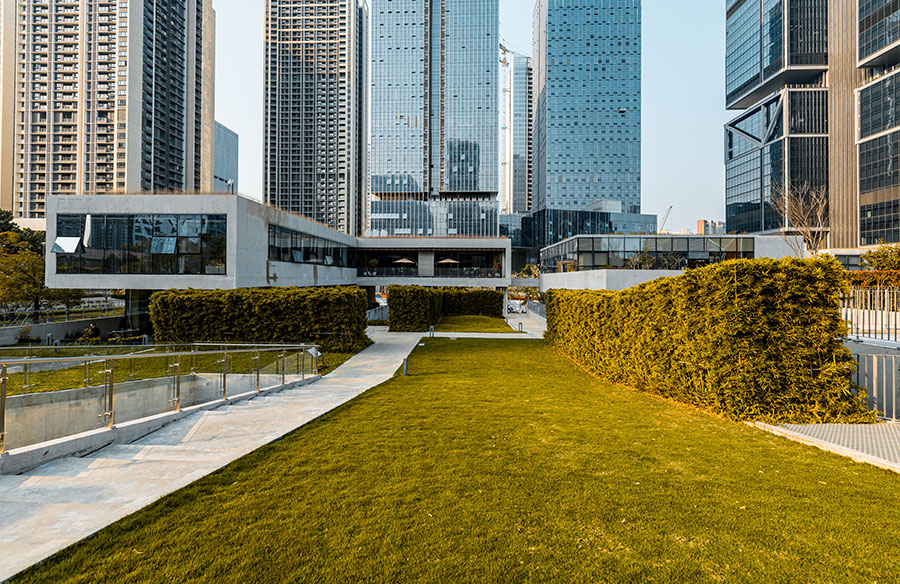
Urban cities are defined by more developed roads, transportation, and infrastructure.
And one thing they all have in common is buildings–lots of them, and often, many of those buildings are tall and large.
Given the number of buildings in limited space, these buildings tend to be rather densely packed together too.
The high density of larger buildings often leaves little space for greenery, and while forward-thinking cities like Singapore may make it a point to incorporate greenery, it’s the exception rather than the norm.
Given that plants help cool spaces down while hard surfaces, especially materials used for buildings like concrete, tend to absorb and store heat, this results in the Urban Heat Island (UHI) effect.
The UHI effect refers to higher temperatures in urban areas as compared to their surrounding rural areas.
This is a huge problem as not only does it make these cities more uncomfortable for residents, but residents also end up using air conditioning more excessively, contributing to more electricity consumption and thus carbon emissions.
In other words, the UHI effect doesn’t just make it harder for residents to live in the city, but also contributes to global warming.
On top of that, with fewer plants to purify the air, air quality decreases as well, making the city not just uncomfortable, but also less healthy.
So how do we combat this?
Well, since you’re not the Hulk and probably wouldn’t be able to take down too many buildings on your own (you likely couldn’t even dent the walls), the best way for the average person to help reduce the UHI effect is by increasing the number of plants.
Here’s how to combat the UHI effect with your landscaping efforts.
1. Green Walls And Roofs
Green walls and roofs are two of the best ways to fight the UHIW effect.
In urban cities, oftentimes, residents will either stay in apartments or have smaller homes with less outdoor space than rural homes.
As such, green walls and roofs, which take up essentially zero additional land space, are perfect for more compact urban homes.
Even if you have a large space and already intend to populate it fully, green walls and roofs are still ways to increase the impact you can make without taking up additional land space.
Furthermore, by covering the walls and roof, your plants don’t just help cool down and purify the surrounding air, but they also block sunlight from solid surfaces, minimizing heat absorption.
And that’s not all. Green walls and roofs, by reducing the heat absorption of your walls and roof, also keep your indoor temperature cooler.
As a result, you won’t need to rely on your air conditioning as much, reducing carbon emissions and saving you money.
Not all homes may be able to support green walls and roofs though.
Green roofs can be a relatively heavy structure due to the soil and water weight when you’re watering your plants or when they trap and hold rainwater.
As such, you need to make sure that your roof is structurally sound enough to support the weight of your plants.
The same goes for your walls, though to a lesser extent, since walls are generally much sturdier than roofs.
As long as your walls aren’t flimsy, they should be able to support a green wall.
If you want to play it safe, you can even just make your green wall an entirely separate structure.
As long as your roof and walls can support the weight, green walls and roofs are going to be one of the best choices you can make to combat the UHI effect.
2. Shade Structures
Another great way to incorporate more plants into your landscape while providing more shade is with shade structures.
While all shade structures will prevent less sunlight from reaching your hard surfaces and being absorbed, the best kinds of shade structures to counter the UHI effect are those that can be outfitted with plants–specifically, pergolas and trellises.
Like your green walls and roof, pergolas and trellises reduce the sunlight that reaches your hard surfaces, minimizing heat absorption, while the plants do their part to purify the air and cool down the environment.
In addition, while they are placed on land, the only supporting structures they need are their posts. These posts are the only parts touching the ground, and they won’t really take up additional land space since they don’t really obstruct the way much, so you can simply continue to place items and features under or around them.
This makes them well-suited for urban houses that typically have smaller outdoor spaces.
If you must use shade structures that can’t incorporate plants, eg awnings, canopies, pavilions, and so on, at least opt for lighter colors, as lighter colors reflect more light and absorb less heat.
3. Prioritize Trees
Lastly, when designing your landscape, prioritize and use trees as much as possible.
Trees help cool down their surroundings better than any other plant, even shrubs, simply because they have a lot more leaves per square foot.
Since transpiration, the process that cools down the surrounding air, takes place through the leaves, with multiple times more leaves, the cooling effect that trees have is also multiplied.
Also, don’t forget that trees are taller and wider too, so they provide much more shade than any other type of plant, even shrubs.
In essence, having trees is akin to installing shade structures with plants, but with an even stronger cooling effect.
Obviously, this is assuming that your tree has plenty of leaves, so make sure to go for trees with an abundance of leaves, which is going to be most trees actually.
In Conclusion
In conclusion, if you’re a homeowner in an urban region, when planning your landscape, do your best to combat the UHI effect so that everyone, including Mother Earth, can be healthier.
And if you’re a landscape architect, especially if you’re more established or reputable, then you have an even greater responsibility to counter the UHI effect, because with great power comes great responsibility.
One such example is Louisville Landscape Pros. They perform both commercial and residential landscaping in Louisville KY, and they make it a point to prioritize combating the UHI effect for every landscaping project they carry out.
Don’t underestimate the difference one home can make. There are thousands of such homes, and if everyone does their part, we can make a huge difference.