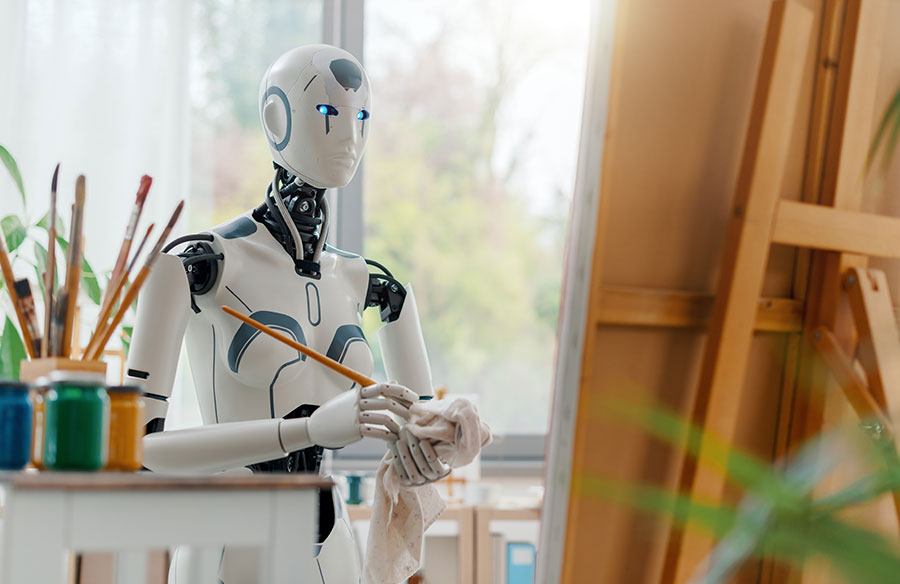
Over the past few years, artificial intelligence has made a grand entrance into the world of art.
From surreal paintings and cinematic scripts to evocative music and poetry, AI has proven it can produce content that is, at times, indistinguishable from human-made work.
But the question lingers: can AI truly be creative, or is it simply mimicking patterns in clever ways?
This debate is at the heart of a broader conversation about technology, art, and the very nature of creativity.
What Does It Mean to Be Creative?
Before diving into what AI can or can’t do, it’s worth revisiting what creativity actually means. Creativity is often described as the ability to produce something original, meaningful, and valuable.
It combines imagination, emotional depth, cultural understanding, and, at times, unpredictability.
In contrast, AI—no matter how advanced—is still rooted in mathematics, algorithms, and learned data.
It “creates” by analyzing vast amounts of existing content and generating new variations based on that input. But is that true creativity or just an extremely sophisticated form of remixing?
The Capabilities of AI in Art Today
Thanks to advances in machine learning, AI can now generate highly convincing artwork and content:
- Visual Art: Platforms like Midjourney and DALL·E 3 can create stunning images based on simple text prompts. These tools have been used in everything from marketing campaigns to album covers.
- Music: AI models like Google’s MusicLM can generate music in a wide range of genres, styles, and moods with minimal human input.
- Writing: Language models like ChatGPT and Jasper can write poetry, scripts, and essays—many of which pass as human-authored in blind tests.
A 2023 study by Deloitte reported that over 48% of creative professionals had incorporated generative AI into their workflows, particularly for ideation and rough drafts. Moreover, the AI-generated art market is booming.
According to Allied Market Research, the generative AI market in the creative sector is projected to reach $5.5 billion by 2028, up from just under $1 billion in 2022.
The Illusion of Creativity
Despite these capabilities, most experts agree that what AI does isn’t creativity in the human sense. Here’s why:
1. AI Lacks Intention
Creativity often comes from a desire to express an emotion, convey a message, or provoke thought. AI doesn’t have intentions. It doesn’t feel joy, sorrow, or inspiration. It processes data and predicts outcomes.
2. No Lived Experience
Artists draw upon their personal experiences, culture, and beliefs. A poem written by someone grieving a loss carries an emotional authenticity that an algorithm simply can’t replicate.
3. AI Can’t Truly Break the Rules
Human creativity often involves breaking conventions and exploring the unknown. AI, on the other hand, is confined to the parameters of its training data. It can only produce what it has been taught, even if the output appears unique.
As Janelle Shane, AI researcher and author of You Look Like a Thing and I Love You, puts it:
“AI doesn’t understand the art it creates. It doesn’t know what’s beautiful, funny, or moving—it only knows what’s statistically likely based on its training.”
Human + AI: A Creative Collaboration
Even if AI can’t be truly creative on its own, it excels as a collaborator. Many artists now use AI to brainstorm ideas, generate drafts, or add stylistic flair to their projects.
For example:
- Filmmakers are using AI to storyboard scenes quickly.
- Authors are co-writing with AI to explore alternate plotlines.
- Musicians are using AI to generate chord progressions or lyrics that spark inspiration.
In these cases, AI becomes a tool for amplification, not replacement.
Ethical Questions Around AI-Generated Art
As AI-generated art becomes more prevalent, so do the ethical concerns:
- Ownership: Who owns AI-created content—the user, the developer, or the model itself?
- Plagiarism and Bias: AI models often train on copyrighted works or biased datasets, which can lead to derivative or problematic content.
- Authenticity: How do we differentiate AI-generated content from human-made art?
This has led to a rise in tools designed to verify content authenticity. Using an AI detector, for example, can help determine whether a piece of text or image was created by a machine or a person—an increasingly valuable asset for educators, publishers, and journalists.
The Limits of Machine-Generated Art
While AI can generate impressive content, it’s still lacking in several key areas:
• Emotional Depth
AI can simulate emotion, but it doesn’t feel. A machine may generate a sad song, but it doesn’t understand sadness.
• Cultural Context
AI can recreate styles and themes, but it often misses nuanced cultural references, satire, or irony—elements that are essential in many forms of creative expression.
• Long-Term Narrative Thinking
AI struggles with developing long-form stories or layered themes over time. While it can write a compelling scene, sustaining character development and thematic arcs across a full-length novel or film remains a challenge.
Looking Ahead
The future of AI in art isn’t about replacement—it’s about redefinition. AI is challenging our notions of authorship, originality, and even what we consider to be art. While machines may never feel or dream the way humans do, they’re opening up a new world of possibilities where creativity becomes more collaborative, iterative, and accessible.
As the technology evolves, so too will the conversation. We’ll continue to ask not just what AI can create, but what it means for something to be creative in the first place.
Final Thoughts
So, can AI be creative? In the traditional sense—where creativity is tied to emotion, intention, and human experience—probably not.
But in a broader, more collaborative sense, AI is already reshaping the creative landscape.
Whether it’s helping artists spark ideas, streamlining workflows, or challenging us to think differently, AI is proving to be an invaluable partner in the creative process.
And as tools improve, the line between inspiration and automation will only get blurrier.
What remains clear, though, is this: true creativity is still deeply human. AI may help us create more, but it’s our stories, emotions, and perspectives that give art its soul.