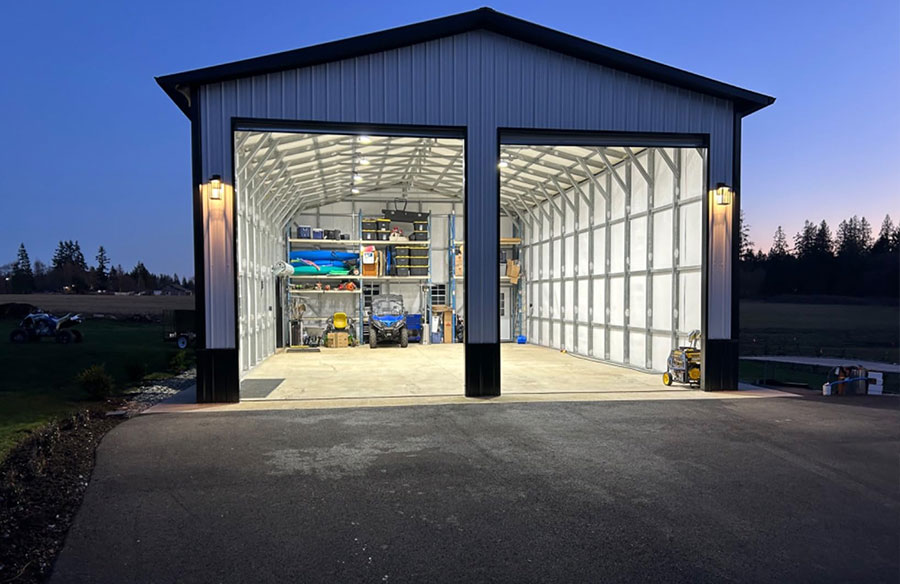
Proper lighting in the Workshop is essential for any creative or construction endeavor. Bright, clear light not only improves operator efficiency, it also creates a more comfortable, focused work environment and reduces safety risks associated with poor visibility. Choosing the right Shop Lights is the first step in creating a productive and safe workspace. So how do you choose the right shop lighting for the job?
Which lighting for the workshop should be chosen?
Here are some guidelines for choosing the best shop lighting for your workshop:
- Types of Shop Lights: The most common types of shop lights for workshops are fluorescent and LED lights, but more and more people are choosing to use LED shop lights than fluorescent lights.
LED lights have many advantages over traditional fluorescent lights, such as high energy efficiency, low electricity costs, and more robustness, which make LED shop lights more useful in a wider variety of environments.
These advantages allow LED shop lights to be used in a wider variety of environmental conditions. For example, in cold or humid environments, fluorescent lamps may become unsuitable, but LED shop lights can still maintain stable operation in harsh environments.
- Color Temperature: When choosing a light fixture, you need to check the corresponding color temperature, which represents the degree of warmth or coolness of the light and is measured in Kelvin (K). For a workshop environment, a light with a color temperature of 5000K would be more suitable.
- Color Rendering Index: The Color Rendering Index (CRI) is also an indicator that determines how accurately you will see the color in the corresponding light. If you’re doing color-critical work like painting, a CRI of 85 or higher is better.
- Installation: There are two ways to install a light fixture: a separate hardwired fixture, or a fixture with a plug that plugs directly into an outlet. If it is a hard-wired installation, experienced electricians can install the lamps more flexibly according to their own needs.
But if the electrician is inexperienced, it is best to hire a professional electrician or choose to install the lamps with plugs to ensure the safety of shop lights installation operation.
How many light fixtures do I need for a workshop?
The number of light fixtures is a common query. Reasonable arrangement and matching of the number of fixtures can ensure a more even light coverage and a better lighting experience in the working environment. We can use the following factors to plan the number of fixtures more reasonably:
1. Measurement of workshop
First of all, you need to measure the dimensions of the workshop, record the length, width and ceiling height of the workshop, and then multiply the length and width to calculate the square footage of the workshop.
2. Calculate the lumens required
For general task lighting, simply multiply the square footage by 70 to get the lumens needed for the base lighting. For example, if your workshop is 1,000 square feet, the base lumens needed would be 70,000 lumens.
If you are doing fine work, multiply the square footage by 105 to get a higher lumen value. For example, if you are doing fine work in a 1,000 sq. ft. workshop, the lumen value is 105,000 lumens.
3. Calculate the number of fixtures
After understanding the total lumen value of the workshop, you can use the lumen value of the individual fixtures selected to calculate the number of fixtures required, you can use the following formula:
Number of Lights = Total Lumens ÷ Lumens per Light
For example, for a workshop with a total lumen value of 84,000 lumens, choosing to use shop lights with 5600 lumens per light would be:
Number of shop lights = 84,000 ÷ 5600 = 15
So a maximum of 15 LED shop lights would be sufficient to get the right lighting effect.
For a workshop, it’s important to have plenty of light. Not only does clear, adequate lighting make work easier and more efficient, it also significantly reduces the number of operator errors caused by poor visibility, which in turn reduces the number of accidents and injuries. By investing in quality lighting, you are bringing security to every delicate operation. Now, it’s time to examine your work environment to see if it’s time to upgrade your lighting system.