
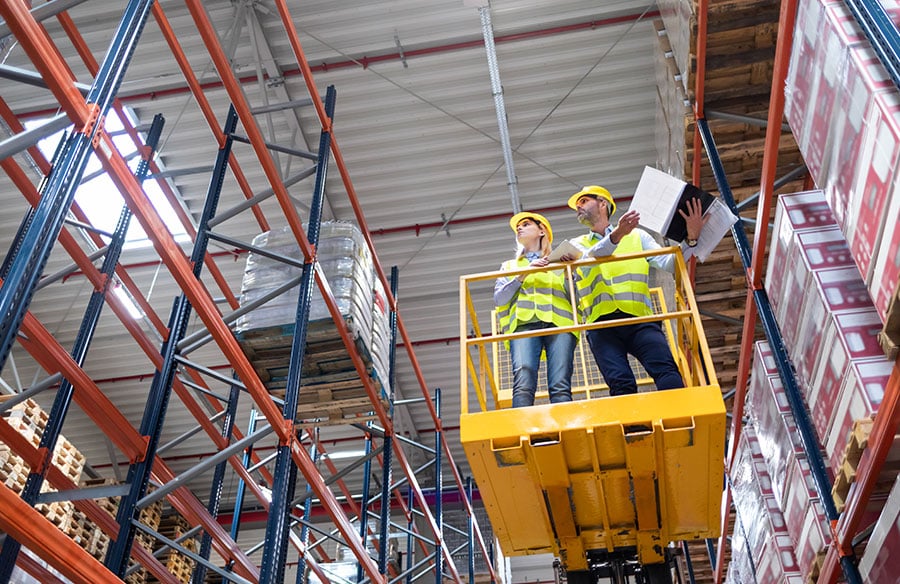
The mezzanine floor lift (AKA platform lifts or pallet lifts) is a vital piece of logistics technology with uses in various sectors. These lifts allow easy access for staff trying to reach mezzanine (raised) floors in industrial settings and warehouses. If you’re new to your industry or simply finding your feet in an unfamiliar setting, you might not understand how a mezzanine lift can be used in your career.
This piece will highlight how a mezzanine goods lift might be utilised in a self-storage, retail or industrial setting, highlighting the specific benefits within each.
Mezzanine lifts for self-storage settings
There are more than 2,200 self-storage units across the UK, with the figure steadily increasing year on year. This accounts to over 55.5 million sq ft of space with a total turnover of almost a billion pounds in 2022. Among these self-storage businesses, there are thousands of larger facilities with mezzanine floors, which is where self-operating mezzanine goods lifts come in handy.
These easy-to-use, modular mechanical lifts use HMI touchscreen controls to allow customers access to higher levels with heavy loads. They’re an essential addition to facilities where people store more substantial items like furniture or art.
Important considerations for self-storage lifts include:
- Providing sufficient safety signage
- Ensuring instructions are clearly provided
- Guaranteeing consistent power provision across the facility
Platform lifts for the retail industry
The retail industry is powered by strong storage facilities and logistics solutions. Between high street, food-based and online sectors, retail facilities occupy over 155.5 million sq ft of warehouse space in the UK, with this breaking down as:
- High street retail – 85m sq ft
- Food retail – 62m sq ft
- Online retail – 8.5 sq ft
(According to the UKWA & Cambridgeshire Chambers of Commerce)
Whether the warehouse processes pharmaceuticals, clothing or groceries, mezzanine floors are an essential structural component for maximising space usage. With this in mind, mezzanine floor lifts are viable in the industry, offering benefits such as:
- Safe handling of stock
- Reduced risk of injuries across different businesses
- Less reliance on forklifts
- Generally enhanced productivity and seamless efficiency
The best lift producers will be able to create bespoke modules, optimised for your retail sector’s specific needs.
Industrial warehouse lifting equipment
Since 2021 manufacturing has been the sector of warehousing with the most growth, with automotive warehousing also having something of a renaissance in recent years. This increase can be attributed somewhat to the UK response to the COVID-19 pandemic, with supply chains increasingly focusing on near or re-shoring. Expanding manufacturing and automotive warehouses in the UK ensures less reliance on global partnerships, especially in an increasingly unpredictable world.
Growing warehouses must have the ability to lift loads of up to 1.5 tonnes, especially if storing large pallets with items like:
- Car parts
- Heavy tools and machinery
- Barrels of paint
- Train refurbishment parts
- Aircraft parts and tyres
- Electrical components
- Office technology
Importantly, all industrial mezzanine floor lifts need to be SWL and IP65-rated to ensure their load capacity and waterproof function.
Finding the right mezzanine floor lift
When it comes to equipping your warehouse, it’s important to choose a provider with adaptability for different industries. True mezzanine lift experts will be able to provide a variety of pre-fabricated and bespoke options, ensuring that occupants and clients can handle their goods, equipment and personal belongings seamlessly. Make sure to seek out a provider with a stellar reputation, known within your industry and boasting all the proper certifications.
Connecting with the right provider will set your warehouse up for efficiency and success, whatever sector it operates within.