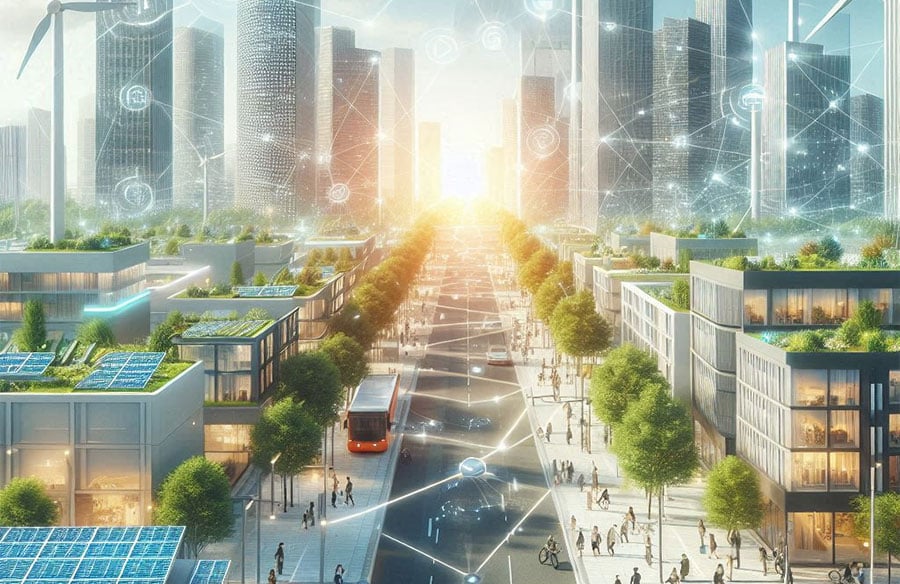
You know that moment when you adjust your home thermostat remotely? It feels seamless, almost magical. Now imagine that level of control, but scaled to entire city blocks, traffic systems, and energy networks. That’s the promise of smart data grids.
These systems aren’t just flashy tech. They’re reshaping how cities manage resources, reduce waste, and prioritize sustainability. Let’s unpack how they work, why they matter, and what tools make them possible.
Real-Time Energy Balancing: No More Guesswork
Think of a smart data grid as a traffic controller for electricity. Instead of blindly sending power to neighborhoods, it monitors usage patterns down to the second. If a solar panel array in one district overproduces, the grid reroutes surplus energy to areas in need.
Amsterdam uses this approach with its City-zen Smart Grid Project, cutting CO2 emissions by 34% in pilot zones. Sensors detect peak demand spikes, then adjust supply from renewable sources. No more relying on coal plants as backup.
Here’s the kicker: these grids need robust software to process millions of data points. Tools like the Most Trusted C# .NET Datagrid Control helps developers visualize energy flows, spot inefficiencies, and automate adjustments. It’s like giving city planners a live MRI of their power infrastructure.
Predicting Problems Before They Happen
What if a city could fix a water leak before pipes burst? Smart grids make this possible.
By analyzing historical data and real-time inputs, they flag anomalies, like a sudden drop in water pressure, and trigger alerts.
Take Barcelona’s IoT-driven grid. It reduced water waste by 25% by identifying leaks 58% faster than manual inspections. The secret? Machine learning models trained on decades of utility data.
But raw data isn’t enough. Architects need interfaces that translate numbers into actionable insights. For example, heat maps showing energy loss in buildings let designers reinforce insulation in precise areas.
Designing Smarter Buildings, Not Just Taller Ones
Ever notice how some offices feel stuffy, even with AC blasting? Smart grids tackle this by syncing HVAC systems with occupancy sensors. Empty rooms stay dormant. Crowded spaces get extra airflow.
Los Angeles’s Net Zero Accelerator Program uses this method in 12 high-rises, slashing energy costs by $4.2 million annually. The key is bidirectional communication: buildings “talk” to the grid, sharing usage data to optimize overall demand.
For developers, this means integrating APIs that let systems share data effortlessly. As noted in a 2023 Gartner report, interoperability is now the #1 hurdle in urban tech. Tools that standardize data formats are becoming non-negotiable.
The Human Factor: Making Data Accessible
Fancy algorithms mean little if planners can’t understand the output. That’s why UX design matters. Dashboards must display complex metrics, like carbon footprints or peak load times, in digestible visuals.
Compare it to a car dashboard. You don’t need to know engine RPMs to drive safely. You just need a clear speedometer and fuel gauge. Similarly, smart grid interfaces should highlight critical trends without overwhelming users.
The Road Ahead: Less Hype, More Precision
Smart grids aren’t a silver bullet. They require upfront investments in sensors, software, and staff training. But the ROI is measurable. For every dollar spent on grid modernization, cities save $4.30 in long-term operational costs, per a 2024 McKinsey analysis.
The real challenge? Avoiding fragmentation. Systems from different vendors must work together seamlessly. Open-source frameworks and tools with cross-platform compatibility will dominate the next decade.
So, what’s the first step for cities? Start small. Pilot a single neighborhood. Collect data. Iterate. Because sustainability isn’t about grand gestures. It’s about smart, incremental wins.