

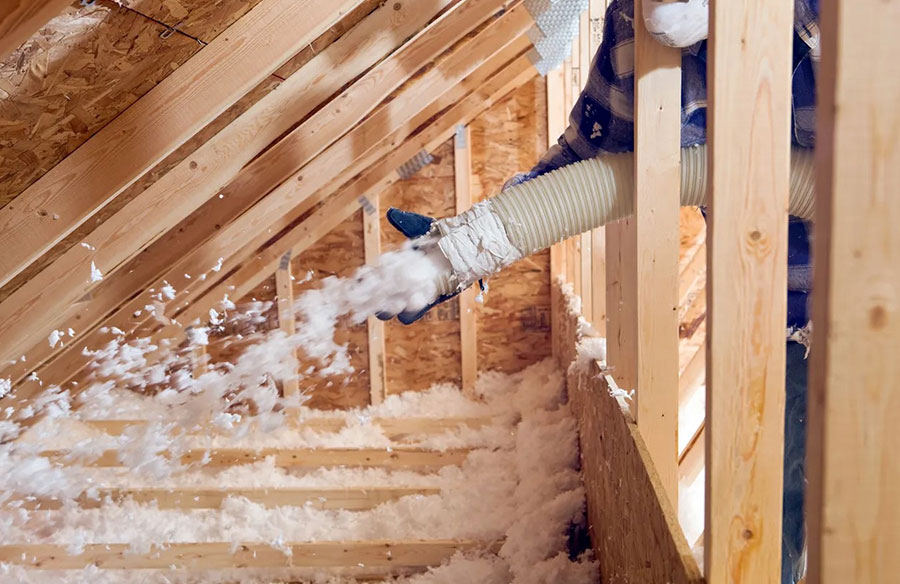
Living in a hot humid climate like Florida, you must have heard about Blown-in insulation; one of the most practical and value-to-money solutions for keeping your home comfortable year-round. Similarly in Florida, where scorching summer heat can drive attic temperatures up to 150°F, air conditioning runs nearly nonstop, the blown-in insulation acts as a shield. It safeguards your living from becoming an oven while keeping that intense heat from seeping.
Great Versatility, Excellent cost-efficiency, and Admirable air sealing are its core points when someone plans to insulate his place. Infact, on the performance side, it fills every nook and cranny, leaving no room for gaps that traditional batt insulation might miss.
Blown-in insulation is often misunderstood. Some people worry about settling, others doubt its durability in humid climates, and many simply don’t know enough about how it works. So, busting the myths, diving into the science, uncovering the facts about blown-in insulations, and Pros and cons will be our topic today.
What is Blown-in Insulation and How Does It Work?
It isn’t a mysterious thing. Research conducted by Oak Ridge National Laboratory confirms that blown-in insulation, especially cellulose, helps significantly reduce air leaks. It’s particularly effective in attic spaces where up to 25% of energy loss occurs if not properly insulated.
But the question is what actually blown-in Insulation is made of?
Blown-in insulation, made from materials like cellulose, fiberglass, or mineral wool, is a loose-fill insulation blown into place using specialized machinery. It stands out for its ability to conform to irregular spaces, unlike batt insulation that comes in sheets. This unique approach allows for thorough insulation, even in hard-to-reach places like wall cavities or irregular attic spaces.
Now, materials like Fiberglass, Rock/mineral wool, and cellulose; how do they work to insulate your home?
Technically, The process involves a high-powered blowing machine that distributes the insulation material evenly across a designated area. The blown-in fibers or particles trap air, slowing the transfer of heat through convection. And according to a study from the U.S. Department of Energy, blown-in cellulose can reduce air infiltration by up to 50% compared to traditional methods, which drastically improves a home’s thermal envelope.
- Comprehensive Coverage: Blown-in insulation can fill crevices and gaps more effectively than batt insulation, providing superior thermal performance.
- Quick and Efficient: Installation can typically be completed within hours for immediate energy savings.
- Energy Efficiency: Properly installed blown-in insulation can lower heating and cooling costs by up to 20%, especially in climates like Florida’s hot, humid summers where attic temperatures can reach as high as 150°F.
Pros and Cons of Blown-in Insulation
Pros:
- Superior coverage and air sealing
- Reduces energy loss by up to 25%
- Cost-effective compared to spray foam
- Eco-friendly options available (e.g., cellulose)
- Fire-resistant properties when treated
Cons:
- May settle over time, reducing effectiveness
- Requires professional installation for optimal performance
- Potential for moisture issues if not installed properly
- Limited R-value compared to spray foam in some cases
7 Myths About Blown-in Insulation (Debunked)
1. Blown-in insulation settles over time, reducing its effectiveness.
Fact: It’s a common myth regarding its effectiveness and value-to-money. While all loose-fill insulation settles slightly, research by the Oak Ridge National Laboratory shows that modern blown-in insulation materials, especially cellulose, lose less than 20% of their thickness after the first few months.
Even after settling, the insulation retains a high R-value and thermal resistance, thanks to the way it traps air and prevents heat transfer.
2. Blown-in insulation is not suitable for humid climates like Florida.
Fact: Spray foam is the most-effective insulation in terms of heat resistance but that doesn’t make blown-in insulation a bad choice. On the contrary, fiberglass blown-in insulation is particularly effective in humid environments.
A study conducted by the National Renewable Energy Laboratory indicates that treated blown-in insulation resists moisture absorption better than many types. Additionally, it is treated with fire retardants and mold inhibitors to resist decay, making it ideal for Florida’s moisture-heavy climate.
3. Blown-in insulation is a fire hazard because it’s made from paper/glass fibers.
Fact: Oh come on! Do you really think this is how things work? This is a common misconception. Specifically, blown-in cellulose insulation undergoes rigorous fireproofing. It’s treated with borate compounds, which are non-toxic fire retardants.
The U.S. Consumer Product Safety Commission mandates that all cellulose insulation must meet strict fire-resistance standards, and in some cases, cellulose insulation performs better in fire tests than fiberglass due to its dense composition that can actually inhibit flame spread.
4. Blown-in insulation causes respiratory issues and is unsafe for homes.
Fact: Research from the American Lung Association highlights that modern blown-in insulation materials, especially cellulose, are free from asbestos and other harmful fibers.
Unlike older types of insulation, today’s blown-in products are designed to be non-irritating and have fewer airborne particles. Whereas Fiberglass, though a competitor, also comes in newer formulations with less dust.
5. Blown-in insulation can’t be installed in existing homes without major construction work.
Fact: Practicality and installation-wise, it’s a way less mess than the latest spray foam. Blown-in insulation is actually one of the most non-invasive insulation methods available for retrofit projects.
According to the Department of Energy, it can be installed through small access points, whether in attics or within existing walls. This minimizes disruption while still delivering full coverage and energy efficiency improvements.
6. Blown-in insulation doesn’t offer much long-term savings on energy bills.
Fact: This couldn’t be further from the truth. A report by Energy Star shows that homes with blown-in insulation can save up to 15% on heating and cooling costs annually. In hot climates like Florida, where attic temperatures can reach over 150°F, blown-in insulation dramatically reduces heat infiltration, resulting in substantial long-term savings.
7. Blown-in insulation installation is a DIY-friendly project.
Fact: It may seem like a quick fix, but proper installation of blown-in insulation requires specialized skills and equipment. TLS Energy Savers, Professional Blown-in Insulation Installers from TLS Energy Savers ensure even coverage, correct density, and proper sealing to prevent air leaks.
A study by the Department of Energy shows that poor installation can reduce insulation effectiveness by up to 30%, leading to significant energy loss. Hiring certified installers guarantees optimal performance, making a real difference in energy savings and comfort.
Blown-in Insulation vs. Other Types
Blown-in Insulation vs. Fiberglass Batts
Blown-in insulation holds superior coverage compared to fiberglass batts, particularly in irregular or hard-to-reach spaces. Studies show that blown-in insulation fills gaps more effectively, minimizing air leakage, which is critical for Florida’s hot and humid climate.
Fiberglass batts, while cheaper upfront, are prone to leaving voids in complex architectural spaces, potentially allowing heat transfer. Additionally, blown-in insulation typically offers higher R-values per inch, ensuring better thermal performance in extreme temperatures.
Blown-in Insulation vs. Spray Foam
Spray foam has a way higher R-value than blown-in insulation, but its cost is considerably higher. But practicality-wise, blown-in insulation is less disruptive during installation and doesn’t require as much prep work.
Research suggests that for attics and walls where retrofitting is needed, blown-in insulation can achieve similar energy efficiency results at a fraction of the cost. Spray foam excels in moisture resistance and sealing properties, but blown-in insulation still performs well when properly installed and treated with fire-resistant and moisture-resistant additives.







