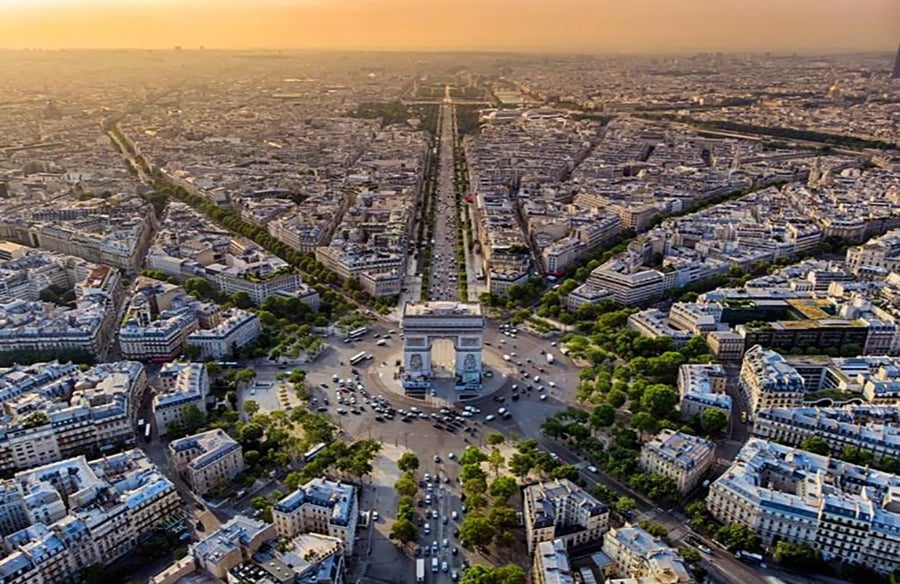
The Étoile, France – Biggest roundabouts in the world
Nestled at the heart of Paris, the Étoile, also known as Place Charles de Gaulle, stands as a testament to the seamless fusion of history, architecture, and urban planning. This iconic roundabout, with its grandeur and strategic significance, not only serves as a major transportation hub but also unveils a rich tapestry of French history and culture.
Architectural Marvels
Arc de Triomphe: A Symbol of Triumph
At the core of the Étoile lies the magnificent Arc de Triomphe, an architectural masterpiece commissioned by Napoleon Bonaparte after his victory at Austerlitz in 1805. Designed by Jean Chalgrin, this neoclassical monument stands 50 meters tall and commemorates the soldiers who fought and died for France during the French Revolutionary and Napoleonic Wars.
Radiating Boulevards: An Urban Symphony
The Étoile isn’t just a roundabout; it’s a hub that connects twelve radiating avenues, creating a star-shaped pattern that is a hallmark of Parisian urban planning. Each avenue tells a story of its own, adorned with historic buildings, charming cafes, and designer boutiques. The urban design emphasizes both functionality and aesthetics, providing a delightful experience for pedestrians and motorists alike.
Urban Planning and Design
Haussmann’s Influence: Shaping Parisian Grandeur
Baron Georges-Eugène Haussmann, the visionary urban planner appointed by Napoleon III in the mid-19th century, played a pivotal role in transforming the cityscape of Paris. The wide boulevards and open spaces around the Étoile are a testament to Haussmann’s vision of modernizing the city, promoting better traffic flow, and enhancing the overall quality of urban life.
The Étoile as a Traffic Hub
As a major traffic junction, the Étoile is a critical component of Parisian transportation infrastructure. The careful orchestration of traffic around the roundabout ensures the smooth flow of vehicles, making it a vital node for both locals and tourists navigating the city. The Étoile’s design accommodates the convergence of multiple avenues, facilitating efficient transportation within the city.
Historical Significance
Witness to History: The Étoile in Modern Times
Beyond its architectural splendor and urban functionality, the Étoile has witnessed numerous historic events. From military parades celebrating victories to the annual Bastille Day festivities, the roundabout stands as a silent spectator to the evolution of French society. Its central location has made it a focal point for public gatherings, political demonstrations, and celebrations throughout the decades.
Preserving the Étoile’s Legacy
Conservation Efforts: Balancing Modernization and Heritage
Preserving the Étoile’s historical and architectural significance is a delicate dance between modernization and heritage conservation. Ongoing efforts by city authorities and preservationists ensure that the roundabout maintains its charm while adapting to the evolving needs of a bustling metropolis. Striking this balance is crucial to sustain the Étoile’s role as a cultural and architectural icon.
Conclusion
In conclusion, the Étoile in France transcends its role as a mere roundabout; it is a living testament to the intertwined narratives of architecture, urban planning, transport, and history. From the grandeur of the Arc de Triomphe to the radiating boulevards that define Parisian elegance, every facet of the Étoile contributes to its allure. As visitors navigate its avenues and locals pass by, the Étoile continues to be a symbol of triumph, a hub of urban connectivity, and a repository of France’s storied past. As we marvel at its architectural splendors, let us also recognize the responsibility to preserve and cherish this iconic landmark for generations to come.