Adjacent to the site of the Chabad Lubavitch Family and Cultural Centre in Berlin’s Charlottenburg Wilmersdorf district, the community centre Pears Jewish Campus Berlin is a facility for children and young people consisting of a school, a crèche, and a kindergarten.
Project Name: Pears Jewish Campus Berlin
Studio Name: Tchoban Voss Architekten Gmbh
Address: Westfaelische Strasse 15, 10709 Berlin
Client: Chabad Lubavitch Berlin e.V., Berlin
Gross floor area: 8,000 sqm incl. basement
Completion: August 2023
Work stages:1-5, artistic direction
Architect: Sergei Tchoban
Associated partner: Frederik-Sebastian Scholz
Project management: Frederik-Sebastian Scholz, Nancy Wendland
Team: Lev Chestakov, Eimear O’Gorman, Valeria Kashirina, Birgit Koeder, Anja Koch, Charlotte Lennertz, Ingo Schwarzweller, Ramona Schwarzweller, Waldemar Strese, Niina Ballheimer, Fabiana Pedretti
Photographer: Roland Halbe, Klemens Renner

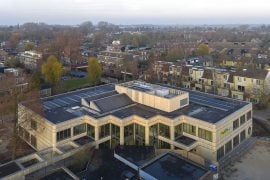
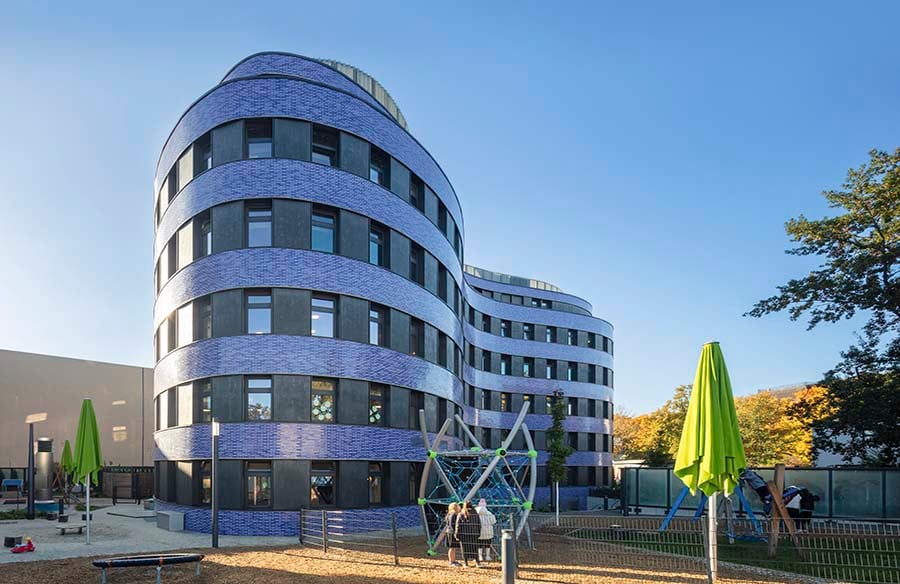
Surrounded by heterogeneous architecture, the new school building with its organically curved form is a free-standing structure embedded in a green school garden with diverse open spaces for different uses, such as playgrounds and sports fields. The two-storey multi purpose hall on the third floor can be used flexibly for sports activities but also for cultural events, such as religious celebrations, or for seminars and conferences. On the fifth floor there is an auditorium with ascending tiers for film screenings or lectures.
The building also has a dining room and a kosher kitchen. The rooms of the basement on the concave side of the building have access to the outside area. Here green cascades with steps lead up to normal ground level.

The curved, amorphous shape of the building is reminiscent of a Torah scroll and was chosen in reference to the interior of the Chabad-Lubavitch Centre, where the contemporary additions to the rectangular, Neoclassical existing building were deliberately executed in the same organic formal language with rhythmic horizontal banding that appears in the structural form and façade of the new building. The vertical slits of light within the horizontal bands on the school’s façade are also a motif found in the interior panelling of the neighbouring synagogue.


The roof slab is a slope-free inverted roof with a two-layer waterproofing in accordance with the flat roof directive. The roof surface will be extensively greened. The school’s main entrance is accessible from street level. Its walls are adorned with two kabbalistic trees of life – light installations by the Berlin artist Anna Nezhnaya. The two brightly coloured trees that greet people at the entrance to the campus are more poetically picturesque than schematic. An oak and an olive tree, they symbolize the two countries – Germany and Israel. The two-storey entrance hall has a mirrored ceiling as a special design element. From the adjacent staircase, all floors are wheelchair accessible via at least one lift.
The concrete wall on the street side shows graffiti by the Berlin street artist TOBO, aka Tobias Friesike.
The facility is intended for use by 450 children and adolescents, ranging from children of crèche or kindergarten age up to grade 12, i.e. between the ages of approximately one and 18. The school rooms (classrooms, subject classrooms, assembly rooms, workshops) are used exclusively by the school; the group rooms, exclusively by the daycare centre.

The façade
Constructed in masonry and concrete, the building immediately catches the eye with its colourfulness and materiality. This is where its name, ‘The Blue House’, comes from. In terms of form and style, the design of the school building again refers to the neighbouring family and cultural centre: there is a colour connection between the iridescent, sky-blue midnight-blue-violet glazed, rear-ventilated clinker-brick façade of the new school building and the blue-white glazed entrance portal of the Jewish cultural centre in the front part of the site.