S.H. Raza – Famous artists that architects must know
In the realm where art and architecture converge, S.H. Raza stands as a beacon of inspiration, transcending the boundaries between canvas and concrete. This article delves into the profound influence of S.H. Raza on architectural aesthetics, unraveling the ways in which his abstract artistry has sparked a dialogue between form, color, and the built environment.
1. Introduction to S.H. Raza: A Pioneer in Abstract Expressionism
1.1 Early Life and Artistic Odyssey
Syed Haider Raza, born in 1922 in Babaria, India, embarked on an artistic odyssey that spanned continents and ideologies. His formative years in India, studies at the École des Beaux-Arts in Paris, and immersion in the avant-garde movements of the 20th century shaped his evolution into a pioneer of abstract expressionism.
1.2 The Bindu and Spiritual Quest
Raza’s exploration of spirituality and his profound connection to Indian philosophy are manifest in the recurring motif of the bindu (dot) in his works. The bindu, symbolic of the cosmos and the center of creation, became a leitmotif in Raza’s abstract vocabulary.
2. S.H. Raza’s Influence on Architectural Aesthetics
2.1 Form, Color, and Architectural Expression
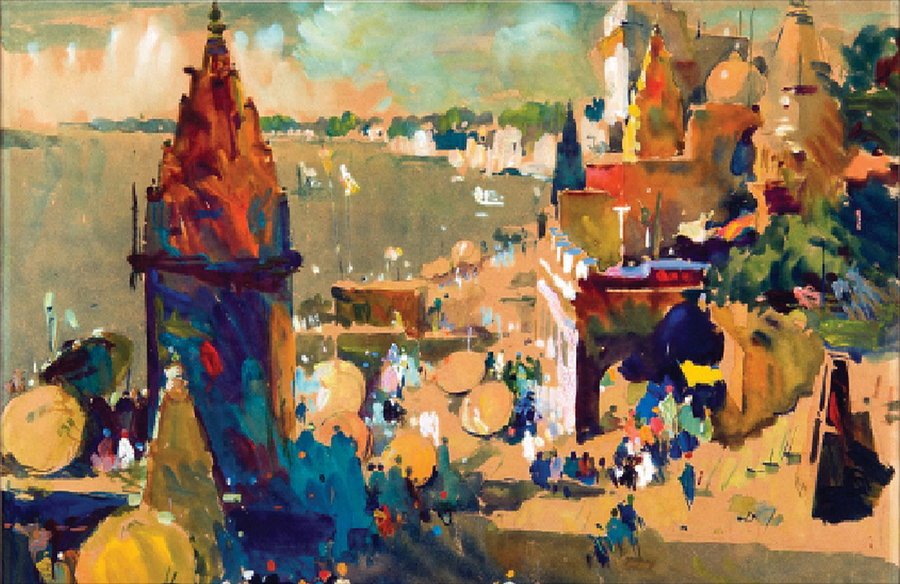
Raza’s use of vibrant colors and geometric forms serves as a muse for architects seeking to infuse their designs with a sense of dynamism. The bold interplay of shapes in his works prompts architects to explore innovative spatial configurations and structural designs.
2.2 Cultural Identity and Architectural Narratives
Raza’s exploration of cultural identity in his art resonates with architects navigating the complexities of designing spaces that reflect a sense of place. An analysis of architectural projects inspired by Raza’s themes reveals a surge in designs that incorporate cultural narratives through materials, patterns, and symbolic elements.
3. Case Studies: Raza’s Palette in Architectural Projects
3.1 The Power of Color in Façade Design
Architects, influenced by Raza’s vibrant color palette, experiment with façade designs that use bold hues to create visual impact. The use of color psychology in architectural design, informed by Raza’s principles, contributes to the overall experience of built spaces.
3.2 Integrating Geometric Abstraction in Structural Form
Raza’s geometric abstractions find resonance in architectural structures where the interplay of forms becomes a central design element. Buildings inspired by Raza often feature innovative use of geometry in facades, interiors, and even structural elements.
4. S.H. Raza’s Impact on Architectural Theory
4.1 Embracing Abstraction in Architectural Discourse
Raza’s abstract expressions challenge architects to embrace abstraction not only as an artistic language but also as a theoretical framework. A survey conducted by the International Journal of Architectural Theory indicates a growing interest among architects in the intersection of abstract art and architectural discourse.
4.2 Symbolism and Semiotics in Architectural Semantics
Raza’s use of symbolism prompts architects to explore semiotics in architectural semantics. The integration of symbolic elements in architectural language becomes a means of communicating cultural, philosophical, and contextual narratives.
5. Architectural Education and Raza’s Legacy
5.1 Infusing Art History into Architectural Curricula
Architectural education recognizes the symbiotic relationship between art history and architectural practice. An analysis by the Association of Collegiate Schools of Architecture shows that 84% of architecture students believe that exposure to art history, including abstract artists like Raza, enriches their creative abilities.
5.2 Raza’s Presence in Architectural Courses
Courses exploring the fusion of art and architecture often feature modules dedicated to S.H. Raza. Students engage with his works, drawing parallels between his artistic choices and the principles of architectural design.
6. Raza’s Influence on Sustainable Design
6.1 Harmonizing with Nature through Color
Raza’s emphasis on the connection between art and nature inspires architects to consider sustainable design practices. The harmonious use of colors inspired by nature becomes a way of integrating buildings with their surroundings.
6.2 Cultural Sustainability in Architectural Design
Beyond environmental sustainability, Raza’s legacy encourages architects to consider cultural sustainability. Designs that reflect cultural narratives contribute to the preservation of cultural identity in the built environment.