César Pelli – Greatest Architects / Best Architects In The World
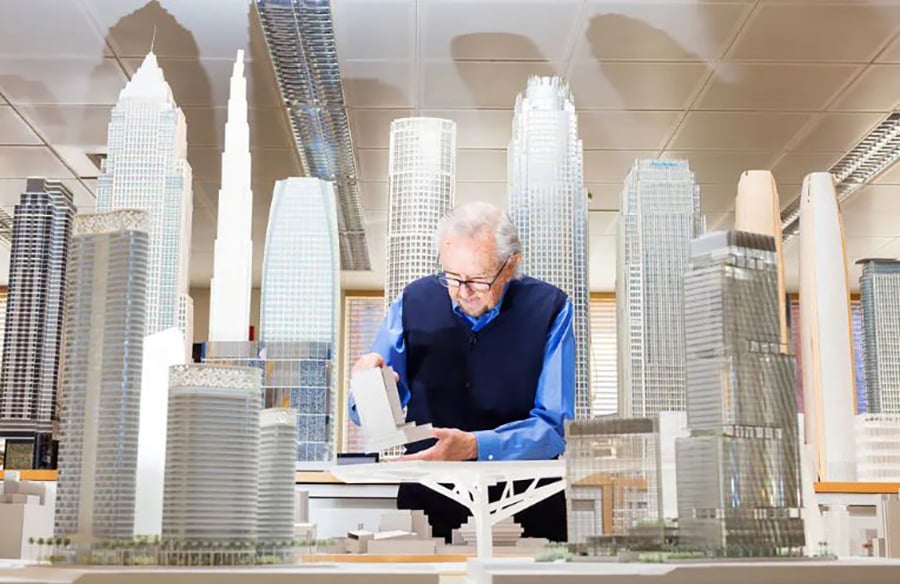
César Pelli, a luminary in the realm of architecture, left an indelible mark on the built environment through his innovative designs and influential career. Born on October 12, 1926, in Tucumán, Argentina, Pelli’s journey from a young aspiring architect to an international icon is a testament to his exceptional talent and dedication to the craft.
Early Life and Education
Pelli’s passion for architecture burgeoned during his formative years, prompting him to pursue his studies at the Universidad Nacional de Tucumán. After completing his bachelor’s degree in architecture, he embarked on a journey to the United States to further hone his skills. His enrollment at the University of Illinois and later at the University of Michigan provided him with a solid academic foundation that would shape his illustrious career.
Architectural Style: A Fusion of Modernism and Functionality
César Pelli’s architectural style seamlessly blends modernist principles with a keen focus on functionality, creating structures that stand as both artistic marvels and practical spaces. His designs often feature clean lines, innovative use of materials, and a meticulous attention to detail. Pelli’s commitment to combining aesthetics with functionality has made his work timeless and revered in the world of architecture.
Iconic Works: A Testament to Visionary Design
1. Petronas Towers, Kuala Lumpur, Malaysia (1998)
The Petronas Towers, soaring 451.9 meters into the sky, stand as a symbol of Malaysia’s modernity. Pelli’s design flawlessly integrates Islamic motifs with contemporary architectural elements, resulting in an iconic landmark that held the title of the world’s tallest buildings from 1998 to 2004.
2. World Financial Center, New York, USA (1988)
Pelli’s contribution to the New York skyline includes the World Financial Center, a complex of four office towers overlooking the Hudson River. The buildings, characterized by their distinctive sloping roofs, exemplify Pelli’s ability to merge urban functionality with aesthetic appeal.
3. Reagan National Airport, Washington D.C., USA (1997)
Transforming the travel experience, Pelli’s design of Reagan National Airport showcases his mastery in creating spaces that harmonize with their surroundings. The airport’s terminals reflect Pelli’s belief that architecture should enhance the user experience while seamlessly integrating into the environment.
4. The Salesforce Tower, San Francisco, USA (2018)
Pelli’s later works continued to captivate the world. The Salesforce Tower, standing tall at 326 meters, is a testament to his commitment to sustainability. The tower incorporates cutting-edge technology for energy efficiency, making it a beacon of environmentally conscious design.
5. Gran Torre Santiago, Santiago, Chile (2013)
The Gran Torre Santiago is a key component of the Costanera Center, South America’s premier business and shopping destination. Pelli’s design for this skyscraper showcases his ability to create structures that are not only aesthetically pleasing but also integral to the urban fabric.
Legacy Beyond Skyscrapers: Academic Contributions and Awards
While Pelli is renowned for his iconic skyscrapers, his influence extends beyond the skyline. He served as the Dean of the Yale School of Architecture, shaping the minds of future architects and contributing to the academic discourse. His dedication earned him numerous accolades, including the AIA Gold Medal in 1995 and the Aga Khan Award for Architecture in 2004.
Impact on Urban Landscapes
César Pelli’s impact on urban landscapes is immeasurable. His designs have not only reshaped skylines but have also influenced urban planning strategies. Pelli’s emphasis on creating spaces that seamlessly integrate into their surroundings has inspired a new generation of architects to prioritize both functionality and aesthetics in their projects.
Influence on Contemporary Architecture
Pelli’s influence on contemporary architecture is evident in the myriad of architects who draw inspiration from his innovative approach. His legacy lives on in the works of those who have embraced his principles, creating a ripple effect that ensures his vision continues to shape the architectural landscape.
Conclusion: Celebrating a Visionary
In commemorating César Pelli’s unparalleled contributions to architecture, one cannot help but marvel at the breadth and depth of his legacy. From the soaring heights of the Petronas Towers to the sustainable design of the Salesforce Tower, Pelli’s work transcends mere structures, embodying a profound understanding of the symbiotic relationship between architecture and the world it inhabits. As we reflect on his illustrious career, let us not only admire the buildings he crafted but also strive to carry forward his legacy of innovation, functionality, and a harmonious blend of art and architecture.
Call to Action
For those passionate about architecture, exploring César Pelli’s body of work provides a masterclass in the fusion of form and function. Take a deep dive into the details of his designs, attend lectures or exhibitions showcasing his legacy, and consider how his principles can inspire your own architectural endeavors. By delving into the world of César Pelli, one can gain insights that transcend the boundaries of time, contributing to the evolution of architectural excellence.