Blue Pottery – Handicrafts of Rajasthan
Nestled in the colorful tapestry of Rajasthan’s handicraft heritage, Blue Pottery emerges as an exquisite art form that seamlessly marries tradition with innovation. This article unveils the rich legacy and intricate craftsmanship of Blue Pottery, exploring its historical roots, unique design techniques, and the enduring charm that distinguishes it as a jewel in Rajasthan’s artistic crown.
Historical Roots: Crafting Timeless Elegance
1. Origins in Persian and Central Asian Influences
Blue Pottery finds its origins in the rich cultural exchanges between Persia, Central Asia, and India. Introduced to Rajasthan by skilled artisans, the craft embraced local influences, adapting and evolving over centuries. The intricate patterns and vibrant blue hues became synonymous with the region’s artistic identity.
2. Evolution in the Royal Ateliers of Jaipur
During the 17th century, under the patronage of Maharaja Sawai Jai Singh II, the Blue Pottery craft found a nurturing environment in the royal ateliers of Jaipur. Artisans honed their skills, experimenting with designs, glazes, and shapes. The royal connoisseurs appreciated the art, and Blue Pottery became a cherished symbol of regal refinement.
3. Decline and Resurgence
In the subsequent centuries, the art of Blue Pottery faced challenges, including competition from mass-produced ceramics. However, a resurgence occurred in the mid-20th century, fueled by the efforts of dedicated artisans and a growing appreciation for handmade, traditional crafts. Today, Blue Pottery stands as a testament to the resilience and adaptability of Rajasthan’s artistic traditions.
Distinctive Techniques: The Art of Blue Pottery
1. Raw Materials and Clay Composition
Unique Blend of Quartz and Multani Mitti
The distinctive blue-green glaze of Blue Pottery is achieved through a unique blend of quartz, fullers’ earth (Multani mitti), sodium sulfate, and raw glaze ingredients. This composition, combined with the use of Egyptian paste, sets Blue Pottery apart from other ceramic traditions.
2. Handcrafted Molding and Shaping
Artisan’s Hands as the Primary Tools
Unlike other pottery forms that extensively use the potter’s wheel, Blue Pottery relies on hand-molding techniques. Artisans skillfully shape the clay using their hands, giving each piece a distinct character. The absence of the potter’s wheel in Blue Pottery adds to its charm and reflects the artisan’s mastery.
3. The Art of Glazing and Firing
Bisque Firing and Low-Temperature Glazing
Blue Pottery involves a unique firing process. The first firing, known as bisque firing, is done at a lower temperature. Following this, the piece is glazed with the signature blue-green mixture and subjected to a second firing. The low-temperature glazing preserves the vibrant colors and prevents the clay from vitrifying.
Design Elements: Intricacy in Every Stroke
1. Floral Motifs and Geometric Patterns
Nature’s Bounty as Inspiration
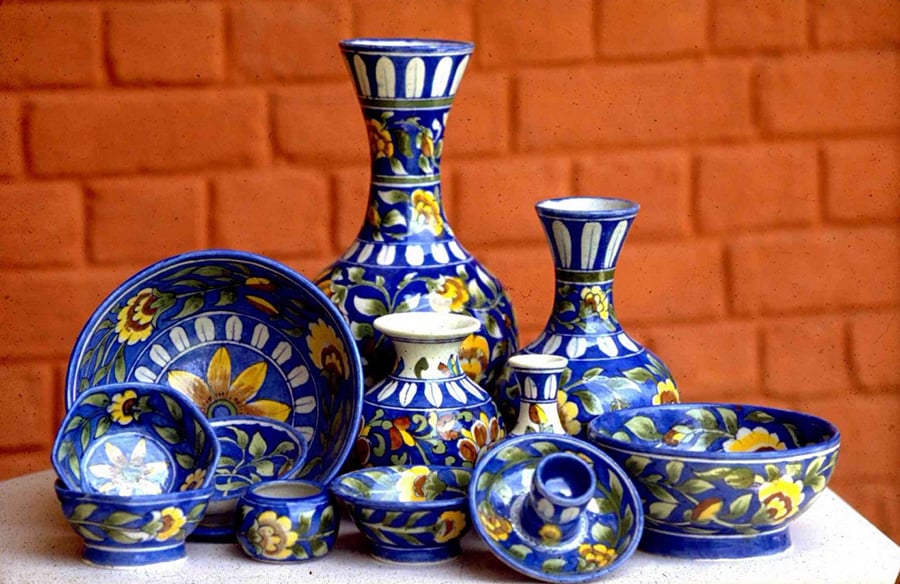
Floral motifs, inspired by the bountiful nature of Rajasthan, dominate Blue Pottery designs. Artisans intricately hand-paint flowers like lotus, roses, and marigolds. Geometric patterns, another hallmark of Blue Pottery, showcase the artisan’s precision in creating symmetrical and visually appealing arrangements.
2. Calligraphy and Persian Influence
Expressing Poetry on Clay
Blue Pottery often features calligraphy, a testament to its Persian and Central Asian roots. Artisans skillfully inscribe verses, couplets, or names onto the pottery, adding a poetic and personalized touch. The fluidity of the calligraphy harmonizes with the rigid geometry, creating a delightful contrast.
3. Animal Motifs and Cultural Symbolism
Spirit of Rajasthan in Clay
Animal motifs, such as elephants and peacocks, find prominence in Blue Pottery, reflecting the cultural symbolism of Rajasthan. These designs symbolize prosperity, royalty, and the vibrant wildlife of the region. Each motif narrates a story, connecting the craft to the cultural ethos of Rajasthan.
Utility and Decor: Blue Pottery’s Versatility
1. Utilitarian Ware: Bowls, Plates, and Tiles
Functional Elegance
Blue Pottery transcends its decorative appeal to serve utilitarian purposes. Bowls, plates, and tiles adorned with intricate patterns become functional art pieces. The craft seamlessly integrates beauty with utility, transforming everyday items into objects of aesthetic delight.
2. Decorative Art Pieces: Vases, Figurines, and More
Elevating Spaces with Artistry
Vases, figurines, and wall hangings crafted in Blue Pottery enhance interior spaces with their artistic allure. The versatility of the craft allows artisans to create both traditional and contemporary designs, catering to diverse tastes and preferences.
3. Architectural Applications: Tiles and Murals
Enriching Built Environments
The vivid hues and intricate patterns of Blue Pottery find expression in architectural applications. Tiles and murals, often used to embellish walls and facades, bring a touch of Rajasthan’s cultural vibrancy to homes, hotels, and public spaces.