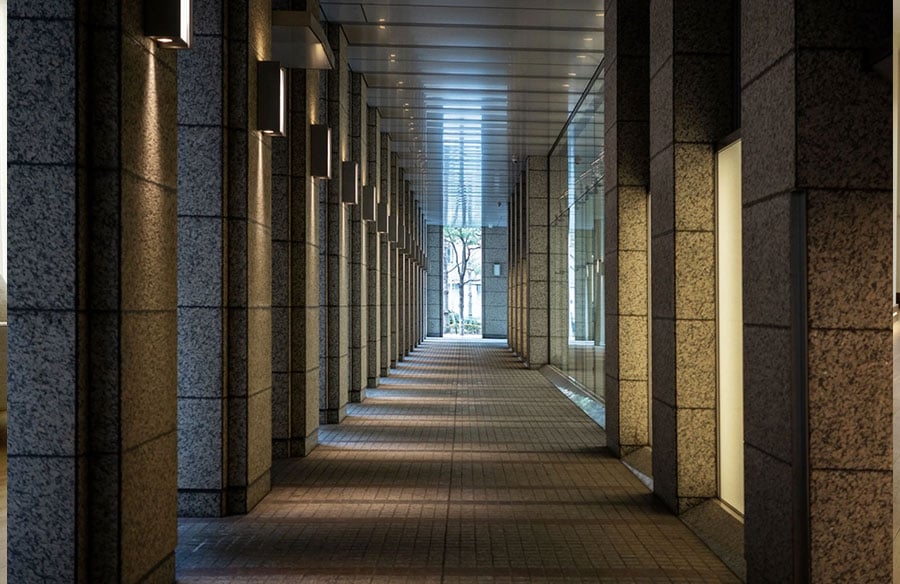
Walk through a recently completed commercial interior and notice what the surfaces are doing. The floors repeat at precise intervals. The wall cladding tiles in a pattern that loops every meter. The reception desk carries a stone-effect finish that looks convincing until the eye finds where the pattern resets. Everything is clean, consistent, and resolved. Nothing asks the eye to keep looking.
This is the visual language of contemporary built environments — surfaces optimized for reproduction, not habitation. They photograph well and specify cleanly. What they rarely do is sustain attention once the first impression has been processed.
Natural stone produces a different experience. Not because it signals tradition or cost. Because it behaves in a way that fabricated surfaces cannot. It does not repeat. It does not resolve. Instead , it keeps producing visual information as light shifts, as the observer moves, as the day progresses. In an era defined by digital perfection, this is why it feels more real — not despite its imperfections, but because of them.
The visual language of digital surfaces
Digital fabrication has changed what surfaces look like in contemporary architecture. The tools available today produce finishes of extraordinary technical quality — consistent color, controlled texture, repeatable pattern at any scale. For production, this is useful. For spatial experience, it has consequences worth examining.
The dominant aesthetic is optimized uniformity. AI-generated textures appear varied while staying within defined parameters. Large-format printing extends patterns across surfaces without visible joins. The result is environments where surfaces are, in a precise sense, rendered — designed to look complete before they are inhabited.
This is the visual logic of the screen applied to physical space. Digital environments are optimized for viewing: consistent, backlit, resolved. When that logic migrates into built surfaces, it produces spaces that read like high-resolution images of spaces — accurate but flat, present but perceptually closed.
The irony is that as fabrication improves, its products become harder to perceive as anything other than fabricated. The better the imitation, the more clearly the imitation logic is felt. Visual accuracy alone does not necessarily create the same perceptual experience as material authenticity.
How the brain reads repetition
The brain scans environments for pattern structure continuously. This runs below conscious thought — registering regularities, building a model of the space from accumulated visual data.
When a surface repeats at consistent intervals — even subtly, even at large scale — the brain detects the loop. The surface closes. The eye has gathered what it contains, the pattern is resolved, and the surface stops being a field of ongoing engagement. It becomes the background.
Natural systems do not work this way. The mineral distribution in granite, the veining in marble, the crystalline structure in labradorite — none of these follow repeating logic. They are products of geological processes that operate under continuously varying conditions over enormous spans of time. No two sections are identical. No pattern loops. The surface resists visual closure.
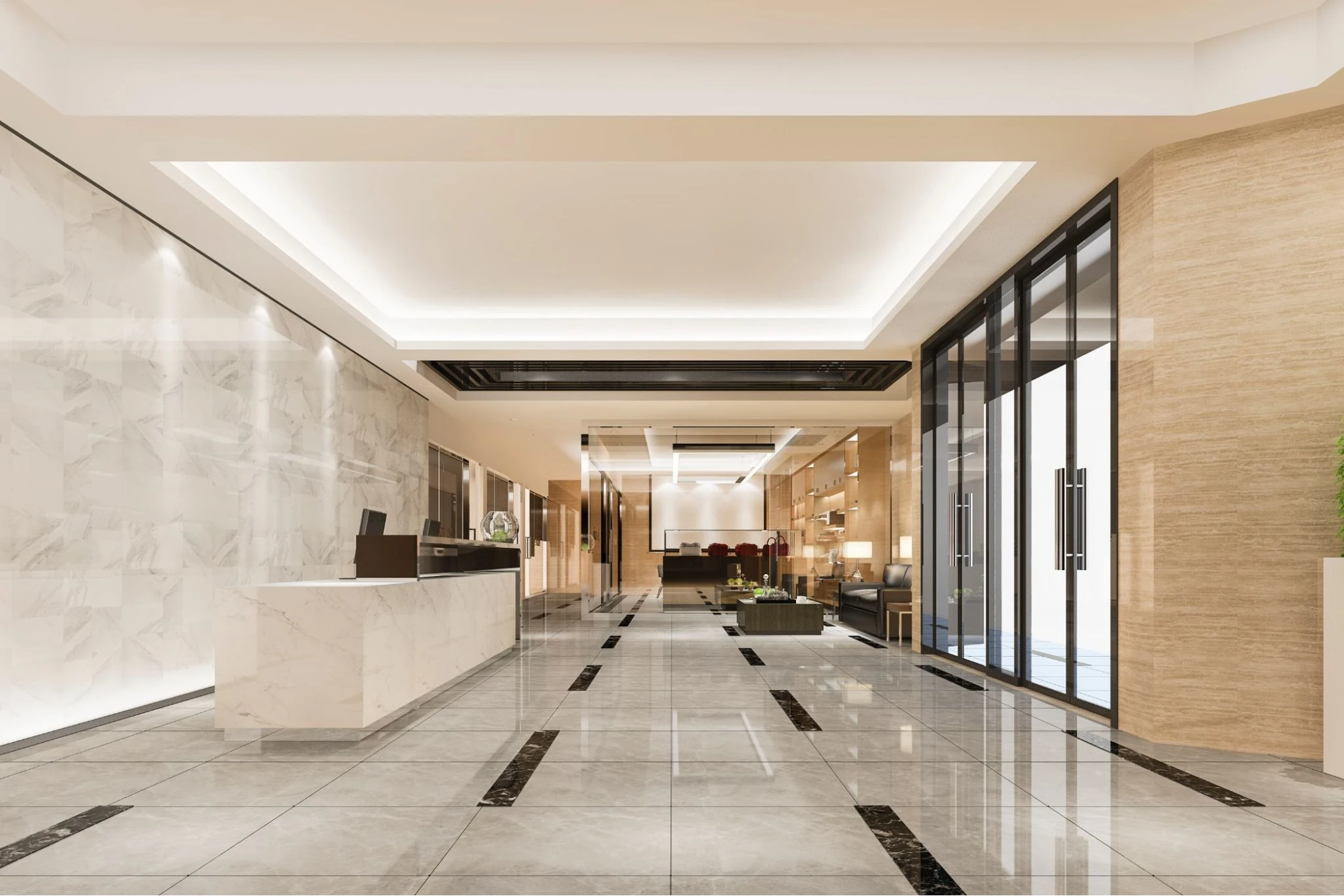 These surfaces tend to sustain visual engagement longer — not because they are more beautiful in some fixed sense, but because they keep offering new information at different distances, under different light, from different angles. In architectural terms, sustained engagement shapes how a space is experienced over time.
Material fatigue and the limits of synthetic authenticity
Most people have experienced a specific perceptual phenomenon without having a name for it. Call it material fatigue — the cumulative effect of time spent in environments dominated by synthetic surfaces.
It builds slowly. Through the steady processing of surfaces that offer nothing new to read, the environment starts to feel static — resolved at the moment of completion and unchanged since. There is nothing left to discover in it.
This is not about minimalism. A spare interior can be perceptually rich if its surfaces respond to light and shift in character across the day. The issue is not complexity versus simplicity. It is whether surfaces stay perceptually active or go silent.
Synthetic surfaces tend toward silence. Once the eye processes the pattern logic — often in the first moments of entering a space — the surfaces recede. They become the container, not the content, of spatial experience. For short occupancy this is often fine. For spaces where people spend hours or years, it shapes experience in ways that are rarely measured but consistently felt.
Imperfection as perceptual evidence
Natural irregularity generates trust in material perception for a specific reason. It has to do with how the brain interprets evidence of formation.
When a surface varies the way natural stone varies — without pattern logic, with shifts that follow mineral rather than design sequences — the brain reads this as evidence of physical process. Not design intent. Not fabrication. Process. The surface carries the record of how it came to exist, and that record is legible to perception even without conscious identification.
This is different from designed imperfection — distressed surfaces, printed variation, controlled randomness within manufacturing parameters. Perceptually, the difference often remains detectable. Designed variation is still variation within a system. Natural variation is the system itself.
Extra large granite slabs allow the material to be read as a continuous spatial field — geological variation extending uninterrupted across walls and floors, carrying depth, light response, and mineral distribution that no fabrication process can generate from the outside in. The surface is not decorated with variation. It is constituted by it.
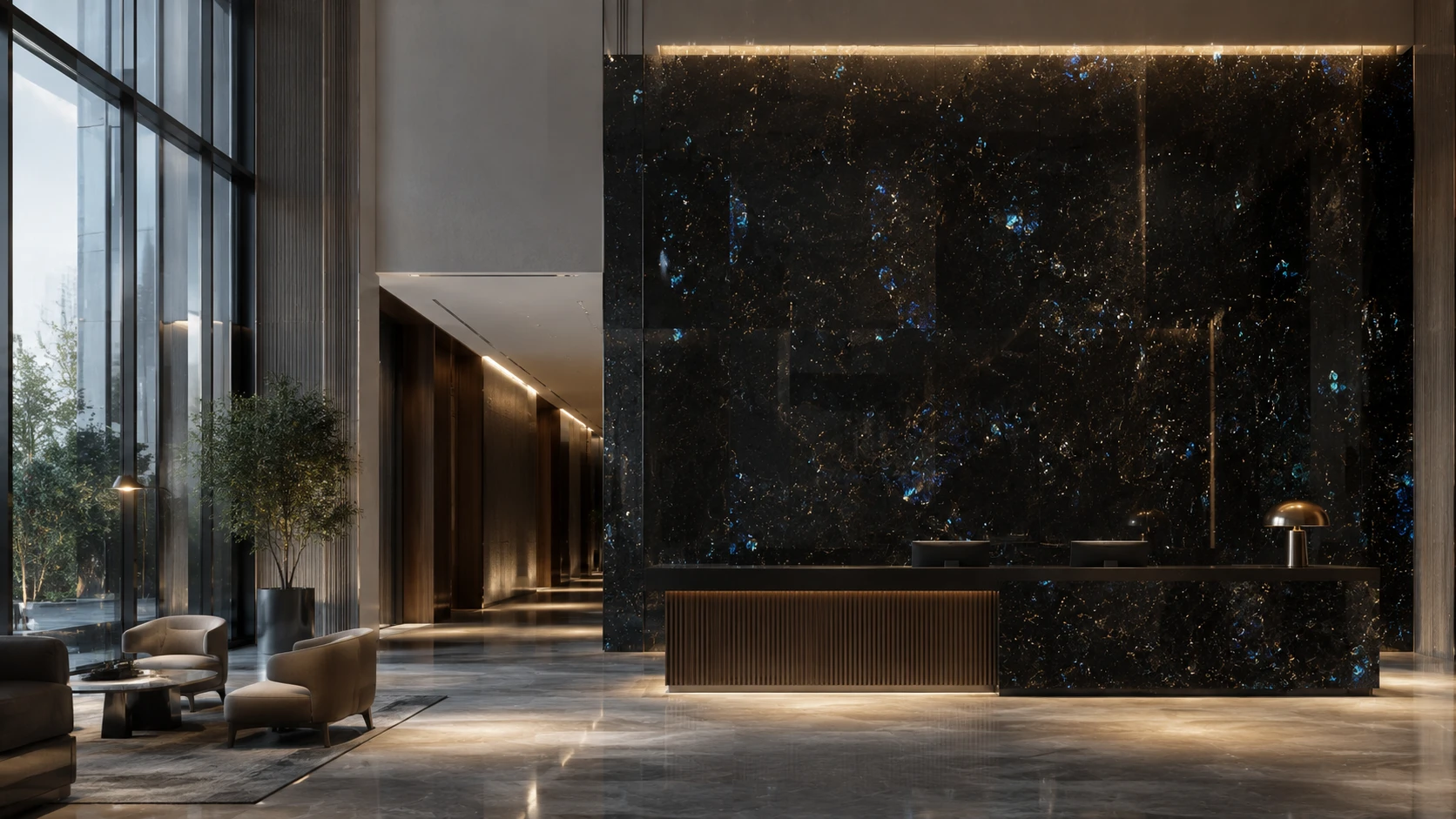 This is what makes natural stone perceptually irreducible. Not that it looks different from synthetic alternatives. But that it behaves differently — and the brain, reading surfaces as evidence rather than images, responds to that in ways that shape spatial experience at a fundamental level.
Tactile honesty as an architectural value
Something is shifting in how architects talk about materials. The conversation has moved toward what might be called tactile honesty — the quality of a material that shows how it formed, rather than concealing it.
This is not nostalgia for predigital craft. It is a response to a specific cultural moment. As digital fabrication becomes the default language of built surfaces, materials that cannot be digitally reproduced gain a different kind of significance. Their value lies not in what they look like, but in what they cannot be made to look like by any other means.
A surface that carries its geological history — in its mineral distribution, its color variation, its behavior under light — communicates something optimized surfaces cannot. It tells the truth about its own existence. In a visual environment saturated with rendered consistency, that quality is becoming architecturally meaningful in ways it simply was not when natural materials were the default.
Stone in the age of the algorithm
Natural stone’s relevance in contemporary practice is not about historical association. It is about structural incompatibility with algorithmic reproduction.
No two slabs are identical. No surface repeats. No slab behaves the same under different lighting at different times of day. These are not qualities that can be added through better fabrication. They are properties of a geological system — and geological systems do not follow the repeating logic that most fabrication requires.
This incompatibility is what makes stone perceptually distinct right now. It cannot be optimized into consistency without becoming something else. Its resistance to digital logic is not a limitation. In a fabricated environment, it is its primary architectural value.
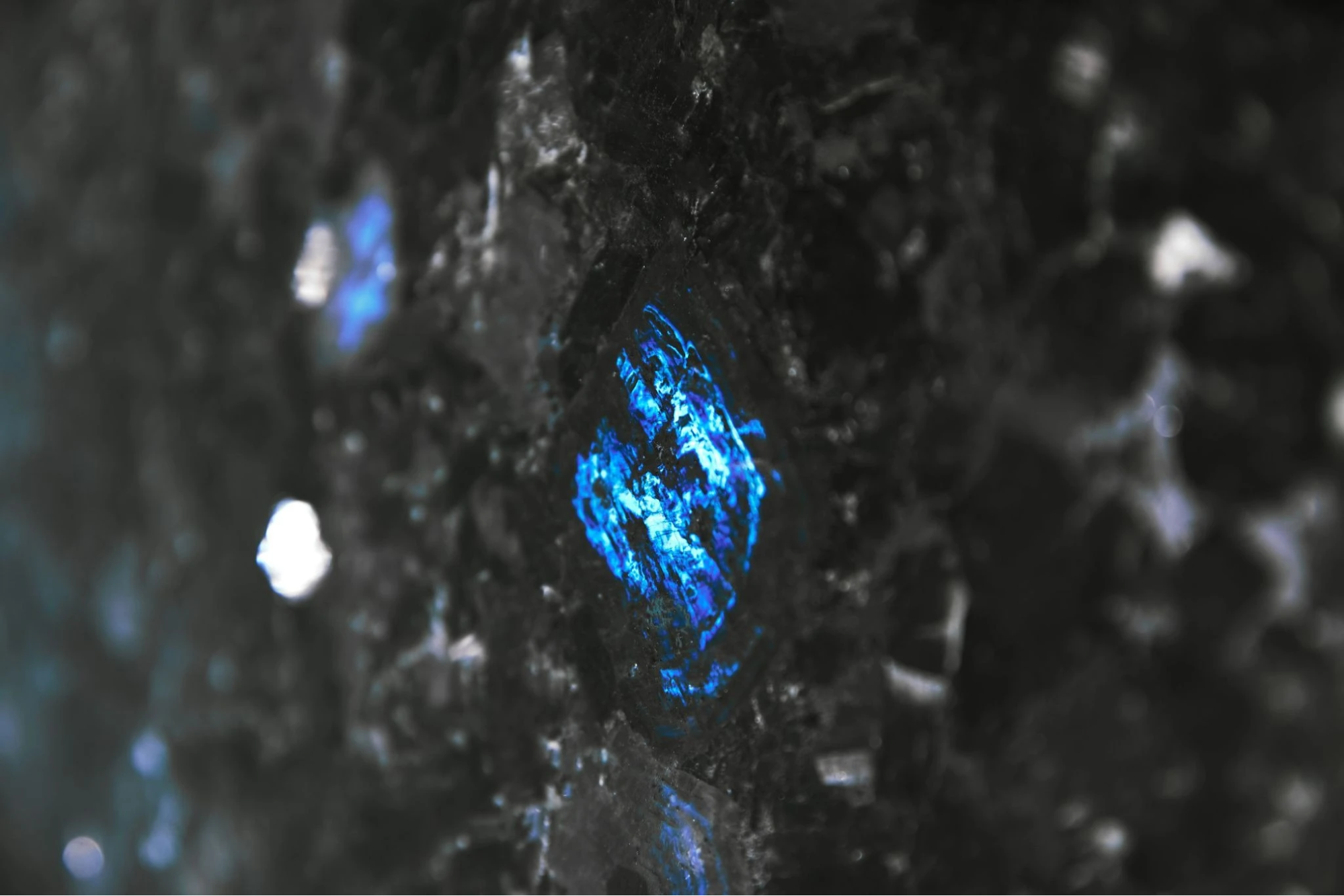
Some stones carry this further through optical behavior that digital tools cannot simulate. Labradorescence — color shifting produced by light interference within mineral structures — changes with every shift in the observer’s position and every change in light. It cannot be anticipated in rendering or replicated in printing. It is an emergent property of geological formation, and it produces spatial experiences that exist only in the physical presence of the material.
 What feels real
In architecture, what feels real is not what is most accurately reproduced. It is what keeps producing perceptual information over time — what changes with the light, shifts with the observer, and carries evidence of its own formation in its surface behavior.
Natural stone belongs to this category not because it is old or expensive. It belongs because its material character remains open to perception over time. Its imperfections are not tolerances to minimize. They are the mechanism by which it stays present across the life of a building.
For architects and designers, one question is worth asking early: will the surfaces defining a space keep offering something to perception a decade from now — or will they have closed completely in the first hour of occupancy? That question shapes everything that comes after.