
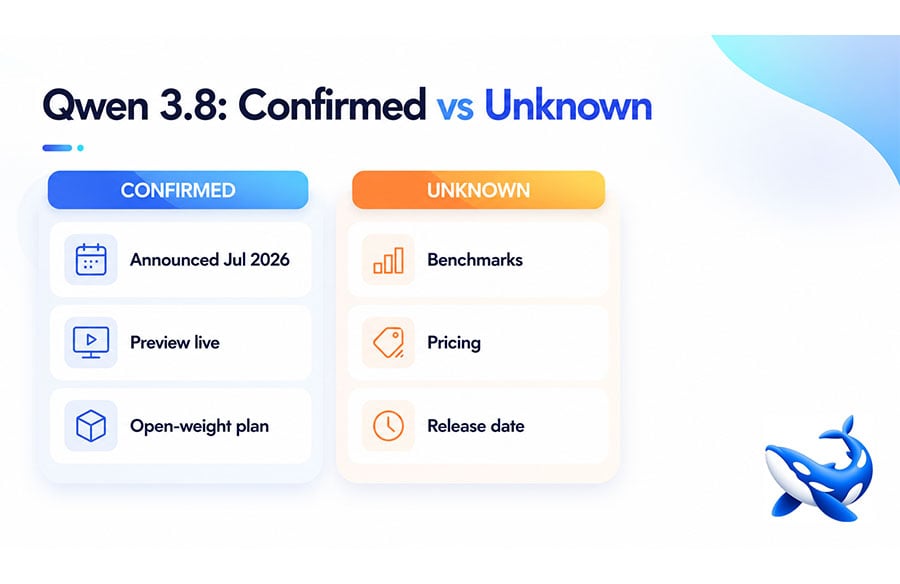
When a major lab announces a flagship before it ships, the internet fills with confident predictions. It’s worth doing the opposite: carefully separating what a vendor has actually said from what people are guessing. Alibaba announced its next Qwen flagship on July 19, 2026, and this article lays out what to reasonably expect — and, just as importantly, what remains genuinely unknown.
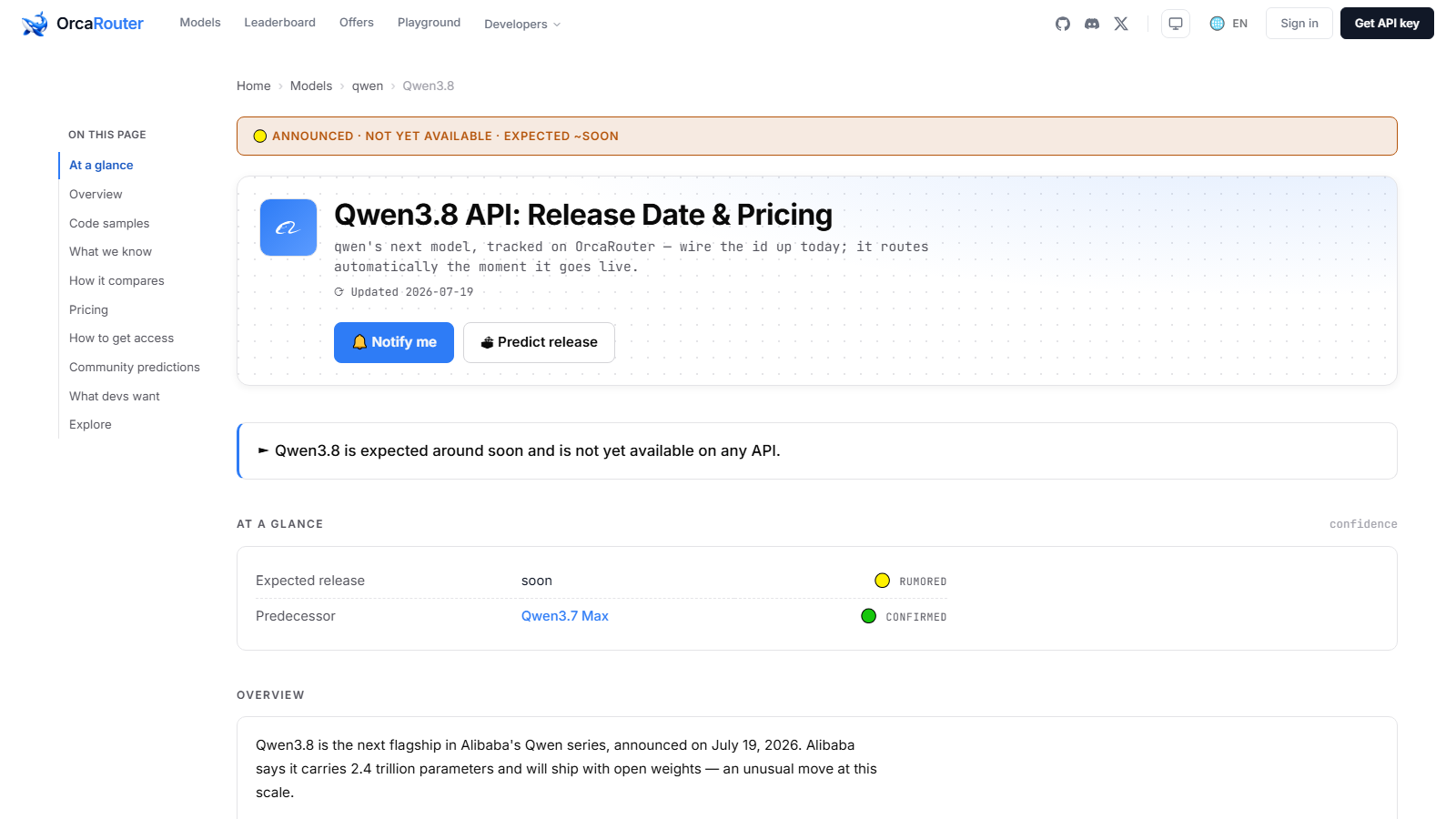
The model, Qwen 3.8, is announced but not yet generally available. Everything known here traces to Alibaba’s own statements or the model’s tracking page; there are no independent benchmarks yet, so we won’t manufacture any. The sensible stance while you wait is to stay flexible – a router like OrcaRouter fronts many models behind one OpenAI-compatible endpoint, so whenever it actually ships you can slot it in and judge it against what you already run.
What Alibaba has actually said
- It’s the next flagship in the Qwen series, succeeding Qwen 3.7 Max.
- It reportedly carries 2.4 trillion parameters.
- It will ship with open weights — notable at this scale.
- A hosted Qwen3.8-Max-Preview is already running on Alibaba’s Token Plan, Qoder, and QoderWork.
- The full open-weight release is expected to follow, “soon,” with no firm public date.
What’s reasonable to expect
From those facts, a few grounded expectations follow. Given the scale and the Qwen line’s trajectory, it’s reasonable to expect a strong general-purpose model aimed at competing with other frontier flagships. Given the open-weight plan, expect meaningful interest from teams that self-host or fine-tune. Given the staged rollout (preview first, open weights later), expect availability to arrive in phases rather than all at once. These are sensible inferences — not guarantees.
 What we genuinely don’t know
This is the important part. We don’t have independent benchmarks, so any claim about how Qwen 3.8 ranks against specific competitors is speculation. We don’t have confirmed public pricing. We don’t have a firm release date. We don’t have verified details on context length or the full modality set for the open release. And we don’t know the exact license terms of the open weights, which will determine how usable they really are. Anyone presenting these as settled is filling gaps with imagination.
How to hold expectations responsibly
The healthy stance toward an unreleased model is “interested but uncommitted.” Note the promising signals — frontier scale, open weights, a working preview — without building plans that depend on unverified performance. When the model ships and third parties can test it, replace expectations with measurements. That discipline protects you from both hype and disappointment.
The one concrete thing you can do now
Rather than predict, prepare. Wire up the Qwen 3.8 model ID through an OpenAI-compatible endpoint so you can evaluate it the instant it’s testable. OrcaRouter tracks Qwen 3.8 and routes to it automatically at launch, so you can run your own prompts through it on day one and form an evidence-based view instead of an anticipatory one. Until then, Qwen 3.7 Max and the hosted preview are what you can actually touch.
How to read a pre-release AI announcement
Qwen 3.8 is a useful case study in reading announcements critically, because the skill applies to every unreleased model. Start by sorting every claim into one of three buckets: confirmed (the vendor states it and it’s checkable, like “a preview is running”), vendor-claimed (stated but not independently verified, like the 2.4T parameter count), and speculation (things other people are inferring, like specific benchmark rankings). Only the first bucket is safe to plan on; the second is a hypothesis; the third is noise until proven.
Next, notice what’s absent. Announcements tend to highlight flattering details and omit the ones that would let you evaluate rigorously — independent benchmarks, pricing, license terms, hard availability dates. The gaps are as informative as the claims: they tell you what still needs verification. Finally, watch the framing. Words like “expected,” “soon,” and “will ship” signal intent, not fact; a working preview signals more than a slide; a published model card with reproducible numbers signals most of all. Applied to Qwen 3.8, this reading yields a measured picture: a real, in-progress frontier model with a genuine preview and a credible open-weight plan, whose specific performance and terms remain to be seen. That’s a far more useful basis for decisions than either breathless hype or reflexive dismissal — and it’s a habit that will serve you for the next dozen model launches too.
Frequently asked questions
What has Alibaba confirmed about Qwen 3.8? That it’s the next Qwen flagship, reportedly 2.4T parameters, will ship with open weights, and has a hosted preview on Alibaba’s platforms.
What are its benchmark scores? Unknown — there are no independent benchmarks yet. Ignore any hard numbers circulating before the model is testable.
When will it launch? “Soon,” with no firm public date as of July 2026.
How can I try it early? Through Alibaba’s hosted Qwen3.8-Max-Preview, or by using Qwen 3.7 Max as the closest available stand-in.
What’s the safest way to plan around it? Prepare, don’t predict — wire up the ID so you can test it at launch, and let your own results shape expectations.
Bottom line
What to expect from Qwen 3.8: a frontier-scale (reported 2.4T), open-weight Qwen flagship arriving in phases, with a preview already live. What not to expect: reliable benchmark rankings, pricing, or a date — none of that is confirmed. Stay interested but uncommitted, prepare by wiring up the model ID so you can test it on day one, and let measurements replace expectations the moment it ships. Approached this way, an unreleased model is neither a savior nor a distraction — it’s simply a candidate you’ll be ready to evaluate fairly, on your own data, the instant it becomes real. That discipline is what separates teams that adopt good models fast from teams that chase announcements and get burned. Qwen 3.8 may well turn out to be excellent — but you’ll know that from your own tests on launch day, not from a pre-release announcement, and that distinction is the whole point.