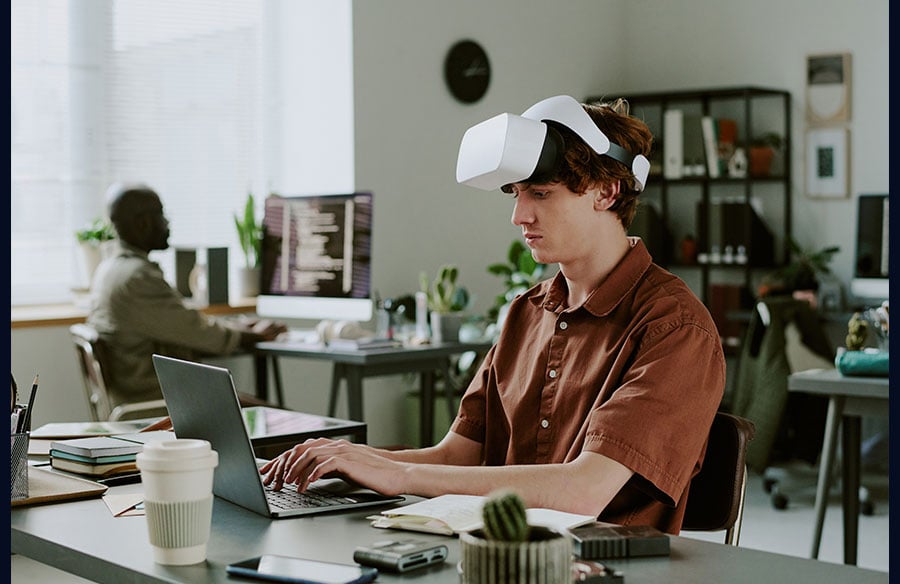
A founder in Tel Aviv runs a twelve-person team. Four of them write code from home three days a week. Two work out of a shared space in Berlin. The rest show up to a physical office on Tuesdays and Thursdays, when the whole company gathers for planning sessions and product demos. None of this looks like the office life anyone described a decade ago, and none of it is temporary. It’s the operating model now, and AI is one of the biggest reasons it holds.
Startups have always moved faster than the buildings around them. But something has shifted in the last two years. AI tools now handle scheduling, first drafts of code, customer support triage, and a growing share of the research work that used to require a desk, a second monitor, and eight hours of uninterrupted focus. When a founder can run a lean team supported by AI copilots, the old argument for a full floor of assigned desks starts to fall apart. You don’t need forty seats when fifteen people, working across three time zones, can outproduce what fifty people managed five years ago in one building.
This is reshaping more than headcount. It’s reshaping what a startup asks of its physical space, and by extension, what architects and workplace designers are being asked to build. The office isn’t disappearing. Founders keep telling researchers the same thing: culture doesn’t transmit well over video calls, and junior employees learn faster sitting next to someone senior. What’s disappearing is the assumption that everyone needs a fixed desk, five days a week, in one city. In its place: a hybrid model built around a much simpler question. What does this space need to do for the two or three days people actually show up?
Why AI Is Rewriting the Startup Org Chart
Look at how a typical seed-stage startup staffs itself now compared to 2019. Back then, a company at that stage might hire a support team of six to handle tickets around the clock. Today, an AI layer resolves most of those tickets before a human ever sees them, and the team handling the exceptions numbers two or three. The same pattern shows up in engineering, where AI-assisted coding tools let a smaller group of senior developers ship features that once required a much larger team split across juniors and seniors.
Smaller teams change the math on real estate. A sixty-person headcount used to mean a lease sized for sixty desks, sixty chairs, and enough meeting rooms to keep everyone from booking over each other. Now that same sixty-person company might have twenty-five people who need a desk on any given day, because the rest are remote, part-time, or contractors coordinating through Slack and an AI-generated daily summary. Signing a five-year lease for a fixed floor plate makes no sense for a company whose headcount, and whose in-office rhythm, might look completely different in eighteen months.
There’s a second effect worth naming directly. AI has made asynchronous work genuinely viable in a way it wasn’t before. A product manager in London can leave detailed notes, an AI-generated meeting summary, and a set of next steps for a designer in Lisbon who picks up the thread eight hours later without losing context. That kind of handoff used to degrade badly across time zones. Now the loss is small enough that founders build entire teams around it, hiring the best person for the role regardless of where they live. Once you can hire that way, you stop thinking about an office as a container for your whole company and start thinking about it as one node in a wider, looser network of places where work happens.
The Real Reasons Employers Are Choosing Hybrid
Cost sits at the top of the list, but it’s not the only driver, and founders rarely admit to it first. Ask a startup CEO why the team went hybrid and you’ll usually hear something about talent before you hear anything about the balance sheet. A company based in Tel Aviv that insists on five days in one office limits itself to candidates willing to relocate or commute daily. The same company, open to two anchor days and flexible remote arrangements the rest of the week, can recruit a machine learning engineer in Warsaw or a growth marketer in Austin without losing them to a competitor down the street who offers that flexibility already.
Then there’s the retention side. Employees who spent 2021 and 2022 working from home developed strong opinions about commute time, and many of them aren’t giving that time back. A hybrid arrangement, done well, lets a company keep the people who built the early product without forcing a return-to-office fight that burns trust and, often, burns headcount. Founders who ran that fight and lost good people learned the lesson once.
The financial case matters too, and it’s more specific than “office space is expensive.” A startup locked into a long lease for a fixed floor is exposed every time headcount shifts, and headcount shifts constantly at that stage of a company’s life. Flexible arrangements, shorter commitments, and shared amenity spaces let a founder scale the physical footprint up or down roughly in step with the team, instead of carrying dead square footage through a slow quarter or scrambling for a bigger floor mid-lease after a funding round. Real estate, for a startup, needs to behave like the rest of the business: adjustable, month to month if possible, and never the reason a company can’t pivot.
Finally, there’s a cultural argument that’s easy to underrate. Startups compete on speed and on the quality of the people they can attract, and both of those depend on morale. A team that gathers in a well-designed space twice a week, with real intention behind those days, often reports a stronger sense of belonging than a team stuck in a office five days a week out of habit rather than purpose. The office becomes a destination again instead of a default, and that distinction matters more than it sounds.
What This Means for the Buildings Themselves
Architects and workplace designers are the ones absorbing the practical fallout of all this. A floor plan built for fixed desks and quiet, individual focus work no longer matches how a hybrid startup actually uses its space on the days people show up. The two or three anchor days a hybrid team spends together skew heavily toward collaboration: workshops, client pitches, onboarding, and the kind of spontaneous hallway conversation that AI tools still can’t replicate. That means fewer rows of permanent desks and more rooms built for groups of four to twelve, with furniture that moves easily and acoustics designed for conversation rather than silence.
Flexibility has become a design requirement rather than a nice-to-have. A space that can be a fifteen-person all-hands on Tuesday and a quiet focus zone on Wednesday earns its square footage twice over. Operable walls, modular furniture, and booking systems that let teams reconfigure a floor in minutes are showing up in workplace projects that would have specified fixed partitions five years ago. Designers are also rethinking density itself: instead of planning for every employee on the roster, they’re planning for the peak number likely to show up on any given day, which for most hybrid startups sits well below full headcount.
The Rise of Flexible Workspace Operators
This shift has been good news for flexible workspace operators, who built their entire model around exactly the uncertainty startups now live with. Mindspace, one of the more established hybrid offices names in this space, has grown by offering companies office space they can scale up or down without signing the kind of multi-year lease that made sense for a different era of business. A startup that needs fifteen desks this quarter and thirty next quarter can adjust inside the same building instead of moving offices entirely, which matters enormously to a founder trying to protect runway.
The appeal goes beyond flexible terms. Operators like Mindspace also handle the parts of running a physical space that founders would rather not think about: reception, cleaning, high-speed connectivity, meeting room booking, and the kind of professional finish that makes a good impression on an investor walking through for a pitch. For a lean team without a dedicated operations hire, that’s real time back. There’s a community effect too. Sharing a building with other startups and growing companies creates the kind of informal networking that used to happen in a single company’s kitchen, now happening across a whole floor of different founders and teams. For a company built to move fast, that combination of flexibility, done-for-you infrastructure, and built-in community solves a set of problems that a traditional lease simply doesn’t address.
Where This Leaves the Office
None of this points toward the end of physical workspace, whatever the more dramatic headlines from a few years ago suggested. It points toward a physical workspace that has to earn its place the way everything else in a startup does: by proving it’s worth the cost and the commute. AI has taken over enough of the repetitive, individual work that used to fill an office day that what’s left, the parts that genuinely benefit from people being in the same room, has become sharper and more deliberate.
Founders are responding by asking harder questions about what a building actually needs to do. Fewer fixed desks, more rooms built for collaboration, shorter and more flexible commitments, and a growing reliance on operators who can absorb the uncertainty that comes with running a company at startup speed. Architects who understand this shift, and who design for a workforce that’s smaller, more distributed, and increasingly AI-augmented, are the ones shaping what the next decade of workplace design actually looks like. The office isn’t going away. It’s being asked to justify itself in a way it never had to before, and the ones that survive that test will look very different from the ones being vacated right now.