The Coway Airmega 100 makes a good everyday air purifier for a Dutch home if you leave it in auto mode and keep the space around it clear. Its 22 × 22 cm footprint suits compact apartments, it uses a single 3-in-1 filter, and its manual lists a rated power of 25 W. This review uses the figures in the Airmega 100 user manual, checked in 2026.
Why does everyday air cleaning matter in Dutch homes?
Newer Dutch homes are built to be airtight so they lose less heat. That is good for energy bills, but it means indoor air quality depends on ventilation grilles, mechanical systems and the habit of airing rooms each day.
Outdoor sources play a part too. RIVM counts roughly 1 million wood-burning stoves and open fireplaces in the Netherlands. In a small Utrecht University study of four homes, ultrafine dust in the living room was 3.7 times higher with the stove on. In spring and summer, open windows also let pollen in. A purifier supports ventilation in these moments. It does not replace it.
What does the Coway Airmega 100 offer?
The list below sets out what the manual states for the Coway Airmega 100. Room size, noise level and filter life are not in the manual, so they are left out here.
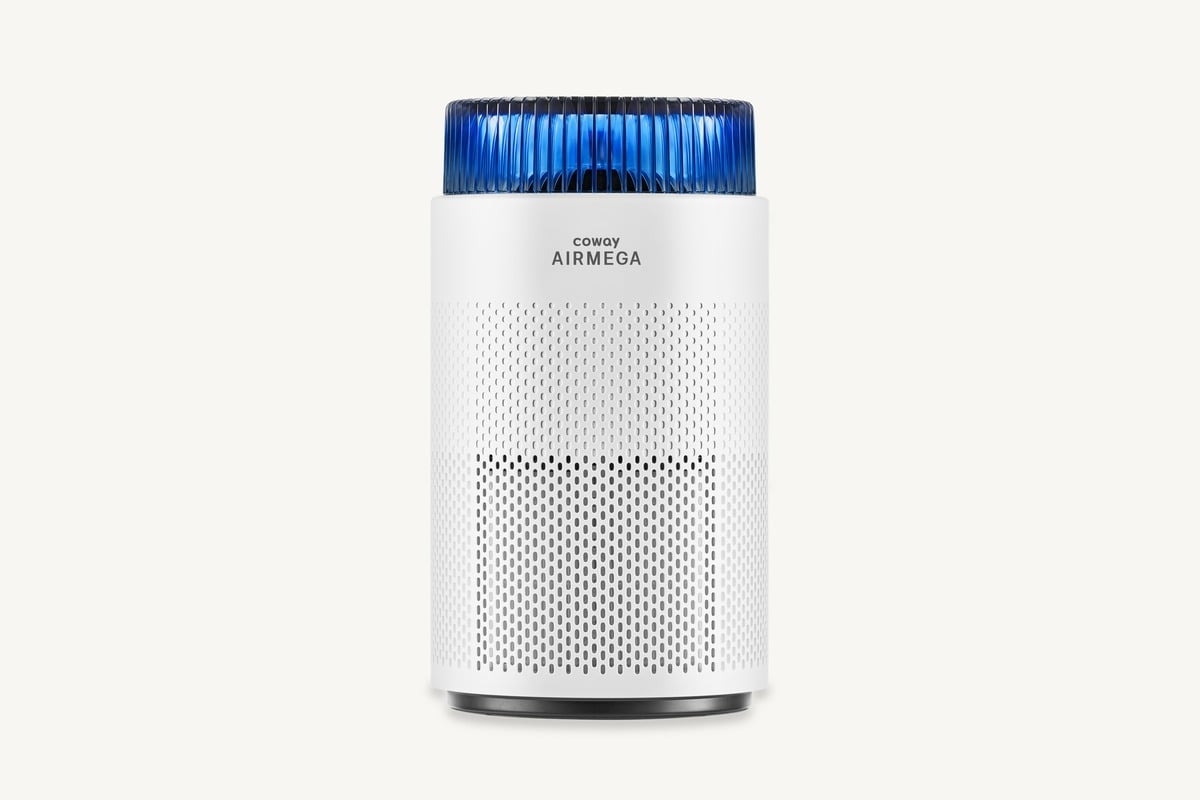 The Coway Airmega 100 uses one 3-in-1 filter that combines a pre-filter, a HEPA filter and a deodorisation filter. Image: Coway.
- Rated power: 25 W, on a 220-240 V supply.
- Size: 22 × 22 × 39.5 cm, and it weighs 3.0 kg.
- Filter: one 3-in-1 filter with a pre-filter, a HEPA filter and a deodorisation filter.
- Controls: auto mode, three fan speeds, sleep mode, a 1, 2, 4 or 8-hour timer and a control panel lock.
- Sensor and light: a PM2.5 sensor and an air quality light that can switch to a night light or off.
- Warranty: two years.
How does it fit into a compact interior?
Floor space is precious in a Dutch apartment or a narrow terraced house. At 22 × 22 cm, the Airmega 100 takes up less floor area than a small side table, and at 3.0 kg it is easy to carry between the living room and the bedroom.
Placement matters more than size. Keep it away from curtains, plants and furniture that could block the air flow, and out of direct sunlight. A clear spot in the middle of the room usually works better than a corner behind the sofa. In open-plan layouts, place it closest to where you spend most time, not near the kitchen extractor.
How do the filters work?
Air passes through one 3-in-1 filter. The pre-filter layer catches larger dust, hair and pet hair, the HEPA layer is the main layer for fine particles in the air, and the deodorisation layer helps reduce household odours such as cooking smells.
The manual says to brush dust off the pre-filter surface with a dry cloth or a vacuum cleaner, not to wash it. When the filter replacement indicator comes on, you replace the whole filter and hold the button for 3 seconds to reset it. The manual also asks you to clean the particle sensor every 2 months.
How much power does it use?
Power use is where the Airmega 100 suits daily use. At its rated 25 W, 24 hours of running uses at most 0.6 kWh, and an eight-hour night uses at most 0.2 kWh.
In auto mode, the fan moves between its three speeds as the sensor reads the air, and the manual says sleep mode reduces power use. Multiply the kWh figure by the rate on your energy contract to estimate the cost.
Is it quiet enough to run all day?
A PM2.5 sensor reads the air, and the light shows the result in blue, green, orange or purple. In auto mode, the fan speeds up when the reading worsens and slows down when the air clears.
The manual describes sleep mode as lowering the fan speed for low-noise operation, and it dims the display. The light button switches between the air quality light, a night light and all lights off, which helps in a dark bedroom. The manual does not give a decibel figure.
Who is it for?
It suits someone who wants one purifier for daily use in a living room, bedroom or home office, without an app or complicated settings. Energy-conscious households will like the 25 W rating.
There is no Wi-Fi control, and the manual gives no room size, so ask Coway before you rely on it for a large open-plan floor. For a larger space or a loft, look at the wider range of Coway luchtreinigers (air purifiers) on the Dutch site.
FAQs
Can the Coway Airmega 100 run all day?
Yes. It is designed for continuous use in auto mode, where the PM2.5 sensor adjusts the fan speed to the air quality. With a rated power of 25 W, leaving it on all day uses at most 0.6 kWh.
How often do I need to change the filter?
Follow the filter replacement indicator rather than a fixed date, as use and home conditions vary. The 3-in-1 filter is replaced as one unit. Between changes, brush or vacuum the pre-filter surface, as the manual says not to wash it.
Does an air purifier replace ventilation?
No. In airtight Dutch homes, ventilation grilles, mechanical systems and daily airing remain the main way to refresh indoor air. A purifier helps reduce airborne particles between those moments, for example on evenings with wood smoke outside.
Will the Airmega 100 help with allergies?
Its HEPA filter is designed to capture fine particles such as pollen and dust in the air. That can support cleaner indoor air, but it does not treat or prevent symptoms. An air purifier supplements ventilation and source control. It does not replace them and is not a medical treatment.
The short version
The Coway Airmega 100 is a sound everyday choice for one room. Leave it in auto mode, keep its sides clear, brush the pre-filter regularly and replace the filter when the indicator lights up. Keep airing your home each day as usual.