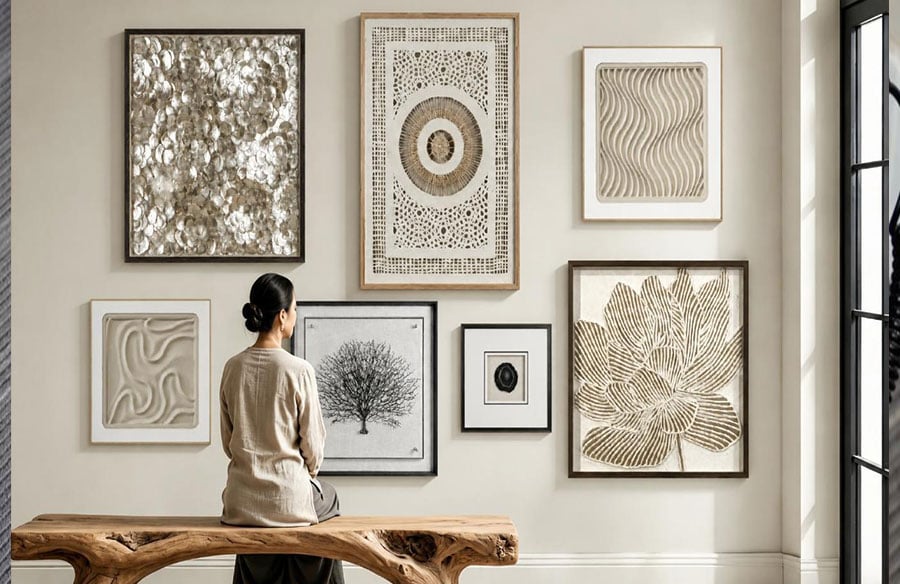
Walls have a significant influence on how people experience an interior. Whether it is a hotel lobby, restaurant, office, retail store, or residential development, carefully selected artwork brings colour, texture, personality, and visual balance to an otherwise ordinary space. For designers, developers, retailers, and hospitality operators, wall decoration is an integral part of the architectural design rather than a final accessory.
From bespoke pieces designed around a brand identity to large collections sourced for multi-location properties, there are many ways to approach wall decoration. Understanding these options helps commercial buyers select artwork that complements their space while meeting practical requirements such as scale, durability, material compliance, and procurement budgets.
Creating Distinctive Interiors with Custom Wall Decor
One of the biggest advantages of customized artwork is the ability to create something tailored to a specific environment rather than relying entirely on off-the-shelf designs. Custom wall decor can be developed around a property’s colour palette, architectural proportions, lighting conditions, or brand narrative.
For example, a boutique hotel may require artwork inspired by local landscapes or cultural heritage, while a contemporary corporate headquarters might seek abstract, dimensional pieces that reflect its corporate identity. Restaurants can also use artwork to reinforce a specific atmosphere, from refined minimalist aesthetics to vibrant, eclectic expressions.
Customization extends far beyond selecting imagery. Depending on project specifications, interior designers frequently specify exact dimensions, substrates, frame profiles, and specialized surface textures, such as 3D relief panels, hand-textured paper wave art, sandstone textures, and acoustic wood slat elements. This level of tailoring ensures the artwork functions as an integrated architectural feature.
For larger developments, customized artwork also provides visual continuity. A curated collection of related pieces can be specified for corridors, reception areas, guest rooms, and dining spaces, maintaining a recognizable design narrative throughout the property.
Using Commercial Wall Art to Strengthen a Business Environment
In commercial interiors, artwork directly contributes to the first impression of a business. Offices, retail flagships, showrooms, and corporate spaces each have distinct functional needs, but all share a fundamental requirement: creating an environment that feels intentional and refined.
Well-selected commercial wall art establishes visual focal points, breaks up expansive wall areas, and harmonizes with surrounding furniture and architectural lighting. Large-format artwork and multi-panel installations are particularly effective in high-traffic reception areas and boardrooms where a strong visual statement is desirable.
Material choices are equally critical in commercial settings. Framed canvas prints, dimensional relief art, metal accents, fiber sculptures, and acoustic panels each create distinct visual and functional effects. Specialized B2B manufacturers, such as Art Deco Supply, offer comprehensive categories of contract-grade wall decor designed specifically for durability and large-scale commercial installation.
Designing Memorable Hotels with Hospitality Wall Art
Hotels and hospitality environments present uniquely demanding design requirements. Guests encounter multiple touchpoints during their stay, including entryways, check-in lobbies, guest corridors, suites, lounges, and dining spaces. Thoughtfully curated artwork helps weave these disparate areas into a unified visual journey.
Hospitality wall art should reflect a property’s geographical setting, architectural lineage, or target demographic. A coastal resort might incorporate organic macrame fiber art and subtle ocean-inspired textures, whereas an urban boutique hotel may favor bold, contemporary abstract artwork reflecting the character of the city.
Scale and proportion play a vital role. While a compact framed print excels above a guestroom nightstand, it lacks presence in an expansive hotel atrium. Conversely, oversized canvas artwork or coordinated gallery walls can fill double-height architectural spaces without cluttering them.
Working with specialized manufacturers allows hospitality designers to tailor art specifications precisely to complex floor plans, custom niches, and guestroom layouts, ensuring consistent scaling across dozens or hundreds of rooms.
Why Wholesale Wall Art Makes Sense for Larger Projects
Large-scale interior developments require substantial quantities of artwork across multiple spaces or geographical locations. Sourcing individual pieces from disparate retail suppliers often leads to inconsistencies in quality, finish, dimensions, and delivery timelines.
For interior designers, real estate developers, furniture buyers, and hospitality groups, partnering directly with a factory-direct wholesale wall art manufacturer provides a far more streamlined procurement model. Bulk sourcing enables the specification of coordinated collections while unifying quality control, custom packaging, and freight logistics under a single management system.
A factory-direct supplier also offers broader capabilities than traditional retail channels. Depending on production facilities, professional buyers can source framed prints, textured wave art, 3D sandstone panels, mirrors, and sculptural wall art through a single partner, supported by full OEM/ODM capabilities and volume pricing.
Choosing Artwork According to the Space
The most visually striking artwork is not always the most suitable for every commercial application. Before finalizing specifications, design teams should carefully evaluate the physical characteristics of the space and its functional requirements:
- Scale and Proportion: Artwork must relate proportionally to wall elevation, ceiling height, and adjacent furniture. Expansive walls call for oversized statements or modular arrangements, whereas intimate spaces benefit from curated smaller series.
- Colour Harmony: Artwork should either complement the primary palette or serve as a deliberate accent. Evaluating upholstery, flooring, drapery, and lighting temperature prior to selection ensures visual cohesion.
- Tactility and Depth: Textured surfaces, macrame fiber art, and 3D relief art introduce tactile depth to minimalist interiors, whereas clean-lined framed prints suit environments requiring sleek, understated elegance.
- Durability and Maintenance: Commercial and hospitality spaces demand contract-grade durability. Substrates, protective finishes, secure mounting hardware, and ease of cleaning must be factored in alongside aesthetic appeal.
From Individual Pieces to Complete Wall Art Programmes
A successful interior concept rarely relies on a single isolated artwork. In commercial and hospitality projects, the most impactful results stem from viewing wall decoration as a comprehensive design programme.
A unified wall art programme establishes visual harmony across different zones of a property. Recurring colour accents, complementary textures, shared thematic elements, or standardized framing profiles foster visual continuity while allowing distinct spaces to retain their individual character.
This strategy is especially valuable for multi-location brands, chain hotels, and residential developers seeking to establish a recognizable interior identity across multiple properties.
Making Walls Part of the Overall Design
Wall art should be integrated into early space planning rather than treated as a final accessory. When artwork, architectural finishes, lighting design, and furniture work in unison, the resulting environment feels deliberate, sophisticated, and complete.
Whether creating a bespoke identity for a boutique hotel, specifying contract art for corporate offices, or developing retail collections for volume distribution, success relies on balancing aesthetic storytelling with practical manufacturing capabilities. With the right combination of design vision, material selection, and factory-direct procurement, wall decor becomes an essential element of modern architectural spaces.