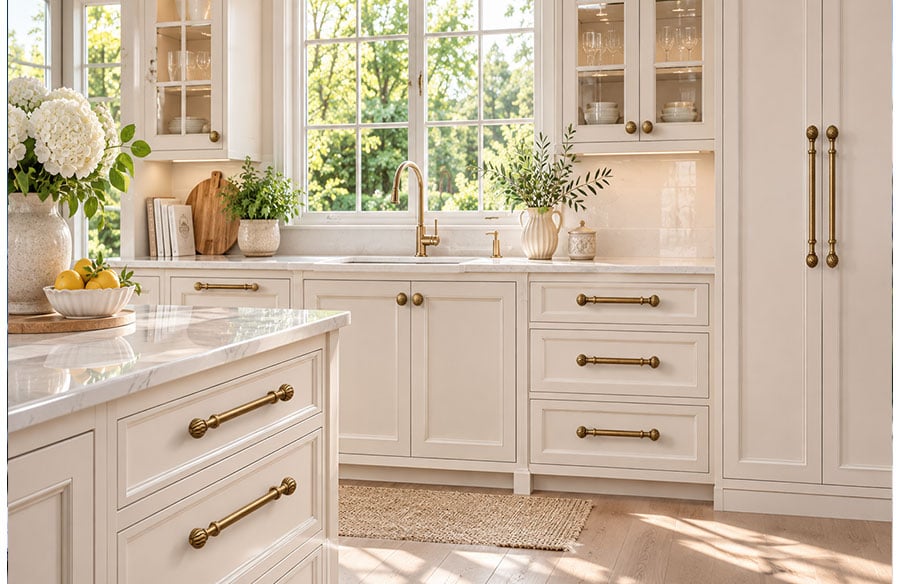
Most people spend far longer choosing a knob than deciding where it goes, and it shows. A beautiful knob in the wrong spot makes a door awkward to open and a run of cabinets look slightly off, even when nobody can say why. Good cabinet knob placement follows a few simple measurements and a handful of judgment calls, and once you know them, every door and drawer in the kitchen starts to read as one considered design.
This attention to detail is fundamental to architectural design, where every element, no matter how small, contributes to the overall aesthetic and functional harmony of a space. Thoughtful hardware placement ensures that the cabinetry, a primary architectural feature in many rooms, presents a cohesive and intentional visual statement.
Why Placement Matters More Than the Knob Itself
A knob does two jobs. It gives your hand a point of leverage, and it acts as a visual full stop on the face of a door or drawer. When the placement is consistent, the eye reads a bank of cabinets as a single composition. When it drifts by even half an inch from door to door, the whole kitchen looks less precise than it really is.
Placement also changes how a cabinet feels to use. A knob set too close to the hinge side gives you less leverage, so the door takes more effort to swing open. The aim is a spot that is easy to reach, gives good leverage and lines up with the cabinet’s own frame.
Size the Knob Before You Mark a Single Hole
Placement measurements assume a knob that suits the door, so size comes first. A knob that is too small disappears on a wide drawer front, while one that is too large crowds a narrow Shaker stile and leaves no room for your fingers. Diameter, projection (how far the knob sits out from the door) and screw length all affect where it can go and how it feels in the hand.
Most brass knobs for cabinet doors and drawers run from about 3/4 inch to 2 inches across, with 1 to 1-1/4 inches suiting most kitchens, and most mount with a single 8-32 screw, the standard thread for US cabinet hardware. That range is a useful reference point for planning: smaller diameters suit narrow stiles and vanity drawers, while larger knobs balance pantry doors and wide drawer fronts. For screw length, measure the door thickness and add roughly a quarter inch, so a standard 3/4 inch door usually takes a 1 inch screw.
- Narrow stiles (under 2-1/2 inches): keep the knob at or under 1-1/4 inches so it sits inside the frame.
- Standard doors and drawers: 1 to 1-1/4 inches covers most kitchens.
- Tall pantry doors and wide drawers: 1-1/2 inches or larger keeps the hardware in proportion.
Standard Knob Placement on Cabinet Doors
For doors, the rule is simple: place the knob on the side opposite the hinges, about 2 to 3 inches in from the corner. On a framed or Shaker door, center it on the vertical stile so it sits in the middle of the frame rather than floating on the panel.
- Base cabinets: place the knob near the top corner, so it is within easy reach when you are standing at the counter.
- Wall (upper) cabinets: place the knob near the bottom corner, which keeps it reachable without stretching.
- Tall pantry doors: place the knob at a comfortable hand height, often in line with the countertop or around 36 to 42 inches from the floor, rather than at the very top or bottom.
- Sink and corner doors: follow the same rule as neighboring doors, so the line of knobs stays continuous across the run.
Consistency matters more than any single number. Pick one offset from the corner and use it on every door in the room, including the bathroom vanity if it is visible from the same space.
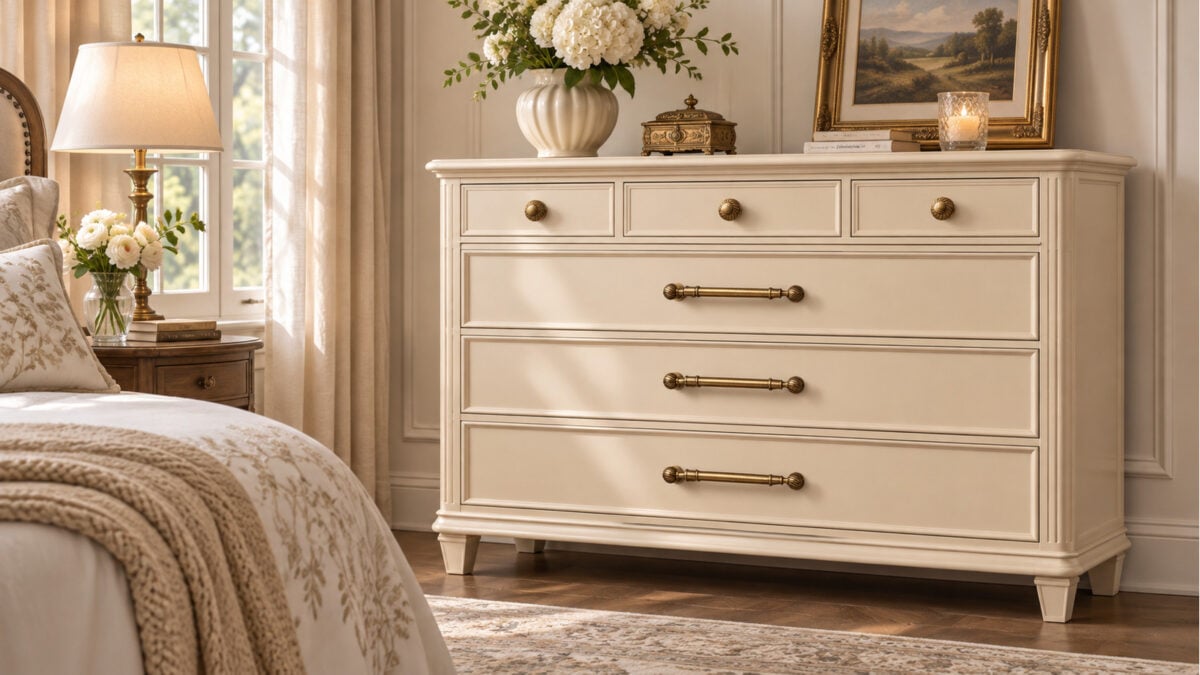 Knob Placement on Drawers
Drawers are centered horizontally, so the only real decision is height. On a slab drawer front, the knob usually goes in the exact center. On a Shaker drawer, centering it on the top rail gives a tidy, traditional look, while centering it on the whole drawer front reads slightly more modern. Either works, as long as you choose one approach for the entire kitchen.
- Small drawers (under 24 inches wide): one knob, centered.
- Wide drawers (24 to 36 inches): two knobs, each set roughly a quarter of the drawer width in from each end, or switch to a pull for better leverage.
- Deep pot drawers: place the knob in the upper third of the front so it lines up with the shallower drawers above.
Heavy drawers are where knobs reach their limits. If a drawer holds cast iron or stacked plates, a single knob can feel strained, and many kitchens move to pulls on these drawers while keeping knobs on the doors.
Shaker and Slab Doors Need Different Thinking
Shaker cabinets give you a built-in guide. The rails and stiles create a frame, and knobs look most natural when they sit centered on that frame. Placing a knob on the recessed panel instead tends to look accidental. Slab doors have no frame, so placement relies entirely on measurements, which makes a template even more important.
These distinctions between cabinet types—Shaker’s framed construction versus slab’s minimalist surface—are core to understanding how different architectural styles influence interior detailing. The choice and placement of hardware then become integral to reinforcing the intended design language, whether it’s the classic lines of a Shaker kitchen or the sleek simplicity of a contemporary space.
Inset and full-overlay cabinets also change the reading slightly. On inset doors, the frame around the opening is visible, so knobs that align with the face frame lines look intentional. On full-overlay doors, the gaps are minimal, and the line created by the knobs themselves becomes the main visual guide.
Edge Cases Most Placement Guides Skip
Standard diagrams cover a plain base door and a plain drawer, but real kitchens have awkward pieces that need their own decision. These are the ones homeowners ask about most once the easy doors are done.
- Tip-out sink fronts: these false fronts often take a knob centered on the panel (some kitchens leave them bare), matching the drawers either side, so the run reads as one line even though the panel only tilts.
- Corner and lazy Susan doors: place the knob on the leaf that opens first, on the stile furthest from the corner, so your hand is not trapped against the adjoining cabinet.
- Stacked uppers and glass-front doors: on a two-tier upper, keep the lower door’s knob at its bottom corner and the top door’s knob at its bottom corner too, so both are reachable from a step stool.
- Doors beside appliances: check that the knob’s projection clears a refrigerator handle or range edge before drilling, since a knob that collides with an appliance chips both.
How to Mark and Drill Without Mistakes
Once you have decided on placement, the work is about accuracy. A cheap hardware jig or a homemade cardboard template saves more time than it costs, because it puts every hole in the same place on every door.
- Mark your offset on the template and check it on one door before drilling any others.
- Drill from the front with painter’s tape over the spot to reduce chipping.
- Hold a scrap block behind the door to stop the bit from splintering the back face.
- Fit one knob, open and close the door a few times, then commit to the rest.
Key Takeaways
Good cabinet knob placement comes down to three habits: size the knob to the door, keep it 2 to 3 inches from the corner opposite the hinges, and repeat the same measurement everywhere. Base cabinets take knobs near the top, wall cabinets near the bottom, and drawers are centered. Get those right and the kitchen looks deliberate, whatever style of knob you choose.
FAQs
Where should cabinet knobs be placed?
On cabinet doors, place knobs on the side opposite the hinges, about 2 to 3 inches from the corner. Base cabinets take it near the top corner and wall cabinets near the bottom corner. On drawers, center it horizontally.
How do you determine cabinet knob size?
Start with the width of the stile or drawer front. Most kitchen doors and drawers suit a knob of 1 to 1-1/4 inches, while narrow stiles need something smaller and tall pantry doors or wide drawers can carry 1-1/2 inches or more.
Should knobs go in the center of a drawer?
Horizontally, yes. Vertically, you can center it on the whole drawer front or on the top rail of a Shaker drawer. The second option is more traditional, and either looks right as long as every drawer follows the same rule.
When should a drawer have two knobs instead of one?
Drawers wider than about 24 inches often look and work better with two knobs, each set about a quarter of the width in from the ends. A single centered knob on a very wide drawer can make it rack slightly as you pull it open.
Can I reuse the old holes when I change knobs?
Usually, yes. Most cabinet knobs mount through a single hole with a standard 8-32 screw, so a new knob can go straight into the old position. Before buying, remove one existing knob to check the screw length and whether a backplate is hiding a larger or second hole.