Quick Answer: Zone Air and MrCool are the only two brands currently that offer “DIY install” multi zone mini split systems with pre-charged quick connect line sets. In other words, Zone Air and MrCool are the only two brands offering multi zone mini splits that you can really install yourself. Senville and Pioneer require an HVAC technician but are still popular with DIYers.
This guide compares DIY multi-zone mini splits for 2026 and covers what you should know about efficiency, sizing, installation, and long-term ownership.
Quick Answer: What’s the Best DIY Multi-Zone Mini Split in 2026?
Best Overall: Zone Air DIY Multi Zone
Best-Known DIY Brand: MrCool DIY Multi Zone
Best Budget Options: Senville and Pioneer
How Multi-Zone Mini Splits Work
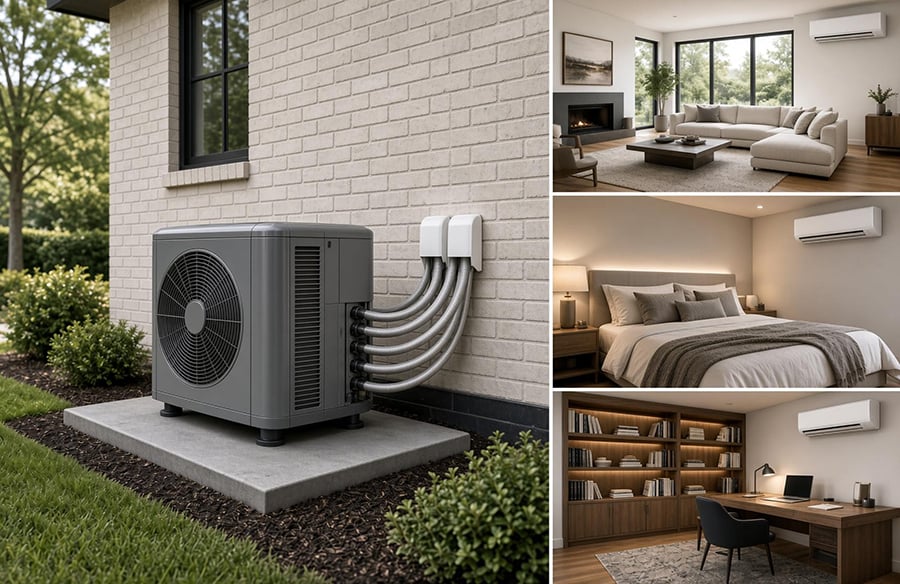
Multi-zone mini splits connect a single outdoor condenser to multiple indoor air handlers. Each indoor unit has an independent thermostat for separate rooms or areas.
Most multi-zone systems support two to six indoor zones depending on the condenser.
Because cooled / heated refrigerant travels directly to the evaporator in each room, mini split systems can avoid the energy losses associated with ductwork running through attics, crawlspaces, and other unconditioned areas.
Why Choose a DIY Multi-Zone Mini Split?
Higher Efficiency
Modern mini splits use inverter-driven compressors that adjust their output to match the home’s heating or cooling demand rather than repeatedly cycling completely on and off.
This can improve efficiency while maintaining more consistent indoor temperatures.
Individual Room Control
Each zone can operate independently. You can keep frequently used rooms comfortable while reducing heating or cooling in unused bedrooms, offices, or other spaces.
Quiet Operation
Many modern indoor mini split units operate around the 30 dB range at lower fan speeds, making them considerably quieter than typical window air conditioners.
Lower Installation Cost
Professional multi-zone installations can involve thousands of dollars in labor.
Homeowners comfortable mounting equipment, drilling wall penetrations, routing line sets, and performing basic installation work can potentially save substantially with a DIY system. You can also install the HVAC equipment yourself and hire an electrician for the dedicated circuit.
What to Look for in a DIY Multi-Zone Mini Split
Efficiency
SEER2 measures cooling efficiency. For a modern mini split, 20 SEER2 or higher is a good target, while systems reaching 22-24 SEER2 are toward the higher-efficiency end of the market.
HSPF2 measures heating efficiency and becomes particularly important if the system will be a primary heat source.
Cold-Weather Performance
If you live somewhere with cold winters, don’t look only at the lowest advertised operating temperature.
Check heating capacity and performance around 17°F, 5°F, 0°F, and below zero. A heat pump may continue operating at extremely low temperatures while producing considerably less heat than its nominal rating.
Electrical Requirements
Larger multi-zone systems generally require 208-230V power on a dedicated circuit.
Before ordering, verify the voltage, minimum circuit ampacity (MCA), maximum breaker size, panel capacity, and local electrical requirements.
Installation Method
This is one of the biggest differences between systems.
A true DIY mini split should ideally have:
- Factory pre-charged line sets
- Quick-connect refrigerant fittings
- No vacuum pump requirement
- No refrigerant gauges
- Clearly labeled wiring
- Detailed installation documentation
If you need to flare copper tubing, pressure-test the system, pull a deep vacuum, and perform traditional refrigerant work, installation becomes considerably more complicated.
Best Overall: Zone Air DIY Multi Zone
Zone Air DIY Multi Zone is our top choice for homeowners wanting high efficiency and a refrigerant installation that can realistically be completed without traditional HVAC tools.
Zone Air uses factory pre-charged quick-connect line sets. Instead of cutting and flaring copper, connecting gauges, and pulling a vacuum, the homeowner connects the pre-charged lines and tightens the fittings according to the installation instructions.
Zone Air also assembles, tests, and inspects its systems in the USA before shipping.
Key features include:
- Up to 24 SEER2
- R-454B refrigerant
- Pre-charged quick-connect line sets
- Approximately -13°F low-temperature operation
- Quiet indoor operation
- 208-230V multi-zone systems
- USA testing and inspection
Systems are available for two through six-zone installations, with outdoor condensers reaching approximately 60,000 BTU depending on configuration.
Different indoor capacities can also be combined. For example, a large living area might use an 18,000 BTU head while bedrooms use 9,000 BTU units.
Customer reviews average around 4.8 out of 5 across verified purchases.
For buyers prioritizing efficiency, cold-weather capability, simple installation, quality control, and technical support, Zone Air offers the strongest overall combination.
MrCool DIY Multi Zone
MrCool is probably the best-known name in DIY mini splits and helped popularize pre-charged line sets in the U.S.
Its current 5th-generation multi-zone systems use R-454B refrigerant and Quick Connect line sets, with efficiency generally reaching the low-20s SEER2 range depending on configuration.
MrCool also offers strong smart-home functionality, including app control and compatibility with common voice assistants.
Its biggest advantage is maturity. MrCool has been selling DIY systems for years, resulting in a large community, numerous installation videos, troubleshooting resources, and readily available replacement parts.
Efficiency is competitive but isn’t necessarily class-leading across every configuration. Buyers should also review the specific warranty registration requirements for their system.
For homeowners who want an established DIY brand with a long track record, MrCool remains an excellent choice.
Senville
Senville is especially attractive for buyers focused on price.
Its systems typically cost less than the more DIY-focused brands while offering good efficiency, heating performance, and a wide selection of capacities.
The biggest downside is installation.
Many Senville systems use conventional refrigerant connections, meaning installation may require flaring copper, pressure testing, pulling a vacuum, HVAC gauges, or having a technician complete the refrigerant portion.
For an experienced DIYer, that may be acceptable. For someone looking for the simplest installation possible, Zone Air or MrCool is a better fit.
Pioneer
Pioneer has sold mini splits in the U.S. for years and has developed a strong reputation for affordable equipment and accessible replacement parts.
Some higher-end Pioneer multi-zone systems offer impressive efficiency. Certain Quantum Ultra dual-zone configurations, for example, reach around 24 SEER2.
However, most Pioneer systems use traditional flare connections and require proper evacuation before startup.
Pioneer offers excellent value if you’re comfortable with a vacuum pump and conventional mini split installation. If simplicity is the priority, Zone Air or MrCool has the advantage.
Zone Air vs MrCool vs Senville vs Pioneer
Zone Air: Best overall balance of efficiency, true DIY installation, cold-weather performance, and quality control.
MrCool: Best-known DIY brand with an established ecosystem and long history.
Senville: Best for buyers focused primarily on upfront price.
Pioneer: Strong value and brand history for experienced DIYers comfortable with traditional installation.
Other respected manufacturers include Mitsubishi Electric, Daikin, Fujitsu, Cooper & Hunter, and LG, but most of their systems are designed primarily around professional installation.
How to Size a Multi-Zone Mini Split
Correct sizing is critical.
An oversized indoor unit can cause short cycling, humidity problems, and uncomfortable temperature swings. An undersized unit may struggle during extreme weather.
As a very rough starting point:
- 9,000 BTU: approximately 250-350 sq. ft.
- 12,000 BTU: approximately 350-550 sq. ft.
- 18,000 BTU: approximately 700-1,000 sq. ft.
These are only general guidelines. Actual loads depend on climate, insulation, ceiling height, windows, sun exposure, air leakage, occupancy, room location, and construction.
A load calculation is always preferable to sizing strictly by square footage.
A Bigger Condenser Isn’t Always Better
One mistake is assuming you should add together the rated capacity of every indoor unit and buy an outdoor condenser that matches that number.
Multi-zone systems are designed around load diversity. Every room usually doesn’t reach its maximum heating or cooling demand at the same time.
A west-facing living room, for example, may experience its largest cooling load late in the afternoon, while an east-facing bedroom receives its strongest solar load in the morning. Occupancy also changes throughout the day.
This is why manufacturers may approve indoor-unit combinations whose combined nominal capacity is higher than the outdoor condenser’s nominal capacity.
Always follow the manufacturer’s approved combination tables rather than simply adding together the BTUs printed on the indoor units.
Indoor Heads Don’t Always Have Their Full Rated Capacity Available
There’s another side to load diversity that buyers sometimes miss.
A 12,000 BTU indoor unit connected to a multi-zone system doesn’t necessarily have 12,000 BTU available under every possible operating condition.
The outdoor condenser has a finite amount of capacity. If several indoor units are simultaneously demanding maximum output, that capacity has to be distributed among the active zones.
In a properly sized system this usually isn’t a problem because every room rarely experiences its absolute peak load simultaneously. But it’s another reason the indoor and outdoor equipment should be sized as one complete system.
Minimum Output Matters Too
Maximum capacity gets most of the attention, but minimum compressor output can matter almost as much.
Inverter compressors can reduce their output as demand decreases, but they can’t reduce it indefinitely. Every condenser has a minimum operating capacity.
This becomes especially interesting with large multi-zone condensers. If a small bedroom is the only zone calling during mild weather, the outdoor unit may still have to produce more capacity than that room actually needs.
So bigger isn’t automatically better. A properly sized condenser can potentially provide better low-load operation than an oversized one, even if both have enough maximum capacity for the house.
SEER2 Doesn’t Tell the Entire Story
SEER2 is useful for comparing equipment, but it doesn’t describe every aspect of real-world operation.
Minimum compressor output, outdoor temperature, indoor-unit combinations, how many zones are operating, and how accurately each room was sized can all influence actual energy consumption.
A properly configured 22 SEER2 system could therefore make more sense for a particular house than a poorly sized system carrying a higher advertised efficiency rating.
What Makes a Mini Split Truly DIY-Friendly?
The term “DIY” is used loosely in the HVAC industry.
A mini split can be sold directly to homeowners while still requiring essentially the same refrigerant procedures used during a professional installation.
The biggest differentiator is pre-charged refrigerant lines.
Traditional mini splits require the installer to connect copper tubing, pressure-test the system, pull a vacuum, and then release the refrigerant.
Pre-charged line sets eliminate much of this process.
A good DIY system should also provide clearly labeled electrical and refrigerant connections, detailed illustrated instructions, accessible technical support, and a complete installation kit containing the major components needed for installation.
Quick Connects Become More Valuable as You Add Zones
One less obvious advantage of pre-charged quick-connect fittings is repeatability.
On a traditional four-zone system, you’re not making one refrigerant circuit. You’re making connections for four separate indoor-unit circuits.
Every additional field-made flare introduces another connection whose quality depends on the installer’s preparation and technique. As the number of zones increases, so does the number of connections that have to be made correctly.
A standardized quick-connect system makes that part of the installation more repeatable, which arguably becomes even more valuable on multi-zone systems than it is on a single-zone installation.
Basic DIY Multi-Zone Installation
Always follow the manufacturer’s installation manual, but most installations follow the same general process.
First, determine where each indoor unit and the outdoor condenser will be located. Consider airflow, wall clearances, condensate drainage, electrical access, and line-set routing.
Mount each indoor unit and drill the required wall penetration, typically around three inches. The penetration should slope slightly toward the exterior to allow condensate to drain.
Install the outdoor condenser on a suitable pad or wall bracket with the required clearances.
Next, route the refrigerant line sets, drain hoses, and communication wiring. Avoid sharp bends or kinks.
With a pre-charged DIY system, connect the refrigerant lines according to the manufacturer’s procedure. Complete the electrical connections in accordance with local codes.
Finally, start the system and test every zone in both heating and cooling. Check temperature output, drainage, error codes, refrigerant connections, indoor fans, and controls.
The Hardest Part May Not Be Connecting the Refrigerant
With a true DIY system, making the actual refrigerant connection can end up being one of the easier parts of the project.
On a four- or five-zone installation, routing everything can become the bigger challenge.
Several insulated refrigerant lines may need to travel from completely different areas of the house back to one outdoor condenser. You also have to consider condensate drainage, bend radius, appearance, wall penetrations, and manufacturer limits on individual and total line-set lengths.
This makes planning especially important with multi-zone systems.
Before mounting the indoor units, sketch out how every line set will reach the condenser. A location that looks perfect from inside the room may become considerably less attractive once you figure out how the refrigerant lines and drain will actually get outside.
For a multi-zone installation, expect the project to take at least a full day and potentially an entire weekend depending on the number of zones and complexity of the installation.
Maintenance
Mini splits require relatively little routine maintenance.
Inspect and clean indoor filters approximately every four to six weeks during heavy use. Periodically inspect the evaporator coil and blower wheel for buildup.
Keep leaves, grass, snow, and other debris away from the outdoor condenser, and periodically check condensate drains to make sure water flows freely.
Proper installation and basic maintenance can help a quality mini split provide many years of reliable heating and cooling.
Final Verdict
For homeowners looking for a multi-zone mini split they can install themselves, installation method matters just as much as efficiency and price.
Zone Air takes our top spot for 2026 because it combines high efficiency, cold-weather performance, pre-charged quick-connect line sets, USA testing and inspection, and a homeowner-focused installation process.
MrCool remains an excellent choice for buyers who prefer the most established name in the DIY category.
Senville provides strong value for budget-conscious homeowners willing to deal with a more traditional installation, while Pioneer is another good option for experienced DIYers comfortable pulling a vacuum and working with flare fittings.
Before purchasing any multi-zone system, calculate the heating and cooling requirements for each room, check your electrical panel, plan your line-set routes, and verify that your desired indoor-unit combination is approved for the condenser.
For most homeowners specifically looking for a true DIY multi-zone system in 2026, Zone Air is the best overall choice.