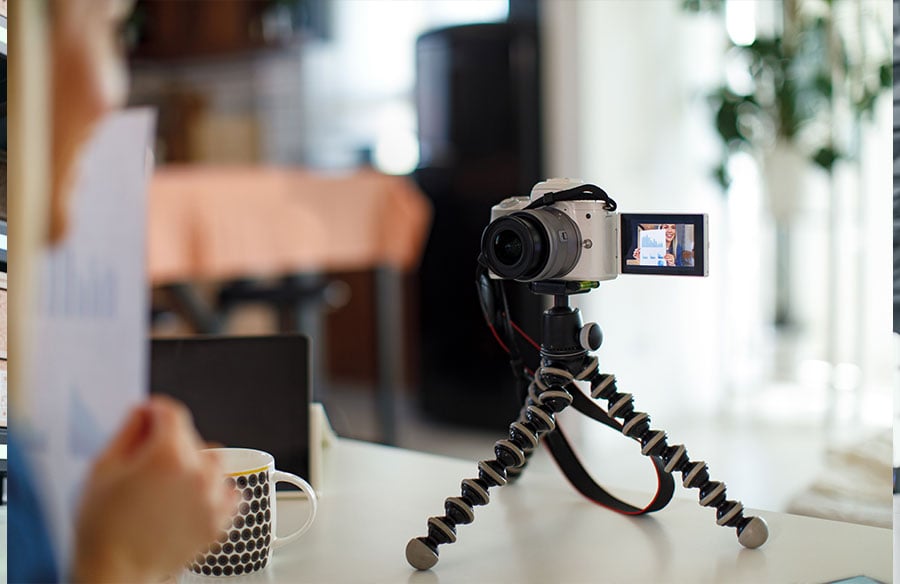
Every vlogger eventually faces the same question: carry one camera that does nearly everything, or build a kit piece by piece? A pocketable, all-in-one camera keeps walk-and-talk clips, travel vlogs, and vertical TikTok and Reels videos quick to capture. An interchangeable-lens system takes more planning but gives talking-head creators more control over background blur and a cinematic look. A rugged action camera often sits alongside either one for sport and water.
Below are the best vlogging cameras, ranked for real-world use, with features, pros, and cons for each.
Comparison table:
| Camera | Type | Max video resolution | Stabilization | Screen | Audio approach | Built for
|
|---|---|---|---|---|---|---|
| Insta360 Luna Ultra | Dual-lens gimbal camera | 8K30fps; 4K up to 120fps | 3-axis gimbal + Deep Track 5.0 AI tracking | Detachable, rotatable 2″ OLED touchscreen | 4 mics, Wind Guard, direct Insta360 Mic Air/Mic Pro connection | Premium all-in-one vlogging with zoom, face tracking, and low-light performance |
| GoPro HERO13 Black | Action camera | 5.3K60, 4K120, 2.7K240 | HyperSmooth 6.0 | 2.27″ rear touchscreen + 1.4″ front display | Bluetooth audio plus accessory ecosystem | Rugged action vlogging and POV footage |
| Sony ZV-E10 II | Interchangeable-lens camera (APS-C) | 4K up to 60fps | No in-body stabilization; lens OSS and electronic stabilization | Vari-angle touchscreen | Mic input and headphone jack | Lens flexibility and cinematic depth |
| Canon PowerShot V1 | Compact camera (1.4″ sensor) | 4K60fps (cropped); 4K30fps (full width) | Optical IS + Movie Digital IS | 3″ vari-angle touchscreen | Built-in mic plus external mic input | Lightweight point-and-shoot vlogging |
| DJI Osmo Pocket 3 | Pocket gimbal camera | 4K up to 120fps | 3-axis gimbal | Rotatable 2″ OLED touchscreen | Stereo recording; direct DJI Mic 2 connection | Compact walk-and-talk vlogs |
1. Insta360 Luna Ultra
Best For: Creators who want a one-camera kit: a single premium, pocketable camera that films smooth, sharp vlogs day and night, with built-in zoom range and AI tracking for filming solo.
The Insta360 Luna Ultra is Insta360’s flagship dual-lens gimbal camera and the strongest one-camera kit on this list. It is built for walk-and-talk vlogs, travel days, and evening scenes without carrying a full camera kit. Its main camera pairs a Leica Summicron lens with a 1″ 8K sensor, F1.8 aperture, and 14 stops of dynamic range. Instead of a bag of lenses, a pro-grade telephoto lens (1/1.3″ sensor, F2.0) is built in, and the two lenses span six focal lengths, with up to 15× (300mm) zoom (with the latest firmware) and 6× (120mm) lossless zoom.
It also builds in what a system would need extra gear for. A 3-axis mechanical gimbal handles stabilization, so walking footage stays steady, and Deep Track 5.0 AI tracking keeps the creator centered, starting with one press of the joystick. A Triple AI Chip system, made up of two imaging chips plus a 4nm AI chip, delivers 4K60fps PureVideo, a dedicated low-light mode that reduces noise while lifting brightness and detail.
The detachable 2″ OLED touchscreen rotates for 4K30fps vertical video for TikTok and Reels, or detaches to act as a monitor and remote control from up to 20 meters away. For two-person audio, it connects directly to two Insta360 Mic Air or Mic Pro transmitters, with no extra receivers needed.
Features
- Main camera: Leica Summicron lens, 1″ 8K sensor, F1.8 aperture, 14 stops of dynamic range
- Second, pro-grade telephoto lens (1/1.3″ sensor, F2.0) for up to 15× zoom, 6× of it lossless
- Resolution and frame rates: 8K30fps, 4K up to 120fps, 1080p up to 240fps
- 4K60fps PureVideo for low light, driven by a Triple AI Chip
- 3-axis mechanical gimbal keeps shots steady
- Auto Tracking, Active Zoom Tracking, Group Tracking, and Smart Framing through Deep Track 5.0
- 2″ OLED touchscreen that rotates and detaches, transmitting the image up to 20 meters
- Selfie-friendly 20mm-equivalent wide-angle main lens at F1.8
- Vertical shooting in 4K30fps, plus 4K60fps Portrait Video
- Leica color profiles alongside 10-bit I-Log and Dolby Vision
- 4-mic array with a pre-installed Wind Guard
- 1550mAh battery: up to 240 minutes at 1080p24fps under specified test conditions, and 80% in 23 minutes
- 47GB onboard storage and up to 2TB via microSD
- Weighs 233g (Cosmic Black)
Pros
- All-in-one design that skips lens changes and a separate gimbal
- Two lenses handle wide vlogs, portraits, and distant subjects
- Strong night and indoor performance thanks to PureVideo
- Stays smooth and keeps the creator centered, even with nobody behind the camera
- Remote monitoring for selfie and group shots via the detachable screen
- Long shoot days are easier with internal storage and flexible recording options
Cons
- Operating range of 0°C to 40°C (32°F to 104°F) and no waterproofing, so it is not the pick for underwater or rugged use
- The Ultra Telephoto Lens, Mini Fill Light, and some other accessories are sold separately
2. GoPro HERO13 Black
GoPro works well as an addition to any kit for action-first vlogging, with an ecosystem built around mounts, POV angles, and durability. It is waterproof to 10m (33ft) without a housing and works with HB-Series lens mods.
Features
- Shoots 5.3K60, 4K120, and 2.7K240
- HyperSmooth 6.0 with AutoBoost
- Front-facing 1.4″ display and 2.27″ rear touchscreen
- 1900mAh Enduro battery
Pros
- Extensive mount ecosystem and broad accessory support
- Made for rugged and underwater filming
- High-frame-rate modes for slow motion
Cons
- Its 1/1.9″ sensor is smaller and weaker after dark than 1-inch-class options
- Fixed wide-angle lens, and lens mods cost extra
3. Sony ZV-E10 II
The ZV-E10 II is the system-builder’s pick, made for creators who want interchangeable-lens flexibility for talking-head vlogs, desk setups, and cinematic background separation. It grows with a lens kit over time.
Features
- 26MP APS-C sensor recording 4K at up to 60fps in 10-bit 4:2:2
- Face-tracking autofocus with 759 phase-detection points
- Vari-angle screen, plus a Cinematic Vlog mode
- Compatible with the NP-FZ100 battery
Pros
- More background blur and a cinematic feel through lens choice
- A strong fit for sit-down, talking-head vlogs and produced content
- Builds into a long-term setup over time
Cons
- Lacks in-body stabilization, leaving handheld footage to lens OSS and electronic stabilization
- Takes up more space than compact and gimbal cameras
4. Canon PowerShot V1
The PowerShot V1 is a simple, single-camera setup for everyday filming. A built-in cooling fan allows extended 4K30 recording, which suits long talking segments and daily vlogs.
Features
- 22.3MP 1.4-inch sensor and 16-50mm equivalent f/2.8-4.5 zoom lens
- 4K30fps at full width, or 4K60fps with a crop
- Vari-angle touchscreen measuring 3″
- ND filter built in, plus Canon Log 3
Pros
- Beginner-friendly, point-and-shoot operation
- Wide built-in lens makes handheld selfie framing easy
- Reliable for creators who upload consistently
Cons
- Shooting 4K60 means a crop
- At 426g, it is heavier than gimbal and action cameras and has no mechanical stabilization
5. DJI Osmo Pocket 3
The Osmo Pocket 3 keeps the kit minimal, delivering the gimbal look in a pocket-sized 179g body that suits walk-and-talk vlogging.
Features
- 1-inch CMOS sensor, 4K up to 120fps
- Mechanical 3-axis gimbal
- 2″ rotatable OLED touchscreen
- 10-bit D-Log M and ActiveTrack 6.0
Pros
- Walk-and-talk footage looks smooth without effort
- Small and discreet for filming in public
- Connects straight to two DJI Mic 2 transmitters
Cons
- Single-lens design without optical zoom or a telephoto option
- Not waterproof, which limits it in wet conditions
Choosing The Right Vlogging Camera
Whether going with one camera or a system, weigh up:
- Vlog Style: Interchangeable-lens cameras give more control for sit-down, talking-head content, but pocket gimbal and action cameras make walking and travel vlogs easier.
- Stabilization Needs: Footage filmed on the move gains the most from mechanical gimbal stabilization, while tripod-based filming can put lens choice first.
- Low-Light Filming: Evening streets and dim interiors favor cameras with larger sensors and dedicated low-light modes.
- Self-Framing Usability: Reliable face tracking and a flip, rotating, or detachable screen reduce missed framing, while a rotating screen speeds up vertical video for TikTok and Reels.
- Ease of Use and Recording Time: All-in-one designs lower the learning curve for beginners, and cooling that prevents overheating plus strong battery life keeps long talking segments running.
- Carry and Setup Commitment: Grab-and-go creators and system builders want different things, the latter a setup that grows with lenses and audio.
Frequently Asked Questions
What Makes A Camera Good For Vlogging?
A good vlogging camera is easy to use and self-frame, records clean audio, and stays stable through mixed light and movement. For travel, walk-and-talk, and night scenes, an all-in-one gimbal camera like the Insta360 Luna Ultra is especially effective, since it packs a 1″ 8K sensor, 3-axis stabilization, face tracking, built-in zoom, and 4K60fps PureVideo into one body.
The Best Vlogging Camera Depends On Portability, Lens Control, or Rugged Versatility
The best camera, or kit, is the one that fits how content gets filmed most often. Pocket gimbal cameras excel at smooth walk-and-talk footage. Interchangeable-lens cameras suit creators who want cinematic control for talking-head videos. Action cameras win for underwater, mounted, and extreme-sport filming.
For creators who would rather carry one premium camera than build a kit, the Insta360 Luna Ultra is the most well-rounded pick. With a Leica Summicron lens and 1″ 8K sensor, up to 15× zoom, a Triple AI Chip, 3-axis stabilization, Deep Track 5.0, and 4K60fps PureVideo, it captures sharp, stable footage from walking vlogs to vertical TikTok and Reels clips, while staying small enough to carry every day.