
Can AI handle the evidence collection burden of SOC 2? That question keeps surfacing in compliance teams that spent the last audit cycle buried in screenshots, spreadsheets, and Slack threads. The manual grind of mapping controls, validating evidence, and chasing policy updates across departments hasn’t gotten easier as frameworks grow more complex. What’s changed is the tooling. A new generation of AI-powered compliance platforms now promises to automate the most tedious parts of SOC 2 prep, from evidence gathering to gap detection to policy generation.
The catch: “AI for SOC 2” means different things depending on who you ask. Some platforms use AI agents that operate with minimal human input. Others treat AI as a copilot that responds when prompted. A few use AI for a single compliance function like access reviews or control mapping. This guide evaluates 10 platforms through the lens of what their AI actually does for SOC 2 readiness, not what their marketing pages claim.
How to choose the right AI SOC 2 platform for your team
Picking an AI compliance tool comes down to three questions: how much AI autonomy do you want, how many frameworks will you need, and what level of human support matters to your team?
If your team is running its first SOC 2 audit and wants AI that works autonomously while GRC professionals provide hands-on guidance, Scytale’s hybrid model covers both needs. Teams that prefer to self-manage with strong automation will find Drata or Sprinto effective.
If you’re managing multiple frameworks and want all-inclusive pricing, Scytale avoids the per-framework costs that accumulate with Drata ($5,000/framework) or the add-on layers from Sprinto. Hyperproof’s 118+ framework support may suit enterprise teams with complex regulatory portfolios.
If your primary need is a specific SOC 2 function rather than full lifecycle coverage, CloudEagle.ai handles access reviews and Hyperproof excels at control mapping. These tools work well alongside a primary compliance platform.
If you already run OneTrust or a large GRC suite, adding SOC 2 through that existing platform may make sense operationally, even if a purpose-built tool would be faster.
1. Scytale
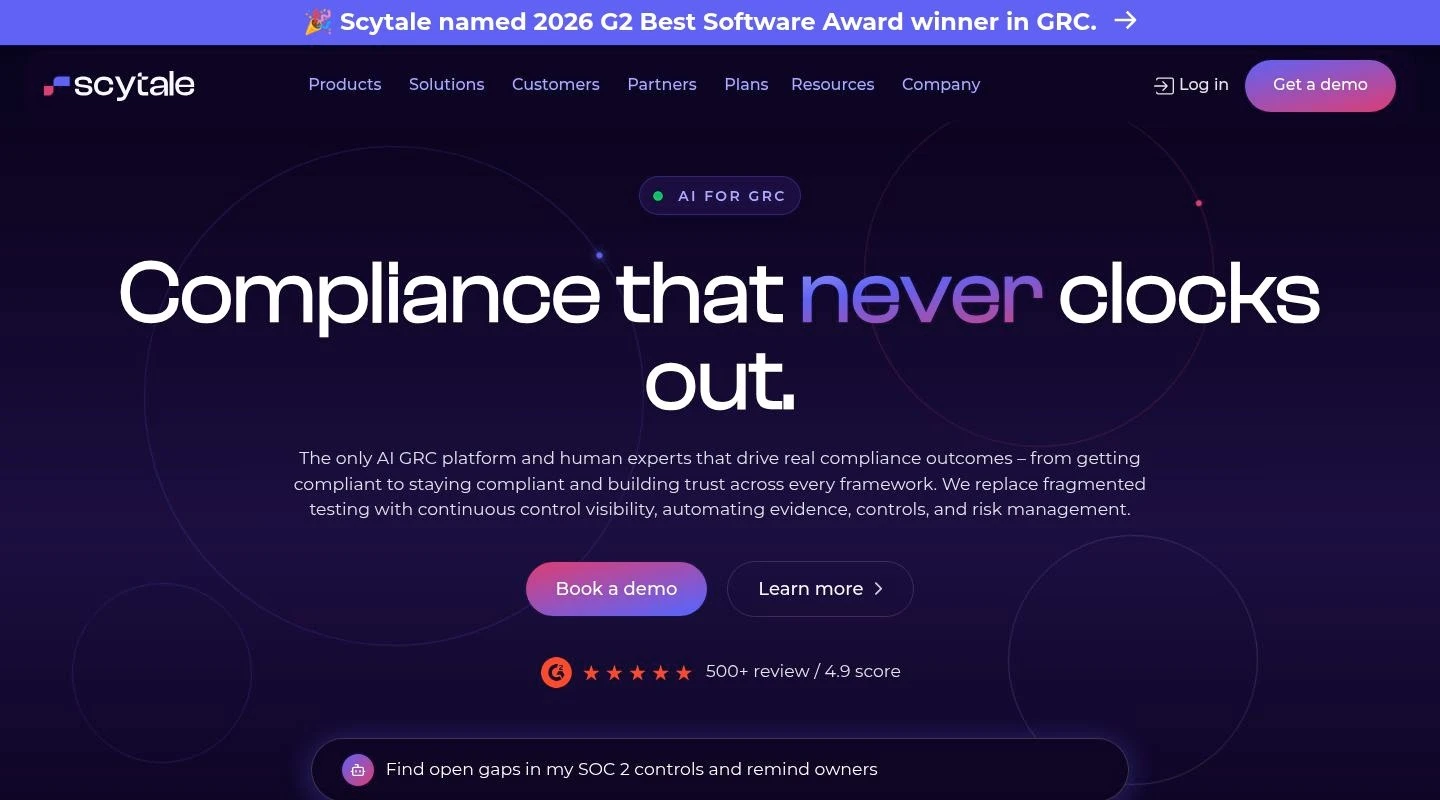
| Scytale at a glance | |
| Core identity | An AI-powered GRC platform that pairs AI GRC agents with dedicated GRC expert support for end-to-end, continuous SOC 2 compliance |
| G2 rating | 4.9/5 (500+ reviews) |
| Frameworks supported | 80+ (SOC 2, ISO 27001, HIPAA, PCI DSS, GDPR, SOX ITGC, EU AI Act, and more) |
| Integrations | 150+; Custom integrations available |
| Best for | Startups through enterprise teams that want autonomous agentic compliance coverage paired with hands-on GRC professionals |
Scytale takes a fundamentally different approach to AI-powered SOC 2 compliance. Rather than layering AI features onto a traditional platform, Scytale built an agentic architecture where AI GRC agents handle evidence validation, gap scanning and remediation, policy generation, security questionnaire completion, vendor risk assessment, and conversational GRC queries. Each agent operates continuously, scanning for compliance gaps and acting on them without waiting for a manual trigger.
The platform offers custom integrations and pairs agentic AI with dedicated GRC expert support. GRC professionals work alongside the automation, providing ongoing guidance through implementation, audit preparation, and compliance strategy. For teams running their first SOC 2 audit, that combination of technology and human expertise addresses the knowledge gaps that pure automation platforms leave open.
The platform supports 80+ frameworks with cross-mapping that reduces duplicated work when organizations expand into additional compliance programs. Streamlined audit management services with auditor matching, integrated penetration testing, and a fully customizable Trust Center come included, with no feature gating or unexpected add-ons. That flexible pricing structure is especially valuable for organizations planning to also pursue frameworks such as ISO 27001, HIPAA, PCI DSS, or future compliance initiatives.
- AI-driven evidence validation that checks every evidence item against framework controls
- Automated gap scanning with remediation suggestions and execution
- Policy generation and updates triggered by regulatory changes
- Security questionnaire auto-completion using existing platform data
- Vendor risk assessment with AI-generated risk scores
- Conversational GRC assistant with confidence scoring for any compliance query
Key AI capabilities:
- Pricing isn’t publicly available on the website
- Some advanced features are available in higher-tier plans
Why Scytale stands out for SOC 2:
Scytale’s AI GRC agents work autonomously across the full SOC 2 lifecycle while GRC professionals provide the human judgment that AI alone can’t replace. The all-inclusive model means no surprise costs when adding frameworks.
2. Drata
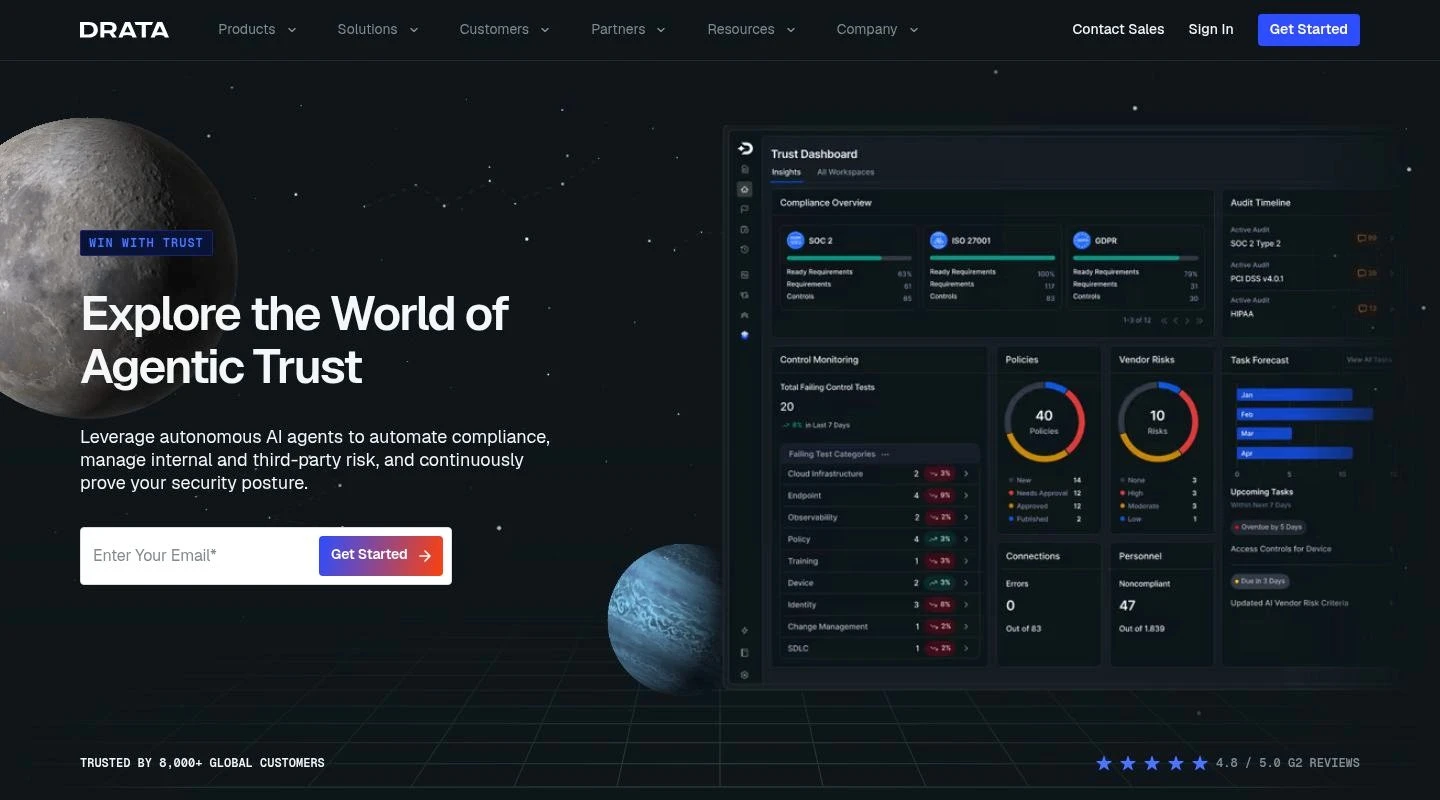
| Drata at a glance | |
| Core identity | An AI-native trust management platform with autonomous compliance agents for continuous monitoring |
| G2 rating | 4.8/5 (900+ reviews) |
| Frameworks supported | 25+ |
| Integrations | 200+ |
| Best for | Mid-market and enterprise teams that want AI-native compliance with strong automation and minimal hand-holding |
Drata positions itself as an “agentic trust management platform” with autonomous agents for evidence collection, control monitoring, and vendor risk assessment. The platform holds ISO 42001 certification, which signals genuine commitment to AI governance rather than surface-level AI marketing. Serving 8,000+ customers including a third of the Cloud 100, Drata has built strong enterprise traction.
The AI-native architecture means compliance agents were designed into the platform from the start rather than bolted on. Continuous control monitoring catches configuration drift automatically, and the AI trust center helps teams share their compliance posture with prospects and partners.
- Autonomous compliance agents for evidence collection and monitoring
- AI-powered vendor risk assessments
- Continuous control testing with drift detection
- AI trust center for external compliance communication
Key AI capabilities:
- Additional frameworks cost roughly $5,000 each, which adds up fast for multi-framework programs
- Heavy automation without proactive human advisory can feel isolating during first audit cycles, according to G2 reviewers
- Enterprise pricing puts Drata out of reach for early-stage companies
Why it stands out for SOC 2:
Drata’s AI-native architecture provides deep automation for teams comfortable managing compliance with minimal advisory support. The per-framework pricing is the main friction point for growing programs.
3. Vanta
| Vanta at a glance | |
| Core identity | The largest compliance automation platform with AI-enhanced monitoring and an AI-powered trust center |
| G2 rating | 4.6/5 (1,400+ reviews) |
| Frameworks supported | 35+ |
| Integrations | 375+ |
| Best for | Companies that prioritize breadth of integrations and a large peer community over deep AI autonomy |
Vanta dominates the compliance automation market with 16,000+ customers and the broadest integration library in the category. The platform runs 1,200+ automated tests hourly and has added AI-powered trust center features, an AI chatbot for compliance queries, and AI-assisted evidence collection. Vanta recently expanded into FedRAMP 20x authorization.
The scale is impressive, but the AI approach is additive rather than architectural. Vanta built a strong compliance automation engine first and layered AI features on top. For teams that need broad integration coverage and continuous monitoring, that approach works well. For teams that want AI handling evidence validation, gap remediation, and policy generation autonomously, the AI capabilities stop short.
- AI-powered trust center with chatbot for prospect-facing compliance communication
- AI-assisted continuous control testing (1,200+ hourly tests)
- AI-driven evidence collection and gap identification
- Automated policy template generation
Key AI capabilities:
- Pricing scales steeply with company size, starting around $10,000/year and reaching $50,000-$80,000+ for enterprise
- Self-serve model provides limited proactive human guidance
- G2 reviewers note AI features feel bolted on rather than architecturally integrated
Why it stands out for SOC 2:
Vanta’s scale and integration depth make it a solid choice for large organizations already embedded in its ecosystem. The AI features enhance monitoring but don’t match the autonomous capabilities of agentic platforms. |
4. Secureframe
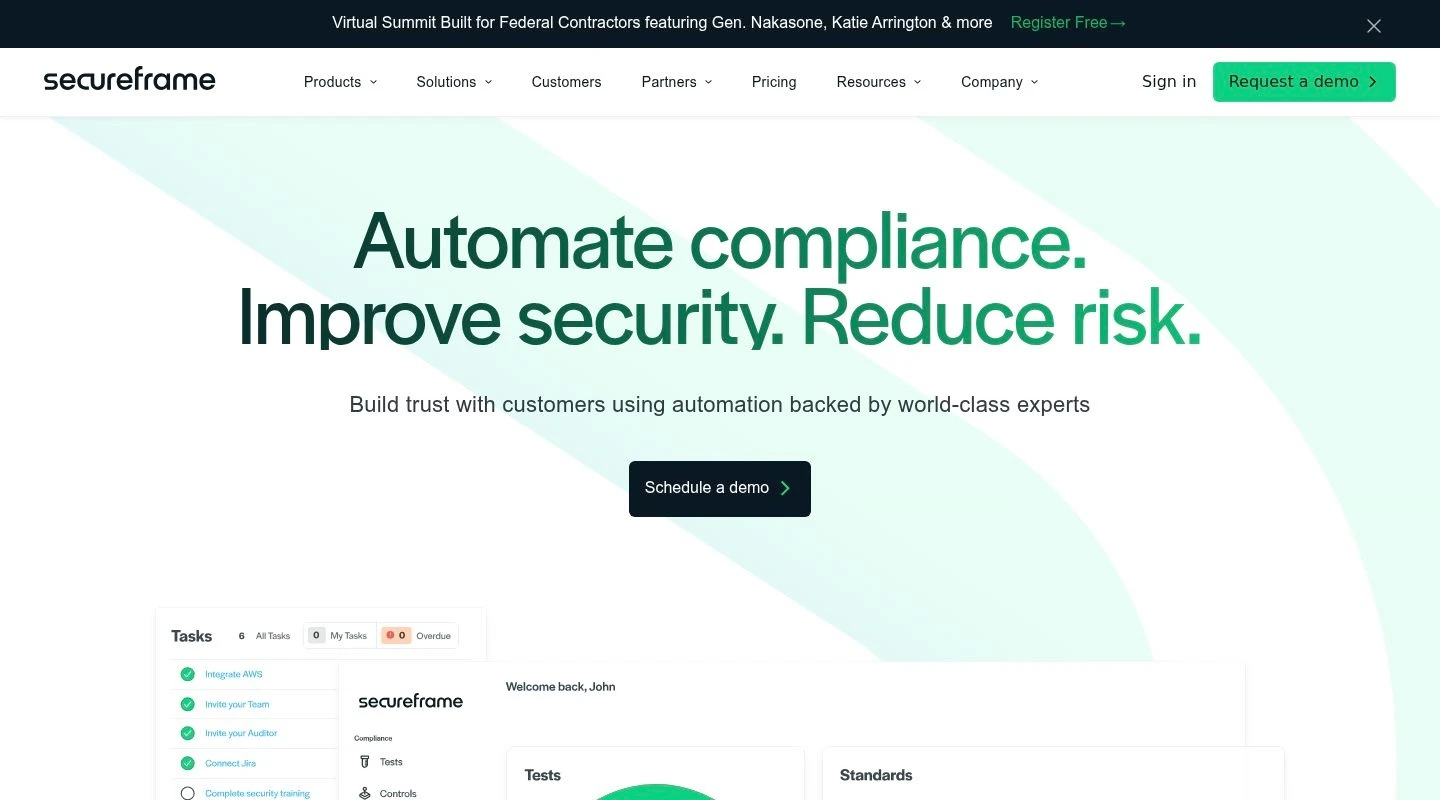
| Secureframe at a glance | |
| Core identity | A compliance automation platform with an AI copilot for guided, step-by-step SOC 2 workflows |
| G2 rating | 4.7/5 (400+ reviews) |
| Frameworks supported | 40+ |
| Integrations | 150+ |
| Best for | Teams new to SOC 2 that want reactive AI guidance to walk them through compliance step by step |
Secureframe condenses 200+ controls into guided processes and uses an AI copilot to help teams navigate compliance workflows. The copilot model is useful for organizations running their first audit because it breaks complex requirements into manageable steps. Secureframe supports 40+ frameworks and holds both FedRAMP and CMMC certifications.
The distinction between copilot and agent matters here. Secureframe’s AI responds when you ask it a question or request help. It doesn’t scan for gaps, validate evidence, or update policies on its own. For teams that want AI handling compliance tasks in the background, the reactive model feels limiting. For teams that want step-by-step handholding, it fits well.
- AI compliance copilot for guided workflow navigation
- AI-powered evidence collection with automatic matching
- AI gap analysis identifying missing controls and evidence
- Continuous monitoring with AI-driven alerts
Key AI capabilities:
- AI copilot is reactive (responds when asked) rather than proactive
- No integrated penetration testing
- G2 reviewers report less pricing transparency than competitors
Why it stands out for SOC 2:
Secureframe’s copilot approach lowers the learning curve for compliance newcomers. It’s a good fit for teams that want guided AI assistance rather than autonomous agents. |
5. Sprinto
| Sprinto at a glance | |
| Core identity | A compliance automation platform with GPT-powered risk management and 90-95% workflow automation |
| G2 rating | 4.8/5 (2,500+ reviews) |
| Frameworks supported | 20+ |
| Integrations | 160+ |
| Best for | Startups that want fast, affordable compliance automation with AI-enhanced risk scoring |
Sprinto has the highest G2 review count in the compliance category with 2,500+ reviews at 4.8/5. The platform emphasizes speed, offering 90-95% automation across compliance workflows with 200+ automated checks. AI enters through GPT-powered risk management and smart evidence matching. Guided expert onboarding helps teams get started fast.
The AI here is an enhancement layer. Sprinto built a strong compliance automation engine and added GPT capabilities for risk assessment and evidence matching. That approach works for startups that need quick SOC 2 attestation without heavy AI investment. The built-in MDM for device health is a unique feature worth noting.
- GPT-powered risk assessment and management
- AI-assisted automated control testing across 200+ checks
- Smart evidence collection with AI matching
- AI-driven compliance gap detection
Key AI capabilities:
- Additional framework layers (ISO, PCI, HIPAA) require paid add-ons
- No built-in audit services, which means managing your own auditor relationship
- Smaller integration library than leaders (160 vs. 375 for Vanta)
Why it stands out for SOC 2:
Sprinto’s speed and startup-friendly approach make it attractive for teams racing toward initial attestation goals. The GPT-powered risk scoring adds intelligence without overcomplicating the workflow. |
Choosing the best AI for SOC 2 compliance in 2026
The compliance automation market has split into distinct AI models, and the right choice depends on how much autonomy you trust AI with during your audit lifecycle. Agentic platforms like Scytale deploy AI agents that work continuously across evidence, policies, gaps, and vendor risk. AI-assisted platforms like Vanta and Sprinto enhance automation engines with targeted AI features. Specialized tools like Hyperproof and CloudEagle.ai focus AI on specific compliance functions where it delivers measurable outcomes.
For most teams evaluating AI-powered SOC 2 compliance in 2026, the deciding factors are the depth of AI autonomy, the availability of human GRC support, and the total cost across frameworks. Scytale’s combination of an agentic compliance platform, dedicated GRC professionals, and custom, flexible pricing addresses all three. Start with the platform that matches your team’s compliance maturity and expand from there.
Frequently asked questions
Can AI fully automate SOC 2 compliance?
No, and any vendor claiming full automation is overstating what AI can do today. AI handles evidence collection, gap detection, policy drafts, and control monitoring at scale. The judgment calls, risk acceptance decisions, auditor communications, and organizational context still require human involvement. Scytale addresses this by pairing AI GRC agents with GRC expert support, so the AI handles repetitive tasks while professionals manage the decisions that require experience.
What’s the difference between agentic AI and copilot AI in compliance?
Agentic AI operates autonomously. It scans for compliance gaps, validates evidence, and takes action without waiting for a prompt. Copilot AI responds when asked, guiding users through workflows step by step. For SOC 2, the practical difference is whether your AI works in the background continuously (agentic) or requires your team to initiate every interaction (copilot). Scytale and Drata use agentic models. Secureframe uses a copilot model. Both have value depending on your team’s preference for control versus automation.
What’s the difference between SOC 2 Type I and Type II when using AI?
SOC 2 Type I evaluates your controls at a single point in time. Type II evaluates them over a period (typically 3-12 months). AI makes the biggest difference for Type II because it provides continuous monitoring, automated evidence collection, and real-time gap detection throughout the observation window. Platforms like Scytale run automated compliance tests daily, generating a continuous evidence trail that simplifies the Type II audit process.
How much of SOC 2 evidence collection can AI automate?
The automation rate depends on your tech stack and how many of your systems integrate with your compliance platform. Platforms with 150+ integrations and custom options (like Scytale) can automate a significant portion of evidence collection for cloud-native companies. On-premise systems, custom applications, and manual processes still require human evidence gathering. The realistic range for most SaaS companies is 70-90% automation of evidence collection tasks.