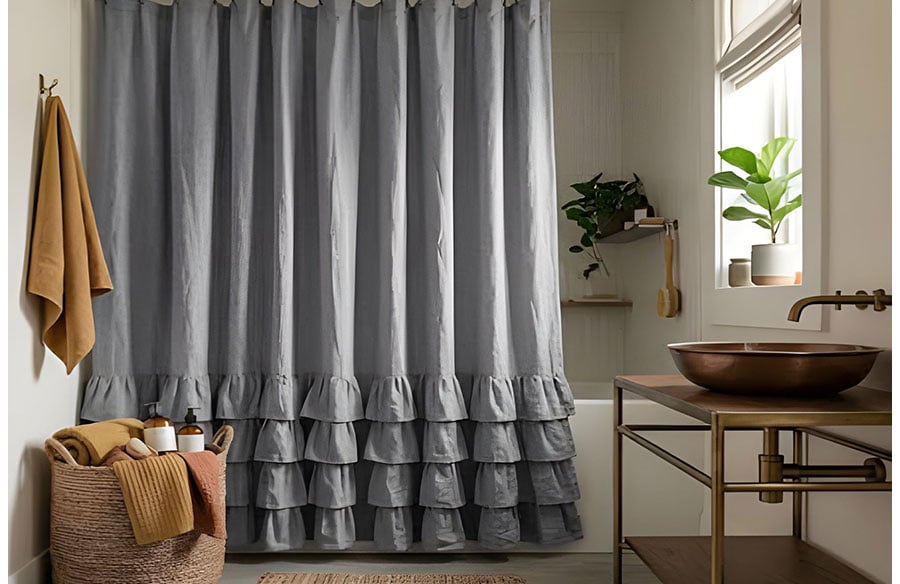
Open the door to a small bathroom and the shower curtain may be the first thing you see. It can cover almost an entire wall, so changing it has a greater effect than swapping a few accessories. A ruffled curtain gives tile and porcelain a softer edge, though the right amount of detail depends on the room around it.
Look at the Room First
A bathroom with patterned floor tile, beadboard walls, and a wood vanity already has plenty to look at. Here, a curtain with a ruffled hem can add texture without crowding the space. If the walls and fixtures are plain, a design with fuller gathers or layered ruffles has more room to stand out.
The same principle applies to the curtain’s color. White does not have to disappear against white tile: the folds and ruffled edge still create shadow. A patterned curtain makes more sense when the rest of the room is quiet.
Choose a Pattern You Can Live With
Stripes, gingham, and florals all suit farmhouse and cottage bathrooms, but they change the mood in different ways. A narrow stripe can pick up the lines of wall paneling. Gingham feels more traditional, while a floral print brings a softer cottage look.
Look at the floor before choosing a print. If it has a strong pattern, a solid curtain may give the eye somewhere to rest. With plain flooring, a check or floral design can supply the detail the room lacks. The classic white, striped, gingham, and floral styles in XOGUIBO’s ruffle shower curtain collection offer useful examples of those different approaches.
You can connect the curtain to the rest of the bathroom without matching everything. Pick up one color in a towel or bath mat, then leave the other textiles simple. In a room with little daylight, a lighter shade may help the space feel more open.
Give the Ruffles Enough Space
The size and position of a ruffle matter as much as its color. A narrow ruffle along the hem can work well in a compact bathroom with a shower. Wider tiers make a stronger statement and may feel more at home in a larger space.
Stand back and look at the vanity and mirror, too. If both are ornate, a heavily layered curtain may be one detail too many. If they are simple, the curtain can carry more of the room’s character. There is no need to add matching ruffles to the towels or bath mat; repeating the same detail everywhere can make the room feel busy.
Measure Before Ordering
Measure the width the curtain needs to cover and the distance from the hanging rings to the point where you want the hem to fall. Ring and hook styles can change the finished drop. A curtain should close comfortably across the opening, while its decorative edge should stay clear of the floor.
A 72-by-72-inch curtain is common for a tub, but shower layouts differ, and the styles in a collection may come in different dimensions. Check the measurements on the individual product page rather than choosing by appearance alone. This matters especially for layered designs, where a hem that drags may be harder to keep dry.
Make It Work for Daily Showers
A decorative fabric curtain may need a separate liner, depending on the product and the shower setup. Check what comes with the curtain and whether a liner is recommended. With a tub, the liner generally hangs inside to help contain water, while the decorative curtain hangs outside.
After a shower, pull the curtain across so the folds have a chance to dry, and ventilate the room where possible. When it needs cleaning, follow the instructions for that particular style. Different fabrics and trims may not respond the same way to washing, drying, or ironing.
A ruffled curtain works best when it suits both the room and the way the bathroom is used. Choose a pattern that has space to breathe, measure the opening carefully, and keep the surrounding accessories straightforward. The result can feel warm and lived in without making the bathroom harder to maintain.